
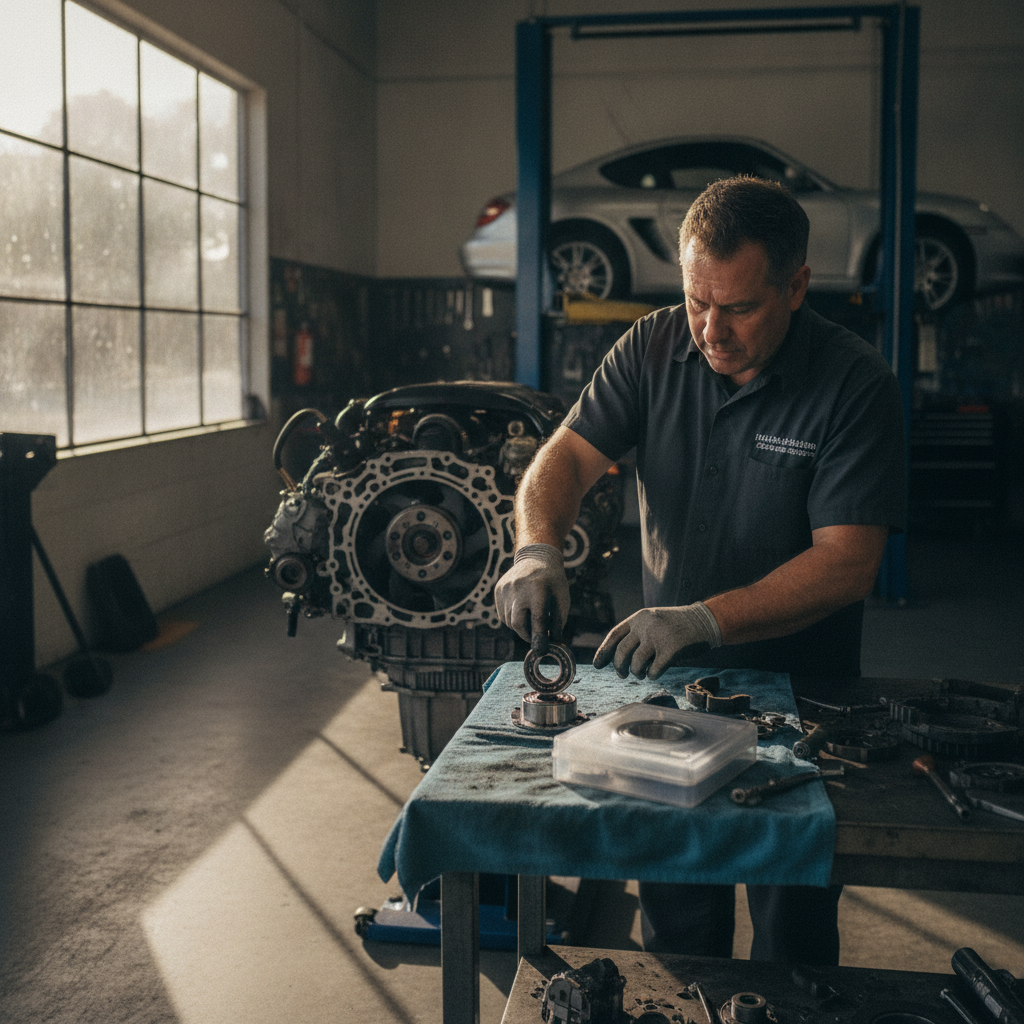
Why Is My Porsche 911 or Boxster’s IMS Bearing Failing in Santa Rosa — and What Does an IMS Upgrade Actually Protect?
The IMS bearing is one of the most consequential potential failure points in the water-cooled Porsche flat-six engine, and if you own a 996-generation 911, a 986 Boxster, or an early 987 Cayman in Santa Rosa or anywhere in Sonoma County, it deserves your serious attention. When the intermediate shaft bearing fails — and in some engine variants, the failure rate is statistically significant — it doesn’t give you much warning before it takes the entire engine with it. The good news: a proactive IMS upgrade, performed when the rear main seal and clutch are already out, costs a fraction of what an engine replacement will run you. The key is knowing what you’re dealing with before the bearing tells you itself.
What the IMS Bearing Actually Does — and Why Porsche’s Design Created a Vulnerability
In Porsche’s M96 and early M97 flat-six engines — used across the 996 911 (1997–2005), 986 Boxster (1997–2004), and 987 Boxster/Cayman through approximately 2008 — the intermediate shaft (IMS) sits between the crankshaft and camshaft drive system. Its job is to synchronize the timing chain and, ultimately, valve timing. The shaft itself is fine. The problem is the bearing that supports it.
On many of these engines, Porsche used a sealed, grease-packed ball bearing on the IMS — a design that works adequately in applications with regular bearing replacement intervals but was never intended to last the lifetime of an engine. Over time, the grease dries out, contamination finds its way in, and the bearing begins to fail. When it does, metal particles enter the oil circuit. At that point, you’re not just replacing a bearing — you’re looking at a full engine rebuild or replacement, which on a 996 or 986 can easily reach $10,000 to $20,000 depending on the extent of damage.
The failure isn’t universal — some of these engines have run 150,000 miles without incident — but the unpredictability is precisely what makes the IMS bearing worth addressing proactively. You can’t reliably predict when it will go. And because it’s tucked deep inside the engine, by the time symptoms appear, damage is often already done.
Symptoms That Suggest IMS Bearing Trouble — Before It Becomes Catastrophic
Most IMS bearing failures don’t announce themselves clearly until it’s too late. That said, there are warning signs worth knowing:
- Fine metallic particles in the oil — found during an oil analysis or visible on a magnetic drain plug; this is often the first real indicator
- A rough or inconsistent idle at cold start that smooths out — sometimes misattributed to injector or fuel system issues
- Subtle bearing noise from the rear of the engine — a faint whirring or grinding that’s easy to dismiss as normal drivetrain noise
- Oil pressure fluctuations on the gauge, particularly at startup or low RPM
- Check engine codes pointing to camshaft timing variances, which can be downstream of IMS deterioration affecting the drive system
If any of these are present on a 996, 986, or early 987 platform, it warrants a proper diagnostic — not a generic OBD-II scan, but a PIWIS-level inspection combined with oil analysis and a physical assessment. At Bavarian Performance in Santa Rosa, that kind of evaluation is exactly where the conversation starts.
What an IMS Upgrade Actually Involves — and When to Do It
The most widely respected IMS upgrade solutions replace the factory grease-packed ball bearing with an open bearing that is lubricated by the engine’s own oil supply — eliminating the root cause of the failure mode. The most common solutions come from LN Engineering, whose IMS Solution retrofit kit has become the industry standard for this job.
The critical piece of timing advice that many shops — and even some dealerships — don’t emphasize strongly enough: the best time to do the IMS upgrade is when the rear main seal (RMS) is already out for replacement. Both the IMS bearing and the rear main seal are accessed through the same rear bell housing area. If you’re already paying for the labor to drop the transmission and engine, doing the IMS upgrade at the same time adds relatively modest additional cost. Performing it as a standalone job later means paying for the same labor twice.
If your 996 or 986 is due for a clutch replacement — a realistic milestone on a car that sees spirited driving on Sonoma Mountain Road or the curves above Healdsburg — that’s your window. Factor in an RMS replacement and the IMS upgrade simultaneously, and you’ve addressed three of the most common late-stage wear items on these platforms in a single service event.
For a more detailed look at what a full Porsche engine and drivetrain service involves at Bavarian Performance, including how we approach these combined service events, that page covers the full scope.
Why Local Sonoma County Driving Conditions Add to the Risk
Porsche owners in Santa Rosa and the surrounding Wine Country area tend to use their cars in ways that accelerate wear on aging engine internals. The roads around Fountaingrove, Oakmont, and the Sonoma Valley aren’t just scenic — they’re demanding. Sustained high-RPM driving on switchback roads, cold starts followed by immediate enthusiastic acceleration, and stop-and-go traffic on Highway 101 during Sonoma County wine tourism season all put stress on an engine that may already have a compromised IMS bearing.
Hot, dry summers in the North Bay also matter here. Porsche’s flat-six engines are sensitive to thermal cycling, and oil that degrades faster in high ambient temperatures provides less consistent lubrication to vulnerable bearings. If you’re running extended oil change intervals — which some owners do, mistakenly trusting the onboard service indicator over factory-trained judgment — you’re compressing that lubrication quality margin further.
Owners coming in from Napa County or the Calistoga area often mention that their Boxsters and 911s see a mix of winding mountain driving and freeway stretches, which creates exactly the kind of thermal cycling that ages engine oil and bearings faster than purely highway or purely city use.
What Competitors in the Area Often Get Wrong About IMS Service
This is worth addressing directly. Several independent shops in Sonoma County will replace a rear main seal or service a clutch on a 996 or 986 without mentioning the IMS bearing at all — either because they’re not Porsche specialists or because they’re quoting the minimum job to win the work. A shop that doesn’t proactively discuss IMS risk during a rear drivetrain service on these platforms either doesn’t understand the platform well enough or isn’t prioritizing your long-term ownership cost.
Equally, generic advice to simply “monitor the oil” is insufficient. Oil analysis is a useful supplementary tool, but metal particle accumulation in oil from IMS wear can be inconsistent — a clean sample doesn’t guarantee a healthy bearing. The correct approach is to treat the IMS upgrade as a proactive component of a comprehensive drivetrain service on any 996 or 986 that hasn’t had it done, rather than a reactive repair triggered by failure symptoms.
At Bavarian Performance, we approach Porsche ownership the same way factory-trained specialists do: the preventative work you do today defines what your ownership costs look like five years from now. For Porsche owners across Sonoma County, that framing matters. Learn more about our broader preventative maintenance approach for European vehicles.
Which Porsche Engines Are Affected — and Which Are Not
Not every Porsche flat-six carries the same IMS risk. Here’s a practical breakdown:
- High-risk: M96 engines in 996 911 (1997–2005) and 986 Boxster (1997–2004) with the single-row ball bearing IMS — statistically the most vulnerable variant
- Moderate risk: M96 engines with the dual-row ball bearing IMS (certain 2000+ production dates) — better, but not immune
- Lower risk but still worth evaluating: Early M97 engines in 987 Boxster and Cayman (2005–2008 approximate) — the IMS design was revised, but not all variants are fully resolved
- Not affected: 997.2 generation (2009+) with the 9A1 DFI engine, 981/982 Boxster/Cayman — Porsche redesigned the intermediate shaft entirely in later platforms
If you’re unsure which engine variant your car has, the VIN and production date will tell a trained Porsche specialist everything needed to assess your specific risk profile.
Frequently Asked Questions: Porsche IMS Bearing Service in Santa Rosa
How much does an IMS upgrade cost?
The part cost for a quality IMS retrofit kit is relatively modest — the majority of the investment is labor, since accessing the bearing requires removing the transmission and engine from the rear. When combined with a rear main seal replacement and clutch service, the additional cost of the IMS upgrade itself is often a fraction of what a standalone job would run. Contact Bavarian Performance for a specific estimate based on your car’s configuration.
Can I drive my 996 or 986 without doing the IMS upgrade?
Many owners do, and many of those cars never experience a failure. The issue is that failure is unpredictable and catastrophic when it happens. The decision comes down to your risk tolerance and how long you plan to keep the car. If the engine is approaching 60,000 miles or more without an IMS upgrade, the conversation is worth having with a Porsche specialist before the next drivetrain service.
Does oil analysis reliably detect IMS bearing wear?
It can help, but it’s not a definitive test. Metal particle contamination in oil can be present before symptoms appear, but a clean oil analysis doesn’t confirm a healthy bearing. It’s a useful data point, not a clearance certificate.
My 987 Cayman was made in 2007 — is it affected?
Early 987 platform cars used a revised IMS design that reduced but did not eliminate risk. Whether your specific car requires attention depends on the exact engine variant, which can be confirmed by a Porsche specialist using the VIN. Don’t assume the later production date means you’re in the clear without verifying.
Does Bavarian Performance serve Porsche owners outside of Santa Rosa?
Yes. Porsche owners regularly come to Bavarian Performance from Windsor, Sebastopol, Sonoma, Petaluma, and across Napa County for drivetrain services that require genuine Porsche expertise. If you’re within the North Bay region and own a 996, 986, or 987, it’s worth the drive to have this work done by a shop that knows these platforms in depth.
Don’t Wait for the Bearing to Tell You It’s Failing
The IMS bearing is one of those known engineering vulnerabilities that rewards proactive owners and punishes those who wait. If you own a 996, 986, or early 987 in Santa Rosa, Healdsburg, Oakmont, or anywhere else in Sonoma County — and you’re not certain whether the IMS has been upgraded — that question is worth answering before your next clutch service, your next RMS job, or your next transmission-out service event.
Bavarian Performance specializes in exactly this kind of factory-level Porsche work: the detailed, platform-specific knowledge that dealership service advisors sometimes lack time to explain and that general independent shops may not carry at all. Reach out to schedule a consultation, get a proper assessment of your car’s IMS status, and make an informed decision about protecting your engine. Contact Bavarian Performance today to book your Porsche evaluation.