
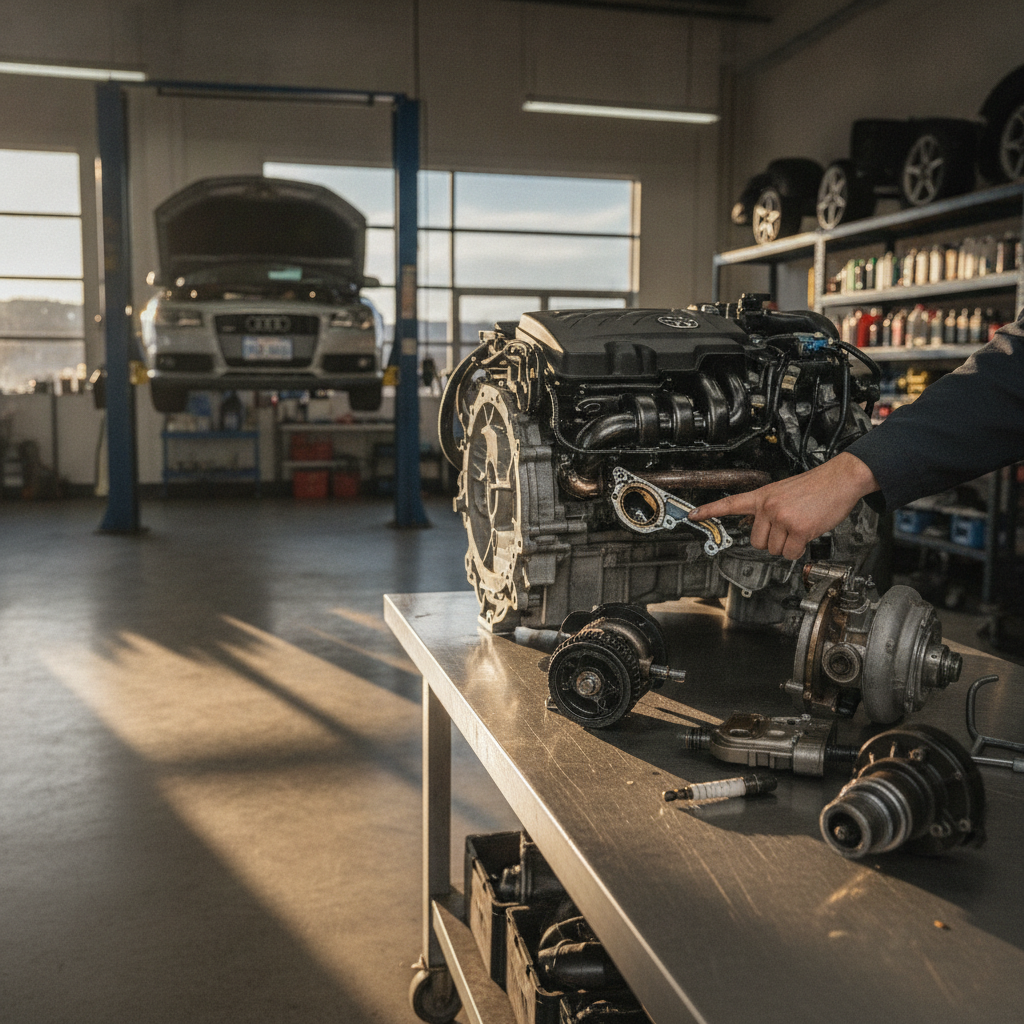
Why Is My Volkswagen’s or Audi’s Engine Consuming Too Much Oil in Windsor — and What Does a PCV System Failure Actually Mean?
If your Volkswagen Golf, Jetta, Passat, or Audi A4 or A3 is chewing through oil between services and you haven’t found an obvious leak, the problem likely isn’t worn piston rings — it’s the Positive Crankcase Ventilation system. PCV failure is one of the most consistently underdiagnosed causes of excessive oil consumption on Volkswagen and Audi 2.0T and 1.8T turbocharged engines, and for Windsor owners making the daily run down Highway 101 toward Santa Rosa or further south toward Rohnert Park, the stop-and-go turbo cycling that comes with that commute accelerates exactly the kind of wear that puts these components over the edge. The good news is that when you catch a PCV failure early, the repair is far less expensive than the engine damage that follows when you don’t.
What the PCV System Actually Does — and Why VW/Audi Gets It Wrong at High Mileage
The Positive Crankcase Ventilation system is responsible for routing blow-by gases — combustion gases that slip past the piston rings and into the crankcase — back into the intake manifold to be burned rather than vented into the atmosphere. On any engine this is a necessary function, but on turbocharged direct-injection engines like the EA888 (Audi’s 2.0T) and its Volkswagen counterpart, the system has to handle significantly higher crankcase pressures than a naturally aspirated engine ever would.
Volkswagen and Audi use an integrated oil separator — sometimes called a crankcase breather valve or CCV — that’s typically built into the valve cover or routed through a separate canister. Over time, the internal diaphragm in this valve hardens, cracks, or collapses entirely. When that happens, one of two things occurs: the system either creates excessive crankcase vacuum (drawing oil up through the turbocharger seals) or it loses the ability to separate oil mist from the crankcase gases before they re-enter the intake. In either case, oil ends up where it doesn’t belong — burned in the combustion chamber, coating your intake manifold, or pushed past turbo seals and into the intercooler.
The result? You’re adding a quart of oil every 2,000 to 3,000 miles and wondering whether your engine is failing. Often, it isn’t — but ignore the PCV failure long enough and it genuinely will be.
Signs Your VW or Audi Has a PCV Problem (Not Just Worn Rings)
One of the reasons PCV failures go undiagnosed so long is that the symptoms overlap with several other common issues. Here’s what actually points specifically toward the crankcase ventilation system:
- Oil consumption without visible puddles under the car — If there’s no leak on your driveway but oil is disappearing, it’s being burned or pulled through the turbo system.
- Blue-tinged smoke at startup or under hard acceleration — Oil mist entering the intake and being combusted produces characteristic blue smoke, especially after the engine has sat overnight.
- A whistling or hissing sound from the engine bay — A collapsed or cracked PCV diaphragm creates an unmetered vacuum leak. Your idle may rough up slightly, and you may pull a lean fuel trim fault under ODIS or VCDS scan.
- Oil coating the inside of the intake hose or intercooler piping — Pull the intake hose at the throttle body. If the inside is slicked with oil film, the separator isn’t doing its job.
- Check engine light with P0171 or P0507 codes — These lean condition and idle control codes frequently trace back to unmetered air entering the system through a failed PCV valve rather than a failing MAF sensor, which is where most generic diagnostic tools will point you first.
A generic OBD-II reader will give you the fault code but won’t tell you why the lean condition exists. Factory-level diagnostic tools — ODIS for Volkswagen and Audi specifically — allow a trained technician to pull live fuel trim data, crankcase pressure readings, and adaptation values that make the actual root cause clear in minutes rather than hours of guesswork.
Why Windsor and North Sonoma County Driving Conditions Make This Worse
The drive from Windsor south on Highway 101 isn’t easy on a turbocharged engine’s ancillary systems. Repeated short trips with stop-and-go acceleration mean the turbocharger spools and spools down constantly without reaching the sustained operating temperature that fully burns off moisture and combustion byproducts from the crankcase. That cycling accelerates the hardening of the rubber diaphragm inside the PCV valve.
Sonoma County’s hot, dry summers compound the issue further. Under sustained heat — the kind that builds up sitting in traffic with an underhood temperature well over 200 degrees — the plastic and rubber components in the crankcase ventilation system age faster than the factory engineers anticipated for a California climate. Owners in Healdsburg, Cloverdale, and the warmer inland corridors see this failure mode more frequently than those closer to the coast, where temperatures moderate more reliably.
Vineyard dust and rural particulates from the roads west of Windsor also accelerate filter element degradation when those particles find their way into the intake system — one more reason that what looks like a simple oil consumption problem often has a compound cause in this region.
What the Repair Actually Involves — and What It Costs to Ignore It
On most Volkswagen and Audi 2.0T and 1.8T applications, PCV system repair involves replacing the crankcase breather valve or oil separator assembly, inspecting the associated hoses and check valves for hardening or cracking, and clearing any oil accumulation from the intake tract. On higher-mileage examples, the turbocharger inlet hose and intercooler should be inspected and cleaned at the same time.
The part itself is relatively inexpensive using genuine OEM components — and this is a case where genuine OEM matters, because aftermarket PCV valves for the EA888 platform have a documented history of premature failure due to inferior diaphragm materials. After the repair, a fuel trim reset and short relearn drive confirms the intake system is operating correctly before the car leaves the shop.
If the failure is caught before turbocharger oil seal damage occurs, you’re looking at a straightforward service. If oil has been pulled through the turbo seals for an extended period, you may be facing a turbocharger rebuild or replacement on top of the PCV work — a significantly more expensive outcome that’s entirely avoidable with timely diagnosis. This is part of why preventative maintenance on turbocharged Volkswagen and Audi engines pays dividends that go well beyond simple oil change intervals.
Why This Diagnosis Is Frequently Missed at Generic Shops
This is a gap worth addressing directly: most local general repair shops and even some European-oriented competitors in Sonoma County treat oil consumption on a VW or Audi as a piston ring or valve stem seal issue by default — especially if the car has over 80,000 miles. That assumption leads to expensive and unnecessary engine teardowns, or worse, a recommendation to simply “top off the oil regularly and monitor it” without ever addressing the root cause.
The PCV system on these platforms requires familiarity with how Volkswagen Group engineers the crankcase ventilation circuit differently across generations of the EA888 — the Gen 1 (2008–2013), Gen 2 (2013–2016), and Gen 3 (2017–present) all have meaningfully different designs. A technician who doesn’t work on these engines regularly won’t recognize the generational differences or know which updated OEM part revision applies to your specific build date.
If your Volkswagen or Audi is due for a broader look — not just the PCV system — a multi-point inspection using factory-level diagnostic tools gives you a complete picture of what’s actually going on, rather than chasing symptoms one at a time.
Frequently Asked Questions
How often should the PCV system be inspected on a VW or Audi 2.0T?
There’s no factory-specified replacement interval for the PCV valve, which is part of why it gets overlooked. In practice, 80,000 to 100,000 miles is a reasonable inspection point, and it should be checked any time you’re diagnosing oil consumption, lean fuel trim codes, or unexplained idle roughness.
Can I drive my Volkswagen or Audi with a failed PCV system?
Short-term, yes — but continued operation accelerates oil loss, contaminates the intake system with oil vapor, and risks pulling oil through the turbocharger seals. The longer it runs in this condition, the more expensive the eventual repair becomes.
Will a failed PCV always trigger a check engine light?
Not always. A partially failed diaphragm may cause oil consumption and subtle idle quality issues without setting a fault code. This is one reason oil level monitoring between services is important on any turbocharged VAG engine — by the time a code sets, some damage may already have occurred.
Does this issue affect Audi Quattro models differently than front-wheel-drive Volkswagens?
The PCV system itself is similar across Quattro and front-drive applications using the same EA888 engine family. Quattro models may have slightly different routing due to drivetrain packaging, but the failure mode and repair approach are the same.
Is this covered under any Volkswagen or Audi extended warranty or service campaign?
There have been customer satisfaction campaigns related to oil consumption on specific model years of the 2.0T, but coverage varies significantly by production date and current mileage. A factory-level diagnostic scan will confirm whether any open campaigns apply to your vehicle before any paid repair is authorized.
Bavarian Performance: VW and Audi Engine Specialists Serving Windsor and Sonoma County
At Bavarian Performance in Santa Rosa, we use ODIS — Volkswagen and Audi’s own factory diagnostic platform — to diagnose oil consumption and PCV failures with the same accuracy a dealership brings, without the dealership wait times or service advisor upsell pressure. We stock genuine OEM components for the full Volkswagen and Audi engine range and have the hands-on familiarity with the EA888 platform’s generational differences that make accurate diagnosis possible the first time.
If your Volkswagen or Audi is using more oil than it should — whether you’re in Windsor, making the commute down to Rohnert Park, or anywhere else in Sonoma County — don’t wait until a lean condition becomes a turbocharger replacement. Contact Bavarian Performance to schedule a diagnostic appointment and get a straight answer about what your engine actually needs.