
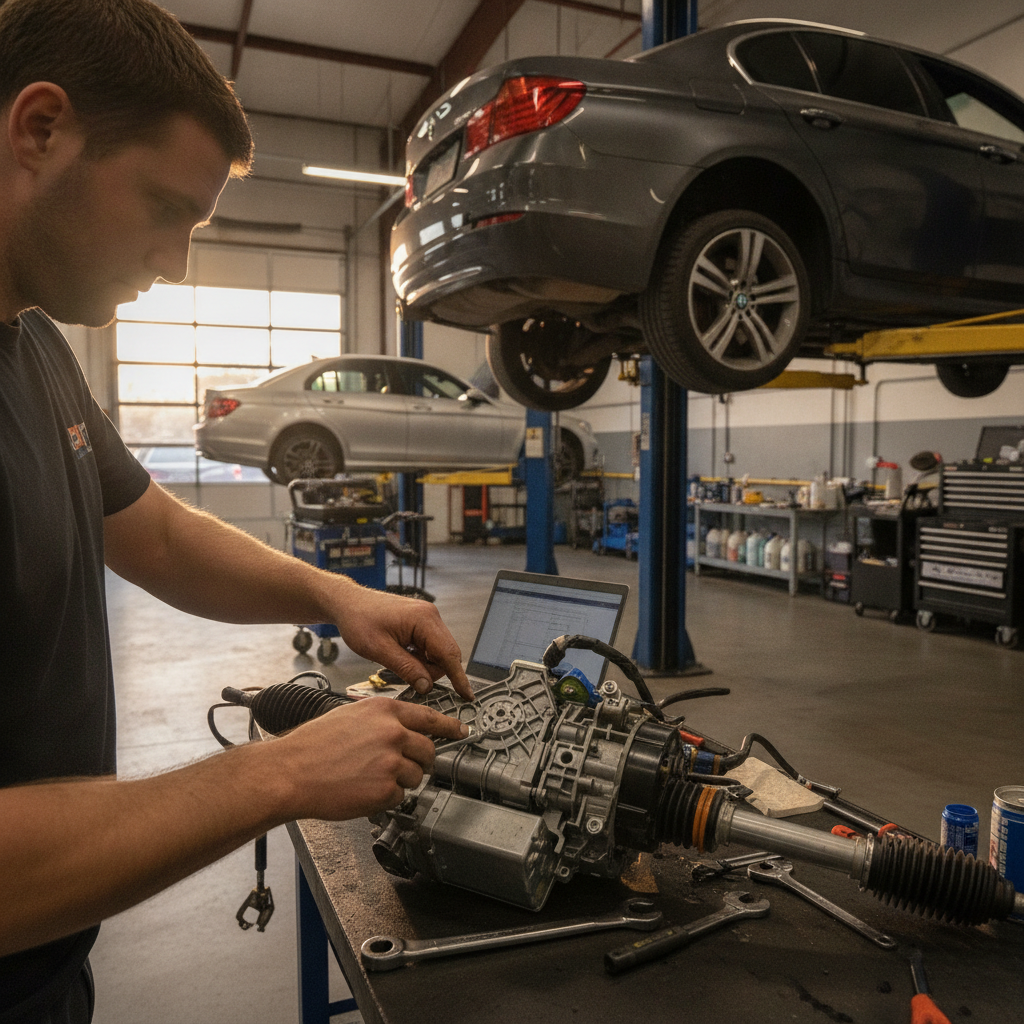
Why Is My BMW or Mercedes-Benz’s Power Steering Feeling Heavy or Jerky in Larkfield-Wikiup — and What Does a Steering Rack or EPS Service Actually Fix?
If you’re driving through Larkfield-Wikiup and notice your BMW or Mercedes-Benz steering feels heavier than usual, pulls to one side, or kicks back unexpectedly over surface changes on Old Redwood Highway — that’s not something to dismiss as a quirk. Steering feel on a modern European vehicle is a precision-calibrated system, and when it degrades, it’s telling you something specific. The answer depends on whether your vehicle uses a traditional hydraulic power steering rack, an electro-hydraulic setup, or a fully electric power steering (EPS) system — and those three platforms fail in very different ways.
Hydraulic vs. Electric Power Steering: Why It Matters for Your Diagnosis
Many BMW owners assume their steering complaint means a simple fluid top-off. That’s rarely the whole story — and on vehicles built in the last decade, there may not even be hydraulic fluid involved. BMW transitioned most of its lineup to electric power steering (EPS) starting around the F30 3 Series and F10 5 Series era. Mercedes-Benz made a similar shift across the C-Class, E-Class, and GLC platforms. These electric systems use a motor-driven assist unit mounted on the steering column or rack, controlled by a dedicated EPS control module that communicates with your vehicle’s DSC (Dynamic Stability Control) and chassis management systems.
On the hydraulic side — still present in older E90 BMWs, pre-2012 C-Class and E-Class Mercedes-Benz models, and many larger platforms — the failure modes are more straightforward: worn rack seals, pump degradation, fluid contamination, or pressure line leaks. But on EPS systems, a steering complaint can originate from a faulty torque sensor, a software calibration drift, a worn intermediate shaft, or even a fault in the EPS module itself — none of which a basic OBD-II scanner will identify correctly.
What Actually Causes Heavy, Jerky, or Inconsistent Steering on European Cars
Here’s what Bavarian Performance technicians commonly find when BMW and Mercedes-Benz owners in northern Sonoma County come in with steering complaints:
- Hydraulic rack seal wear: On older BMW and Mercedes platforms, inner seal failure causes pressure loss at full lock — you’ll notice it most during parking maneuvers or tight turns.
- Power steering pump degradation: Whining under load, especially when cold, often points to a deteriorating pump. In northern Santa Rosa’s cold winter mornings, this symptom is more pronounced as hydraulic fluid thickens before reaching operating temperature.
- EPS torque sensor fault: This causes the system to apply incorrect assist levels — sometimes too much, sometimes too little — making the wheel feel inconsistent or grabby at highway speeds on the 101 corridor between Larkfield-Wikiup and Windsor.
- Intermediate shaft wear or play: A clunking or grinding sensation on-center, especially over rough pavement, is a classic intermediate shaft spline wear symptom on BMW E-series and F-series vehicles. Misdiagnosed as a rack problem far too often.
- EPS module faults requiring reprogramming: On Mercedes-Benz models with Servotronic or Active Steering systems, module calibration errors after a battery replacement or electrical work can produce incorrect variable-ratio steering behavior.
- Steering rack end wear: Inner and outer tie rod ends wear with mileage and load cycles — and Fountaingrove’s steep grades accelerate this compared to flat highway driving.
Why Winding Roads and Hilly Terrain Make This Worse
Steering systems in BMW and Mercedes-Benz vehicles are calibrated for European road surfaces — which are generally smoother and more consistent than what you’ll encounter on Sonoma County’s more rural corridors. If you’re regularly commuting through Larkfield-Wikiup, running up into the Fountaingrove hills, or taking Highway 12 east toward Kenwood and Glen Ellen, your steering rack and tie rod ends are absorbing more lateral load and surface shock than a flat freeway commuter’s car ever would. That mechanical fatigue compounds over time — and the symptoms often appear first as vague handling imprecision before they escalate into something the driver can’t ignore.
Vineyard dust and grit from rural roads also works its way into steering rack boots over time, accelerating seal wear on hydraulic racks and contaminating steering column bearing surfaces. This is a slower, less dramatic failure mode — but it’s one we see regularly at the shop from vehicles driven along River Road, West County, and the northern Healdsburg corridor.
What a Proper Steering Diagnosis at an Independent Specialist Actually Looks Like
This is where generic shops fall short. A correct diagnosis on a modern BMW or Mercedes-Benz steering complaint requires factory-grade diagnostic access — ISTA for BMW, XENTRY/DAS for Mercedes-Benz — not a generic scanner that reads powertrain codes and calls it done. The EPS module stores fault history, records assist torque output logs, and flags sensor plausibility errors that are invisible to off-brand tools.
A proper steering inspection at Bavarian Performance includes:
- Factory scanner pull of EPS module fault codes and live data (assist torque, sensor inputs, module supply voltage)
- Physical inspection of the rack, boots, and end links for wear, leaks, or damage
- Intermediate shaft check for play and spline wear
- Steering angle sensor check and relearn procedure verification (often reset incorrectly or skipped after unrelated work)
- Wheel alignment check — because steering feel issues are often misattributed when the real problem is alignment drift from worn tie rod ends
If a hydraulic rack replacement is indicated, we use OEM-spec components and fill with the correct fluid specification for your vehicle — not a generic power steering fluid that can degrade rack seals on BMW and Mercedes systems over time. If an EPS unit or control module needs replacement, we perform the required coding and adaptation through the factory software before returning the car to you.
You can learn more about our full range of European auto repair services in Santa Rosa and what a diagnostic visit at Bavarian Performance typically involves.
BMW-Specific: Active Steering and Variable-Ratio Systems
If your BMW is equipped with Active Steering (available on select E60, E90, and E70 platforms), you have an additional planetary gear unit on the steering rack that actively varies the steering ratio based on speed and DSC inputs. When this system develops faults — often triggered by a failing actuator motor or a position sensor error — the car can suddenly steer differently at parking speeds versus highway speeds, and in some cases, the system locks into a fixed ratio as a failsafe. This requires BMW-specific ISTA diagnosis to differentiate a sensor fault from a mechanical failure in the rack actuator unit itself.
Don’t let a general shop guess at this with a universal scanner. Active Steering faults on BMW are one of the cleaner examples of where factory-level diagnostic access is non-negotiable.
Mercedes-Benz: Servotronic and the Variable Steering Assist Calibration Issue
On Mercedes-Benz vehicles with Servotronic — which modulates assist pressure or motor output based on vehicle speed — steering feel complaints frequently surface after unrelated electrical work or battery replacements. The Servotronic module loses its adaptation values and defaults to a generic assist curve that feels wrong to a driver accustomed to the car’s normal behavior. A proper XENTRY adaptation reset resolves this without replacing any hardware — but only if the shop has access to the right software. This is a gap in what many generic shops can offer, and it’s something Bavarian Performance handles routinely for Mercedes owners across Sonoma County.
If your Mercedes-Benz is due for a broader inspection alongside the steering diagnosis, a multi-point inspection in Santa Rosa is a practical way to assess the overall condition of the vehicle at the same time.
Frequently Asked Questions
How do I know if my BMW’s steering problem is the rack or something else?
The clearest indicator of a rack problem versus a sensor or intermediate shaft issue is whether the symptom is position-dependent (happens at full lock or specific steering angles) or speed-dependent (happens only at low or high speeds). An intermediate shaft issue typically produces a clunk or grinding on-center during small corrections. Factory scanner data narrows this down quickly — a physical inspection alone is often not enough.
Can I drive on a failing steering rack or EPS system?
It depends on the severity. A minor seal leak on a hydraulic rack can be monitored short-term, but fluid loss accelerates pump wear. An EPS system in failsafe mode (full assist locked off) makes the vehicle significantly harder to control, especially at lower speeds. If the steering wheel is pulling, jerking, or the warning light is on, get it inspected before the next long drive.
Does a BMW or Mercedes steering rack replacement require wheel alignment afterward?
Yes, always. Removing and reinstalling a steering rack disturbs the toe settings on both front wheels. Any shop skipping an alignment after steering rack work is leaving the job incomplete — and your tires will show uneven wear within weeks.
Is there a difference in cost between repairing a hydraulic rack and an EPS unit?
EPS rack assemblies tend to be more expensive than hydraulic racks on a parts basis, but hydraulic systems carry additional labor costs for fluid flush and sometimes power steering pump replacement. The total job cost depends heavily on which system your specific model uses and the condition of the surrounding components. We’ll give you an honest assessment before any work begins.
Do Rohnert Park or Windsor BMW and Mercedes owners experience steering problems more often?
Mileage and road conditions matter more than geography, but drivers who frequently use Highway 101 stop-and-go commutes combined with hilly residential areas — common for residents throughout the northern Santa Rosa and Windsor corridor — do see accelerated wear on steering components compared to steady freeway driving. It’s a pattern we see consistently at Bavarian Performance.
Get Your Steering Diagnosed by Specialists Who Know These Systems
If your BMW or Mercedes-Benz steering feels off — whether it’s a subtle heaviness at parking speeds or a more noticeable pull on the highway — the right first step is a factory-level diagnostic, not a parts swap based on guesswork. At Bavarian Performance in Santa Rosa, we work exclusively on European and luxury vehicles and have the tools, training, and OEM-spec parts to diagnose and repair steering systems correctly the first time.
Serving drivers throughout Larkfield-Wikiup, Windsor, Healdsburg, Rohnert Park, Fountaingrove, and greater Sonoma County — contact Bavarian Performance today to schedule a steering inspection or ask us what a proper diagnosis looks like for your specific vehicle.