
Why Is My Mercedes-Benz’s Transmission Slipping or Shuddering in Petaluma — and What Does a Conductor Plate Service Actually Fix?
If your Mercedes-Benz is hesitating between gears, shuddering at low speeds, or has triggered a transmission warning light somewhere between Petaluma and your next destination, the conductor plate inside your 722.6 or 722.9 automatic transmission deserves immediate attention. This component — a multi-function control module integrated directly into the valve body of Mercedes-Benz’s most widely used automatic transmissions — is responsible for managing gear selection, pressure regulation, and real-time communication between the transmission and the engine control unit. When it begins to fail, the symptoms can range from an occasional shudder on the freeway to complete gear engagement loss. And it is, by a significant margin, one of the most frequently misdiagnosed transmission problems on any Mercedes-Benz built in the last two decades.
What Is the Conductor Plate — and Why Does It Fail?
Mercedes-Benz’s 722.6 five-speed and 722.9 seven-speed automatic transmissions were fitted across a remarkably wide range of models — C-Class, E-Class, S-Class, ML, GL, GLE, CLK, CLS, SLK, and more — spanning roughly 1996 through the mid-2010s. That means a very large number of Mercedes-Benz vehicles in Sonoma County are running one of these two units right now.
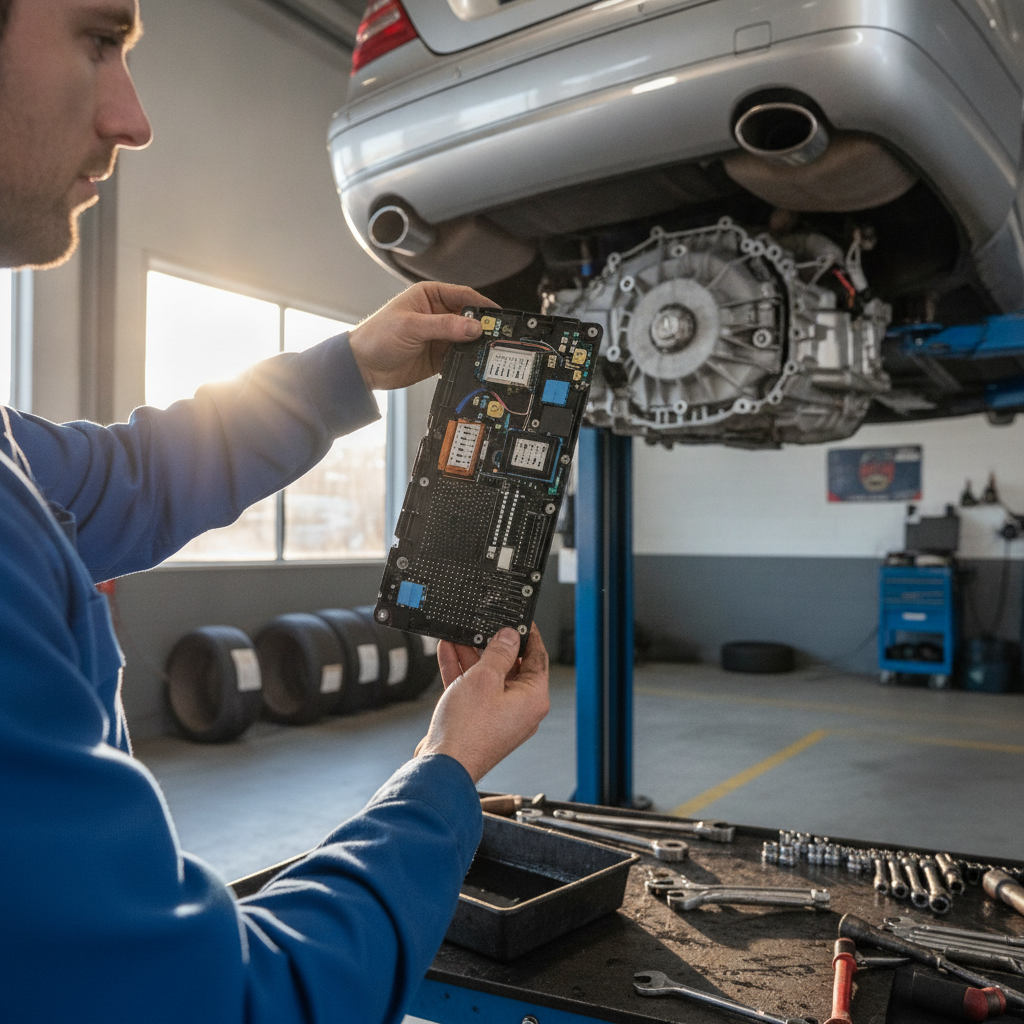
The conductor plate sits inside the transmission’s valve body and integrates the solenoids, speed sensors, and wiring harness into a single sealed assembly. Unlike a conventional wiring harness that can be inspected and repaired in isolation, the conductor plate is a bonded unit — and it operates in a chemically harsh environment, submerged in automatic transmission fluid and subjected to significant thermal cycling every time you drive. Over time, the internal solder joints and sensor contacts degrade. The plastic substrate that bonds the circuit traces becomes brittle. The result is intermittent or total loss of electrical signal to the solenoids that control clutch pack engagement and hydraulic pressure.
When the conductor plate starts failing, your transmission control module (TCM) loses reliable feedback. It may command a gear change that the solenoid cannot execute properly — which is exactly what produces that characteristic shudder, slip, or delayed engagement you’re feeling on your commute down Highway 101 through Petaluma or Rohnert Park.
Symptoms That Point Specifically to the Conductor Plate
Several failure patterns are especially common with conductor plate degradation, and they’re worth knowing because they can mimic other, more expensive transmission problems:
- Low-speed shudder or vibration during light acceleration, often mistaken for a torque converter issue
- Delayed or harsh gear engagement when pulling away from a stop — common on the Highway 101 corridor where stop-and-go traffic is frequent
- Transmission fault codes stored in the TCM referencing specific solenoid circuits, speed sensor signal loss, or implausible ratio errors
- Limp-home mode activation, where the transmission locks into third gear to protect itself
- Intermittent symptoms that seem to disappear when the car warms up — a hallmark of a thermally compromised circuit connection
- Transmission fluid contamination with fine metallic debris or burnt odor, indicating the solenoids have been working harder than they should
If a shop reads your fault codes with a generic OBD-II scanner and immediately recommends a full transmission replacement, be cautious. Without factory-level diagnostic access — which means proper Mercedes-Benz XENTRY/DAS software, not a generic scan tool — they are not getting the full picture from your TCM. A solenoid circuit fault code does not automatically mean a failed solenoid. It may simply mean the conductor plate can no longer reliably carry the signal to that solenoid.
What a Proper Conductor Plate Service Actually Involves
A conductor plate replacement is a precision job, but it is not a transmission rebuild — and that distinction matters enormously for cost and outcome. Here is what a qualified independent European specialist will do:
- Factory-level TCM scan to pull all stored and pending fault codes, live data from speed sensors, and solenoid activation patterns
- Transmission fluid inspection — color, smell, and debris content tell a trained technician a great deal about the internal condition of the transmission before it’s opened
- Valve body removal — the transmission pan is dropped, the fluid is drained, and the valve body assembly is carefully extracted
- Conductor plate replacement with a genuine OEM unit — not a remanufactured offshore alternative, which carries real risk of premature failure in this application
- Valve body inspection during the process — worn solenoids or damaged bores should be addressed at the same time
- Fresh OEM-spec ATF fill — Mercedes-Benz 722.9 units require MB 236.14 fluid specifically; using the wrong fluid will damage the clutch pack friction material
- TCM adaptation reset and programming — after replacement, the transmission control module must relearn clutch pack engagement points through a controlled drive cycle
That last step is one area where independent shops without proper factory software often fall short. Without resetting the TCM adaptations after a conductor plate replacement, your transmission will not shift cleanly — and the new conductor plate will begin life working against corrupted learned values. This is why factory-grade diagnostics matter at every step, not just at initial inspection. You can learn more about how we approach European transmission repair in Santa Rosa with the same level of precision.
Why This Issue Is Particularly Relevant for Sonoma County Mercedes-Benz Owners
The Highway 101 corridor between Petaluma, Rohnert Park, and Santa Rosa is genuinely hard on automatic transmissions. Stop-and-go commute traffic — whether you’re heading south to Novato, San Rafael, or into Marin County for work — keeps the transmission cycling through low gears repeatedly, generating heat and hydraulic pressure fluctuations that stress the conductor plate’s internal circuitry over time.
Add to that the reality that a significant portion of Mercedes-Benz vehicles in Sonoma County are now outside the factory warranty window. A well-maintained E350 or ML350 with 80,000 to 130,000 miles is squarely in conductor plate failure territory if it has never had a proper transmission fluid service. Mercedes-Benz’s old “lifetime fluid” recommendation has long since been revised by technicians who actually see the condition of that fluid at high mileage — and what we typically find is oxidized, contaminated fluid that has accelerated wear on both the conductor plate and the valve body.
If your Mercedes-Benz has been sitting in Wine Country traffic or running Highway 12 between Sonoma and Santa Rosa without a transmission fluid change in the last 50,000 miles, that service alone may prevent a conductor plate failure from becoming a full transmission failure.
OEM Parts vs. Remanufactured: Where It Matters Most
This is an area where the choice genuinely affects the outcome. Remanufactured conductor plates sourced from overseas suppliers have an inconsistent track record in 722.9 applications — the circuit trace bonding process is proprietary, and off-spec units often present the same fault codes within 12 to 18 months. For this repair, genuine Mercedes-Benz OEM or a reputable approved-source remanufacturer with a verifiable warranty is the only sensible choice. The cost difference is not insignificant, but neither is returning to the shop a year later for the same repair.
For a comprehensive look at how we evaluate all your Mercedes-Benz’s systems during a repair visit, our multi-point inspection service is a good starting point — especially if your vehicle hasn’t had a full review recently.
Frequently Asked Questions
How do I know if my Mercedes-Benz needs a conductor plate replacement or a full transmission rebuild?
A factory-level diagnostic scan with XENTRY software is the only reliable way to differentiate between conductor plate failure, solenoid failure, clutch pack wear, or valve body damage. Symptom patterns alone are not sufficient — and a shop that recommends a full rebuild based on a generic scan code alone should raise a flag. Most conductor plate failures, when caught before the transmission enters limp-home mode regularly, do not require a rebuild.
What Mercedes-Benz models are most commonly affected?
Any Mercedes-Benz with the 722.6 or 722.9 automatic transmission is susceptible — which covers the vast majority of C, E, S, CLS, CLK, ML, GL, and GLE models built between approximately 1996 and 2015. The 722.9 seven-speed is particularly common in vehicles from 2004 onward.
Can I drive my Mercedes-Benz to the shop if it’s already in limp-home mode?
Limp-home mode locks the transmission into a single gear to prevent catastrophic damage — the vehicle can still be driven carefully at low speeds for short distances. However, continuing to drive in this condition for extended periods risks overheating the clutch packs and accelerating damage beyond a conductor plate repair. Arrange transport or call ahead so you can come in directly.
How often should I be changing transmission fluid in my Mercedes-Benz?
Despite early “fill for life” marketing language, most factory-trained technicians recommend a 722.9 fluid service every 40,000 to 60,000 miles, or sooner if the vehicle sees regular towing, heavy stop-and-go commuting, or mountain driving. Petaluma and Sonoma County driving patterns generally fall into the more demanding category.
Is this repair significantly cheaper at an independent specialist than at a Mercedes-Benz dealership?
In most cases, yes — independent European specialists typically offer meaningfully lower labor rates than dealerships while using the same OEM parts and factory-equivalent diagnostic tools. For a repair that involves precise TCM programming and valve body work, the difference in quality between a competent independent specialist and a dealership is minimal; the difference in cost can be substantial.
Bring Your Mercedes-Benz to Bavarian Performance
If your Mercedes-Benz is shuddering, slipping, hesitating, or has triggered a transmission fault code anywhere in Petaluma, Sonoma County, or the surrounding North Bay area, don’t let a misdiagnosis lead you toward an unnecessary transmission replacement. At Bavarian Performance in Santa Rosa, we use factory-grade Mercedes-Benz diagnostic software, genuine OEM parts, and the kind of transmission-specific expertise that comes from working on these vehicles every day — not occasionally between oil changes.
Reach out through our contact page to schedule a diagnosis or ask about your specific vehicle. We work with Mercedes-Benz owners from Petaluma, Rohnert Park, Novato, and across Sonoma County — and we’ll give you a straight answer about what your transmission actually needs before any work begins.