
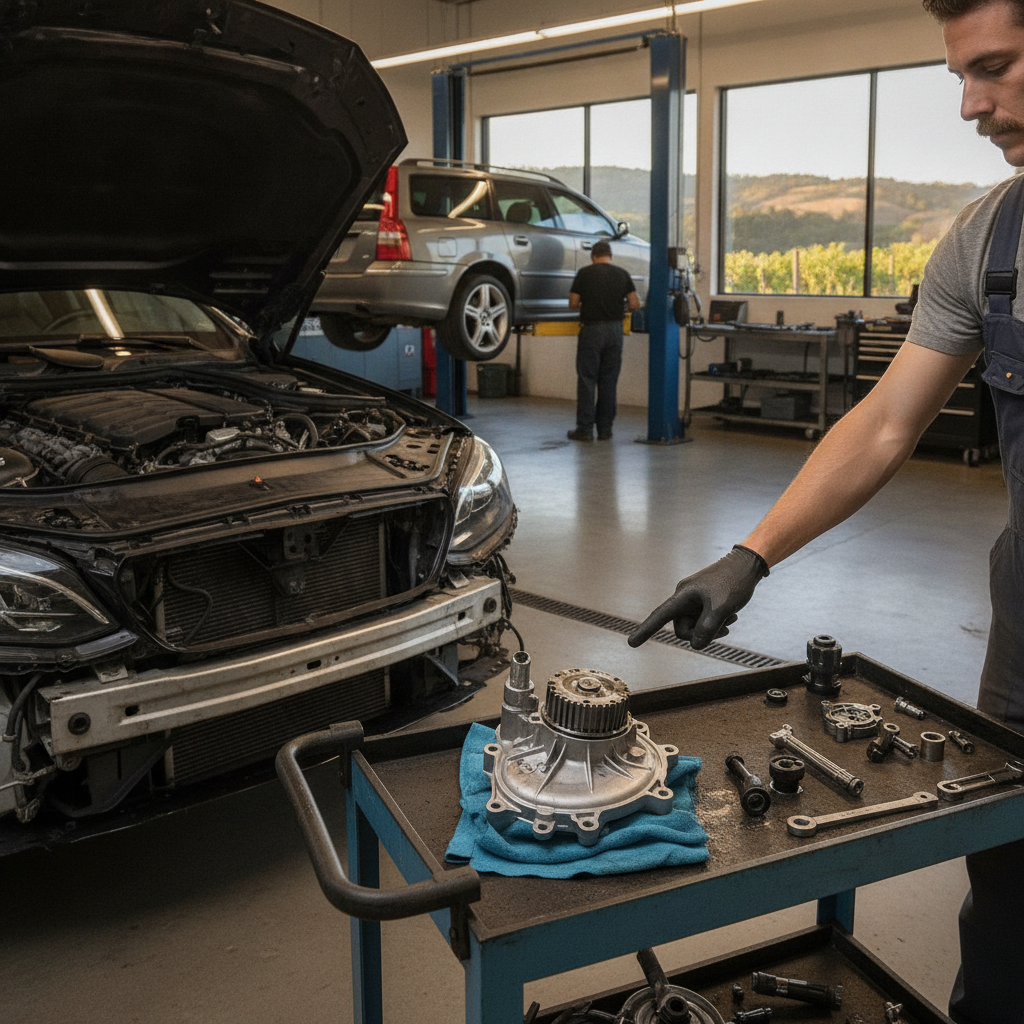
Why Is My Mercedes-Benz or Volvo’s Water Pump Failing in Windsor — and What Does a Cooling System Overhaul Actually Involve?
If your Mercedes-Benz or Volvo is showing a mild temperature gauge climb, a low coolant warning, or a faint sweet smell around the engine bay while driving through Windsor or up toward Healdsburg, there’s a good chance your water pump is beginning to fail — and on these platforms, that’s not a symptom to defer. By the time an overtemperature warning lights up your instrument cluster, significant damage can already be in progress. A proper cooling system overhaul by a factory-trained specialist is the repair that prevents a manageable service from becoming a six-figure engine replacement.
Why Mercedes-Benz and Volvo Water Pumps Fail the Way They Do
These two brands share something that surprises many owners: both have historically used plastic impeller water pumps in key model lines — and plastic, as any engineer will tell you, does not love prolonged heat cycling. On Mercedes-Benz M272 and M273 V6 and V8 engines, the water pump impeller is known to delaminate from its shaft over time. The pump keeps spinning, but coolant circulation drops to a trickle. Your temperature gauge may behave normally for months before you get an actual overheat event — making this one of the more insidious failure modes in the German lineup.
Volvo’s situation is slightly different. On the 2.0T and 2.5T engines found across the S60, V60, XC60, and XC90 platforms, the water pump and thermostat housing are integrated into a single assembly. When the seal or pump body fails, you get a coolant leak that often weeps slowly through the back of the engine — an area not immediately visible during a casual inspection. Volvo’s cooling systems also rely on a precisely specified OEM coolant (a purple-dyed formula on later models) that should never be mixed with generic green or orange antifreeze. Cross-contamination causes gel formation inside the cooling passages and accelerates pump bearing wear.
How Windsor’s Driving Environment Accelerates the Problem
Windsor sits in a pocket of Sonoma County that sees genuine summer heat — temperatures regularly pushing into the mid-90s and beyond during July and August, with little of the coastal fog relief that moderates temperatures in Sebastopol or along the Bodega Bay corridor. If you’re making regular runs up Highway 101 toward Geyserville wine country, or commuting south toward Santa Rosa and Rohnert Park, your cooling system is working hard during the hottest part of the day.
That sustained thermal load is exactly what accelerates plastic impeller degradation and stresses aging coolant hoses and reservoir caps. A pressure cap that’s marginally weak — rated for 1.4 bar, now holding only 1.1 — won’t cause a problem on a cool morning. But on a 95-degree afternoon after a 45-minute Highway 101 run, it’s the difference between a stable coolant system and a reservoir that’s pushing fluid out through the overflow.
Vineyard dust from the rural roads running between Windsor and Healdsburg also clogs the front of the radiator and condenser stack over time, reducing airflow and making an already-stressed cooling system work even harder. This is something many owners don’t think about until a multi-point inspection reveals a radiator face that looks like a dust filter.
What a Proper Cooling System Overhaul Actually Involves
This is where independent shops in Sonoma County often fall short. A cooling system overhaul isn’t a coolant drain-and-fill. On a Mercedes-Benz or Volvo, doing the job correctly means treating the system as a unified assembly — not replacing individual components in isolation.
At Bavarian Performance, a full cooling system service on these platforms typically includes:
- Water pump replacement with a genuine OEM or OEM-equivalent unit — On Mercedes-Benz M272/M273 engines, this means sourcing an updated pump with a metal impeller, not a replacement plastic-impeller unit that will fail on the same timeline. On Volvo, the pump and thermostat housing are replaced as an assembly.
- Thermostat replacement — The thermostat on both platforms should always be replaced at the same time as the water pump. They’re in the same thermal environment, often have similar service life, and the labor overlap makes separate replacement wasteful.
- Full coolant flush and refill with the correct OEM-specified fluid — Not universal antifreeze. Not whatever was cheapest at a parts store. Mercedes-Benz and Volvo both specify particular coolant chemistry, and using the wrong type creates corrosion inside aluminum cooling passages.
- Inspection and pressure-testing of hoses, clamps, and the expansion tank — The plastic coolant reservoir on these platforms becomes brittle with age and heat cycling. A reservoir that cracks while you’re driving toward Geyserville on a summer afternoon is a tow call.
- Radiator cap pressure test — Often overlooked, but a weak cap changes the boiling point of your coolant and causes chronic low-grade overheating that’s easy to miss until it isn’t.
- Post-repair system bleed with factory-grade scan tools — Mercedes-Benz in particular uses an electrically controlled auxiliary coolant pump on many models. Proper bleeding requires commanding that pump through factory-level software — not a generic OBD-II reader — to fully purge air pockets from the system.
That last point is a gap that generic shops and quick-lube chains consistently miss. An air pocket left in the cooling system after a water pump replacement causes localized overheating and temperature sensor spikes that look like a new problem. The repair is only complete when the system is fully bled and verified with the right equipment.
When to Address This — and Why Timing Matters
On Mercedes-Benz M272/M273 engines, the factory guidance is to inspect the water pump by 80,000–90,000 miles and replace proactively before failure. On Volvo’s 2.0T and 2.5T engines, coolant leaks from the pump housing area are common from 70,000 miles onward, particularly on vehicles that have spent years in the hot, dry conditions of inland Sonoma County summers.
If you’re driving a Mercedes-Benz E-Class, C-Class, or ML with the M272 or M273 engine and you’re past 80,000 miles, this is a conversation worth having before the pump fails — not after. The cost of a planned water pump replacement is a fraction of what a head gasket replacement or warped cylinder head costs after an uncontrolled overheat event.
For Volvo owners in Windsor, Healdsburg, or the surrounding area: if you’re seeing any coolant loss between services, or if your coolant level seems to drop slightly between inspections without an obvious external leak, have the pump housing and expansion tank inspected. Slow internal weeping through a deteriorating seal is a common Volvo failure mode that shows up in the data before it shows up dramatically on the road.
You can learn more about the full range of preventative maintenance services Bavarian Performance offers for European vehicles, including cooling system overhauls for both of these platforms.
Why OEM Parts Are Non-Negotiable on These Systems
The aftermarket cooling parts ecosystem for Mercedes-Benz and Volvo is full of components that meet the minimum spec on paper and fall short in practice. We’ve seen aftermarket water pumps with substandard bearing seals fail within 20,000 miles on platforms where the correct OEM unit would last 80,000. On Volvo, aftermarket thermostat housings made from lower-grade plastic crack faster under thermal cycling than the OEM assembly. The cost savings upfront evaporate when the labor has to be repeated.
For a more detailed look at how Volvo cooling system service is handled at Bavarian Performance, including the parts standards we hold for every repair, visit our Volvo repairs page.
Frequently Asked Questions
How do I know if my Mercedes-Benz water pump has a plastic impeller?
If your Mercedes-Benz is equipped with a V6 M272 or V8 M273 engine (common across C, E, CLK, ML, and GL models from roughly 2004–2012), there is a high probability your original water pump has a plastic impeller. When we replace these pumps, we always install a metal impeller unit — it’s not optional on these engines.
Can I drive to Santa Rosa if my coolant warning light comes on near Windsor?
It depends on the warning. A low coolant level light means you may have time to add coolant and drive carefully. An overtemperature warning means pull over immediately, shut the engine off, and call for a tow. Driving even a few miles on an overheating European engine can warp cylinder heads or crack a head gasket — damage that multiplies the repair cost dramatically.
Why does my Volvo smell sweet near the engine but I don’t see a leak?
Ethylene glycol coolant has a distinctive sweet smell that’s detectable well before a visible puddle forms. If the weep is happening at the back of the engine or inside the engine bay in a hard-to-see area, you may smell the vaporized coolant without seeing it drip. This is a common early symptom on Volvo cooling systems and warrants immediate inspection.
Is a cooling system flush the same as a cooling system overhaul?
No. A coolant flush replaces the fluid only. A cooling system overhaul means inspecting and replacing the water pump, thermostat, pressure cap, and hoses as a system — then properly bleeding the system with factory-grade tools. On a Mercedes-Benz or Volvo past 80,000 miles, doing only a coolant flush without inspecting the pump is a missed opportunity to prevent a much larger failure.
Do you service Volvo and Mercedes-Benz vehicles from Healdsburg and Geyserville?
Yes. Bavarian Performance serves Windsor, Healdsburg, Geyserville, Rohnert Park, and the broader Sonoma County area. Most owners from north county make the drive to our Santa Rosa facility — it’s a straightforward run down Highway 101 and the turnaround time on most cooling system services is same-day or next-day.
Schedule Your Cooling System Inspection at Bavarian Performance
If your Mercedes-Benz or Volvo is showing any sign of coolant loss, temperature variation, or you simply haven’t had the cooling system inspected past 70,000 miles, this is not a service to put off through another Sonoma County summer. Bavarian Performance uses factory-trained technicians, factory-grade diagnostic equipment, and genuine OEM parts to handle cooling system overhauls the right way — without the dealership wait times or the dealership markup.
Owners from Windsor, Healdsburg, and the surrounding area are welcome to contact us to schedule an inspection or request an appointment. We’ll tell you exactly what your system needs — and what it doesn’t.