
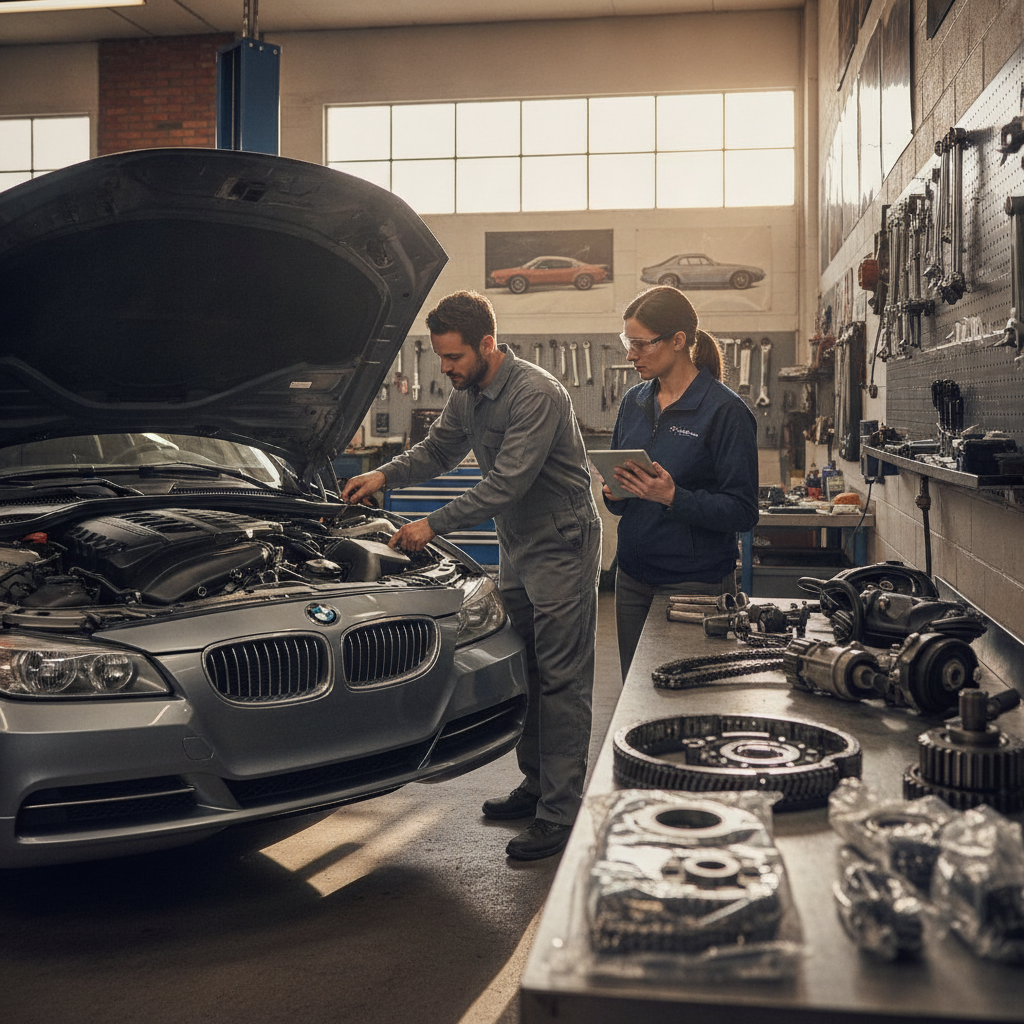
Why Is My BMW or Audi’s Timing Chain Rattling at Startup in Petaluma — and What Does a Timing Chain Tensioner Failure Actually Mean?
If your BMW or Audi produces a metallic rattle for the first two or three seconds after a cold start — then quiets down once the engine warms up — that’s not a quirk you can ignore. For Petaluma drivers and Sonoma County owners of turbocharged German vehicles, that brief rattle is your engine’s hydraulic timing chain tensioner losing its ability to maintain proper chain tension before oil pressure builds. Caught early, this is a manageable repair. Left alone, it can lead to catastrophic engine damage that no independent shop — or dealership — can fix cheaply.
What the Timing Chain Tensioner Actually Does
Your engine’s timing chain keeps the crankshaft and camshafts synchronized to within fractions of a degree. The tensioner is a spring-loaded, oil-fed hydraulic piston that maintains precise chain tension at all times — especially during that critical window between ignition and full oil pressure, which takes anywhere from one to three seconds on a cold start.
When the tensioner’s internal check valve wears out or the tensioner body itself cracks or fatigues, oil drains back out of the tensioner during shutdown. The next morning, there’s nothing holding the chain taut until the oil pump builds pressure. The chain slaps against its guides — and you hear that telltale rattle. Over time, that slap wears through the plastic guide rails, stretches the chain, and eventually allows timing to jump. When timing jumps on a modern interference engine, the valves and pistons occupy the same space at the wrong time. That’s a bent valve, a damaged piston, or in worst cases, a destroyed head — a repair that can cost as much as the car is worth.
Which BMW and Audi Engines Are Most Affected
This isn’t a universal European engine problem — it’s concentrated in specific platforms, and understanding which one you have changes your urgency level considerably.
BMW: N20, N47, and Some N55 Applications
BMW’s N20 four-cylinder (found in the 320i, 328i, 528i, and X1 from roughly 2012–2016) has a well-documented timing chain tensioner issue. The problem is compounded by the N20’s timing chain being located at the rear of the engine — meaning labor to replace it is substantially higher than on front-mounted systems, because the transmission must come out. If you own a 3 Series or 5 Series with this engine and you’re hearing a cold-start rattle, this is the first thing to investigate. The N47 diesel (sold in Europe and some North American markets) has an even more serious reputation for chain failure at mileages that feel premature. The N55 twin-scroll turbo is generally more robust, but tensioner wear still occurs past 80,000 miles and should be inspected as part of any comprehensive engine service.
Audi and Volkswagen: The 2.0T TFSI (EA888)
The Audi 2.0T found in the A4, A5, Q5, and TT — as well as Volkswagen’s GTI, Jetta GLI, and Passat — uses a timing chain system that in earlier generations (particularly Gen 1 and early Gen 2 EA888 engines) had a documented tensioner and guide rail failure pattern. Audi issued a technical service bulletin and extended warranty coverage on affected vehicles, but many of those coverage periods have now expired. If you’re driving a 2009–2014 Audi or VW with a 2.0T and you haven’t had the tensioner inspected, it belongs on your radar — especially if the vehicle has been through multiple Sonoma County summers where oil degrades faster under sustained heat.
Proper diagnosis requires more than a generic OBD-II code reader. At Bavarian Performance, we use factory-grade diagnostic tools — including ISTA for BMW and ODIS for Audi and Volkswagen — to read actual camshaft correlation values and timing deviation data that a generic scanner won’t surface. That data tells us whether the chain has already stretched beyond acceptable limits or whether you’re still in the early warning window. You can learn more about our approach to European engine repair and what a proper diagnosis actually involves.
What Sonoma County’s Climate Does to Timing Chain Systems
Here’s something that doesn’t get discussed enough in generic auto content: the hot, dry summers across Sonoma County — Petaluma included — accelerate oil degradation in ways that directly affect timing chain tensioner life. When oil breaks down from heat cycling, it loses viscosity and its ability to maintain hydraulic pressure in the tensioner’s check valve. If you’re running your oil past the manufacturer’s recommended interval (which many owners do), you’re compounding the risk. BMW’s flexible oil service indicator can stretch intervals to 10,000–15,000 miles under certain conditions, but in a climate with sustained summer temperatures and stop-and-go commuting on Highway 101, that’s often too long for a tensioner that’s already showing early wear.
We also see this problem more frequently in vehicles that sit for extended periods — something more common than you’d think in Wine Country, where owners sometimes have a primary vehicle and a secondary European car that goes weeks between drives. Oil drains from the tensioner more completely when a car sits, and the cold-start impact is more pronounced.
What a Proper Timing Chain Service Actually Involves
This is where a lot of shops — including some competitors in the Petaluma and Rohnert Park area — fall short. Replacing only the tensioner on a chain that has already stretched, or on guides that are already worn, is an incomplete repair. A proper timing chain service for a BMW N20 or Audi 2.0T should include:
- Tensioner replacement with a genuine OEM unit — not an aftermarket part that may not meet the original hydraulic specifications
- Chain inspection and measurement — stretched chains must be replaced, not simply re-tensioned
- Guide rail inspection — plastic rails crack and wear unevenly; a rattle that has continued for more than a few cold starts often means guide damage has already occurred
- Timing alignment verification using factory-specification locking tools — this is not optional on interference engines
- Oil system flush and fresh oil fill — there’s no point putting a new tensioner on a system full of degraded oil
On the BMW N20 specifically, because the timing system sits at the rear of the engine, the repair is labor-intensive. That’s the honest reality of this platform. But the alternative — letting the chain jump timing — will cost multiples of what a proactive repair costs today.
Why Genuine OEM Parts Matter Here
On timing chain tensioners, the case for genuine OEM parts is particularly strong. The hydraulic check valve tolerances inside a tensioner are tight. Aftermarket tensioners — even well-branded ones — sometimes have check valves that don’t hold pressure as well under cold-start conditions, which is precisely the scenario you’re trying to fix. We use genuine BMW and genuine Audi/Volkswagen parts for this repair because the failure mode you’re trying to prevent is exactly where aftermarket quality variance shows up. This is not a brake pad situation where premium aftermarket is perfectly acceptable. The tensioner is a precision hydraulic component, and it needs to meet the original specification.
If you’re managing a broader set of services for a high-mileage European vehicle, a preventative maintenance appointment is the right starting point — it lets us assess the timing system alongside other wear items and give you a prioritized picture of what needs attention now versus what can wait.
Frequently Asked Questions
How long can I drive with a timing chain rattle before it becomes dangerous?
There’s no safe answer to this question. A tensioner rattle can remain stable for weeks or progress to chain jump in days — it depends on how worn the guides and chain already are. The rattle itself is a sign that something is already wrong, not a warning that something might go wrong. Have it diagnosed immediately.
Will a check engine light come on before the timing chain fails?
Sometimes. Stretched timing chains can trigger camshaft position correlation fault codes (P0011, P0012, P0016, P0017 and related codes), but the chain can also fail without triggering a fault code in the early stages. Cold-start rattle alone is sufficient cause for diagnosis — don’t wait for a warning light.
Can I drive my Audi or BMW from Cotati or Sebastopol to your shop if it’s rattling?
If the rattle resolves quickly at startup and you haven’t noticed any loss of power, rough running, or illuminated warning lights, a short, carefully driven trip is generally manageable. Call us first at (707) 545-2002 and describe what you’re hearing — we can help you assess whether the vehicle should be driven or towed.
Is this the same as the Mini Cooper timing chain issue?
Related, but distinct. The Mini Cooper N14 engine has its own tensioner failure pattern. The BMW N20 and Audi 2.0T timing chain issues involve different mechanical designs and different failure modes, though the underlying principle — inadequate tensioner pressure at cold start — is similar.
Does a timing chain replacement come with any warranty?
At Bavarian Performance, we stand behind our parts and labor. We use genuine OEM components and provide warranty coverage on the repair — ask us directly for current terms when you book your appointment.
Schedule a Timing Chain Diagnosis at Bavarian Performance
Petaluma and Sonoma County BMW and Audi owners don’t have to choose between dealership wait times and shops that aren’t equipped to handle the precision this repair demands. At Bavarian Performance in Santa Rosa, we have the factory tooling, genuine OEM parts, and direct experience with N20, N55, and EA888 timing chain systems to diagnose your vehicle accurately and repair it right the first time.
If you’re hearing a cold-start rattle — or if your high-mileage turbocharged BMW or Audi has never had its timing chain system inspected — don’t wait for a fault code or a catastrophic failure to make the decision for you. Contact Bavarian Performance to schedule a diagnosis. We’ll tell you exactly what we find, what it means, and what needs to happen next — no guesswork, no unnecessary upsells.