
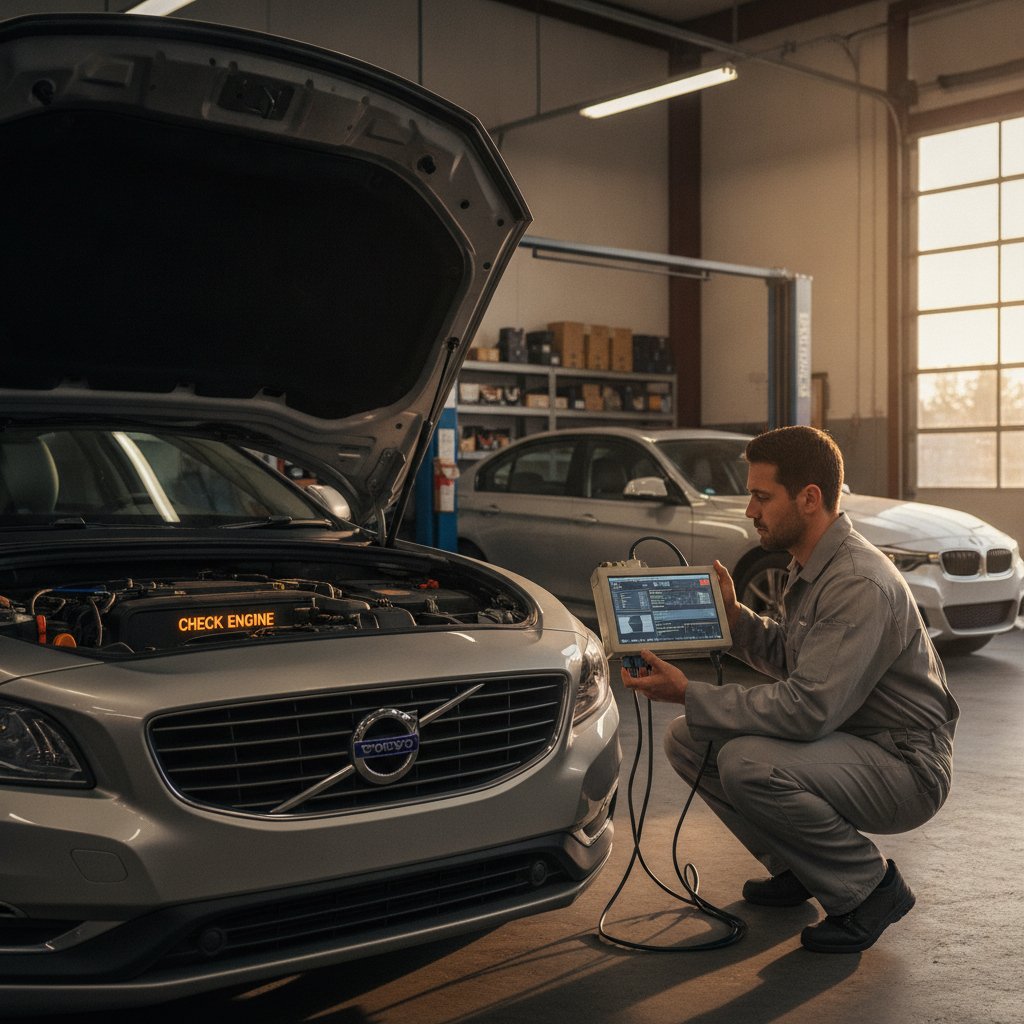
Why Is My Volvo’s or BMW’s Engine Warning Light On in Healdsburg — and What Does a Professional Scan Tool Diagnosis Actually Tell You?
If you’re driving a Volvo or BMW through the Alexander Valley or heading into Healdsburg on a weekend morning and that amber engine light flicks on, your first instinct might be to swing by an auto parts store for a free OBD-II read. That’s understandable — but on a modern European vehicle, a generic fault code reader gives you roughly the same information as a smoke detector gives you about what’s actually burning. You’ll know something is wrong. You won’t know what, where, or why. A factory-grade diagnostic tells a fundamentally different story, and if you care about your car’s long-term health, that story is worth hearing properly.
What a Generic OBD-II Reader Actually Captures — and What It Misses
The OBD-II standard, introduced in the mid-1990s, was designed to give emissions regulators access to a vehicle’s powertrain data. It does that reasonably well. What it was never designed to do is access the proprietary control module architecture that BMW, Volvo, and other European manufacturers have layered on top of that foundation over the past two decades.
A generic Bluetooth dongle or a parts-store reader will pull standardized fault codes — typically P-codes that tell you something like “catalytic converter efficiency below threshold” or “mass airflow sensor out of range.” That’s a starting point, not a diagnosis. What those tools cannot access includes:
- BMW’s DME and DDE modules — the Digital Motor Electronics system that governs fuel delivery, ignition timing, VANOS cam adjustment, and dozens of subsystem parameters that a P-code summary never touches
- Volvo’s CEM (Central Electronic Module) and ECM fault trees — Volvo vehicles use a modular control architecture where a fault in one module can cascade into warning lights in another, and tracing that chain requires VIDA (Vehicle Information and Diagnostics for Aftersales), Volvo’s factory software
- Freeze-frame data and pending codes — faults that have occurred but haven’t crossed the threshold to illuminate the check engine light yet, which on European vehicles often predict the next failure before it leaves you stranded
- Live data streams — real-time sensor readings that let a trained technician watch how an engine behaves under load, cold start, and steady cruise, rather than reading a static snapshot
When you bring a Volvo XC90 or a BMW 5 Series into a shop with factory-level tools, the technician isn’t just reading codes — they’re having a conversation with every module in the vehicle simultaneously.
Why Healdsburg and Northern Sonoma County Driving Conditions Trigger Specific Faults
The driving environment around Healdsburg, Geyserville, and Cloverdale creates wear patterns and fault triggers that aren’t common in urban settings. Vineyard access roads and the stretches of Highway 101 north of Windsor are hard on sensors, intake systems, and fuel trims in ways that owners don’t always anticipate.
Vineyard dust is particularly fine and pervasive from late summer through harvest season. On BMW N20 and N55 engines — and on Volvo’s Drive-E four-cylinders — that dust loads mass airflow (MAF) sensors faster than you’d see in an urban environment. A contaminated MAF sensor skews fuel trim data, which the DME interprets as a lean or rich condition, which triggers a check engine light with a P0171 or P0174 code. The code says “lean condition.” The actual culprit is a dirty MAF sensor. A technician who only reads the code and replaces an oxygen sensor has solved nothing.
Hot, dry summers in this part of Sonoma County also stress cooling system components in ways that directly affect engine management. BMW’s N20 four-cylinder engine uses an electronically controlled thermostat that the DME monitors continuously. When the thermostat begins to fail — a known wear point on this engine — the DME logs a specific BMW-proprietary fault code that a generic reader either misreads or misses entirely. By the time it shows up as a generic P-code, the cooling system has already been operating outside spec for some time.
What Factory-Grade Diagnostics Actually Look Like in Practice
At Bavarian Performance in Santa Rosa, diagnostics on BMW and Volvo vehicles are performed using the same software platforms the factory dealers use: BMW’s ISTA (Integrated Service Technical Application) and Volvo’s VIDA system. These aren’t aftermarket approximations — they’re the actual factory diagnostic environments.
What that means for you as the vehicle owner is significant. When a technician runs an ISTA session on your BMW, the system doesn’t just read fault codes — it runs guided diagnostic routines that prompt the technician through a decision tree specific to your vehicle’s engine variant, production date, and current software version. It knows, for example, that a B58-equipped 540i built after a certain production date has a revised VANOS oil pressure specification that differs from earlier build dates. A generic tool doesn’t know that. Neither does a technician working only from memory.
For Volvo owners in northern Sonoma County, VIDA access is particularly critical when the amber engine light coexists with a warning in the instrument cluster or an unusual behavior like rough idle or hesitation. Volvo’s modular control architecture means that a fault in the throttle body module, for example, can create apparent symptoms in the transmission control module that show up as separate fault codes. Without seeing the full picture across all modules simultaneously, it’s easy — and expensive — to replace the wrong component.
The Wildfire Factor: What Smoke and Ash Do to European Engine Sensors
This is a diagnostic angle that almost no local shop discusses directly, and it’s one of the more practically important ones for Sonoma County owners. Since the 2017 Tubbs Fire and subsequent wildfire seasons, vehicles throughout the region — particularly those garaged or parked outdoors during smoke events — have experienced accelerated sensor contamination that triggers check engine lights months after the event.
Fine ash particulate compromises MAF sensors, oxygen sensors, and evaporative emission system components. On a Volvo with the T5 or T6 turbocharged engine, wildfire smoke contamination of the intake system can trigger lean-condition fault codes that persist even after the smoke season ends. On BMW’s B58 engine, ash contamination of the EVAP purge valve is a documented source of recurring check engine lights that return shortly after a technician clears the codes without addressing the underlying contamination.
If your check engine light came on during or shortly after a wildfire smoke event and has been intermittent since, that history is diagnostically relevant. Mention it when you bring the vehicle in. A technician running a factory diagnostic session can cross-reference the fault freeze-frame timestamps against dates when air quality alerts were active in your area — and that context changes the repair path significantly.
When a Check Engine Light Means Stop Now vs. Drive It In
Not every check engine light is a four-alarm emergency, but some absolutely are. Here’s a practical framework for Volvo and BMW owners:
- Steady amber light, no drivability symptoms: Schedule service within a few days. Monitor for changes.
- Steady amber light with reduced power, rough idle, or unusual smell: Drive it in promptly — within 24 to 48 hours. Don’t wait for a scheduled appointment slot.
- Flashing or blinking amber light: This indicates an active misfire that can damage your catalytic converter in real time. Reduce speed, avoid hard acceleration, and get the vehicle to a shop the same day.
- Red engine warning or low oil pressure warning alongside the check engine light: Pull over safely and do not drive. Call for transport.
Volvo’s warning system uses a color hierarchy — amber for advisory, red for stop immediately — that communicates urgency clearly. BMW’s iDrive system will often display a plain-language description of the fault alongside the warning light. Read it. It’s more informative than it used to be, even if it still doesn’t tell you the root cause.
Frequently Asked Questions
Can I drive my BMW or Volvo from Healdsburg to Santa Rosa with the check engine light on?
If the light is steady, there are no drivability symptoms, and no additional warning lights are present, a short drive is generally manageable. If the light is flashing, or if you notice rough running, reduced power, or unusual smells, reduce speed and call for advice before proceeding.
Why does my check engine light come back on after I have the codes cleared?
Clearing codes without correcting the underlying fault is a temporary measure, not a repair. On European vehicles, recurring codes after a reset almost always indicate that the root cause — a failing sensor, a mechanical issue, or a software fault — was never addressed. Factory-grade diagnostics identify the root cause, not just the symptom code.
Does a check engine light void my warranty or affect my vehicle’s value?
An unresolved check engine light will typically cause a vehicle to fail a California smog inspection, which affects registration renewal and resale. If your vehicle is still under a manufacturer’s powertrain warranty, the fault should be addressed by a qualified facility using factory-calibrated tools that create a proper repair record.
Are check engine light diagnostics expensive?
A professional factory-level diagnostic session is a discrete service with its own cost — and at Bavarian Performance, that fee is applied toward any resulting repair. What you’re paying for is the difference between a confirmed diagnosis and a parts-replacement guessing game. On a European vehicle, the latter is almost always more expensive in the long run.
My Volvo’s check engine light is on but it drives perfectly fine. Does it still need attention?
Yes. Many fault conditions on Volvo vehicles — particularly those related to the EVAP system, lambda sensors, or secondary air injection — produce no drivability symptoms in early stages but will fail a California smog test and, if left unaddressed, can lead to component failures that are significantly more expensive to repair later.
Schedule Your Factory-Level Diagnostic at Bavarian Performance
If your BMW or Volvo’s engine warning light is on — whether you’re in Healdsburg, Windsor, or anywhere in Sonoma County — the answer isn’t a parts-store code read and a guess. It’s a proper diagnostic conversation with the vehicle’s control systems, performed with the same tools and software the factory uses.
At Bavarian Performance in Santa Rosa, our factory-trained technicians run ISTA and VIDA diagnostics on BMW and Volvo vehicles respectively, giving you a complete picture of what’s actually happening — not just a fault code summary. We use genuine OEM parts when repairs are indicated and provide transparent explanations of what we found and why it matters.
Contact Bavarian Performance to schedule your diagnostic appointment — and get a real answer about what that warning light is actually telling you.