
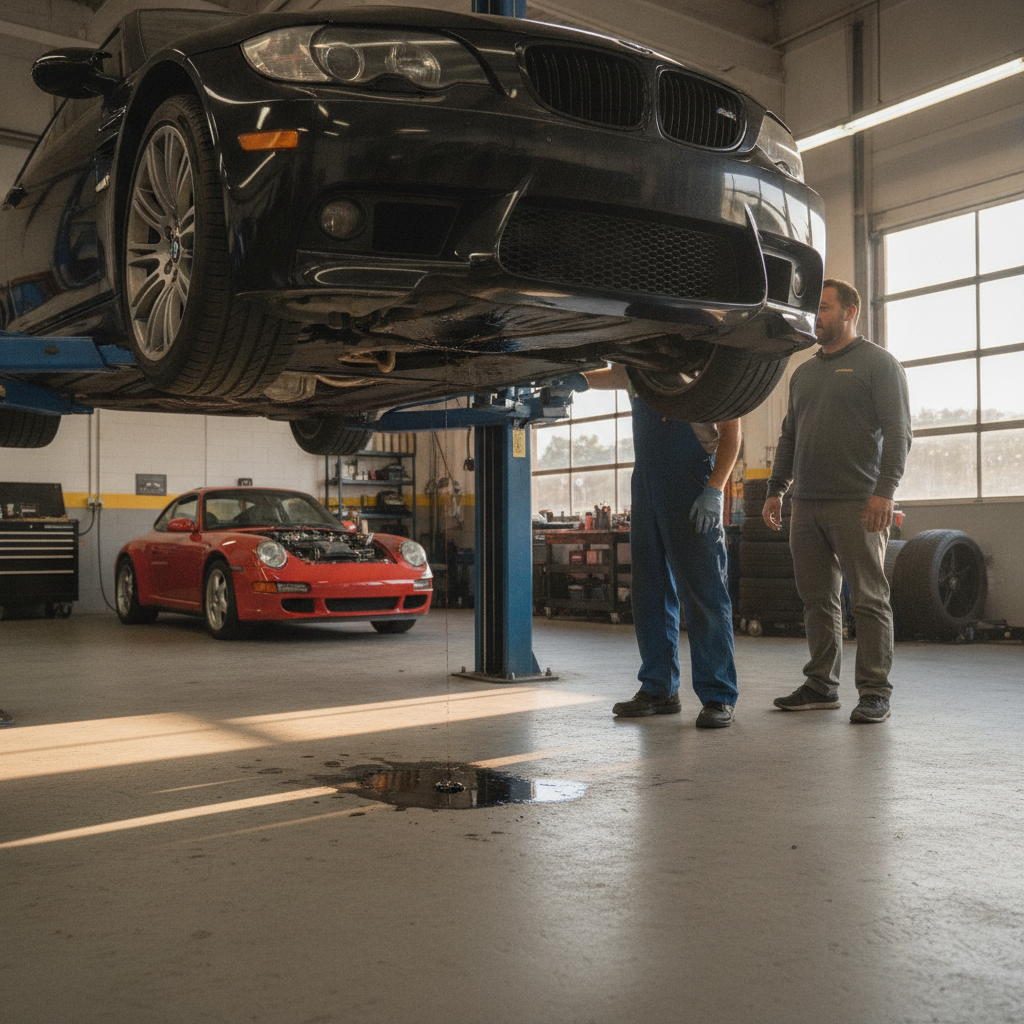
Why Is My Porsche or BMW’s Oil Leaking in Petaluma — and What Does an Oil Filter Housing Gasket Replacement Actually Fix?
If you’re parking your BMW or Porsche in Petaluma and noticing a dark spot on the driveway, or catching a faint burning oil smell after a drive up Highway 101 or along the two-lane stretch of Highway 116, you’re dealing with one of the most common — and most frequently misunderstood — failure points on German engines: the oil filter housing gasket. It’s not dramatic. It won’t leave your engine seized on the side of the road today. But left alone, a weeping oil filter housing gasket quietly drips onto hot exhaust components, migrates toward belt-driven accessories, and sets the stage for repairs that cost three to five times more than the gasket job itself. Here’s what’s actually happening, what a proper repair involves, and why the fix matters more than the price tag.
What Is the Oil Filter Housing Gasket — and Why Does It Fail?
On BMW’s inline-six and four-cylinder platforms — including the N52, N54, N55, and the earlier M54 — the oil filter housing is a plastic or aluminum module mounted directly to the engine block. It houses the oil filter element, integrates with the oil cooler circuit, and connects to the engine’s lubrication passages. The gasket sealing that housing to the block is made of rubber, and rubber does exactly one thing over time in a hot engine bay: it hardens, shrinks, and cracks.
BMW’s engineering team placed this component near the top of the engine, which means when the gasket fails — and on N52 and M54 engines, it’s rarely a question of if but when — oil doesn’t puddle harmlessly in a drip tray. It runs down the side of the block, onto the front accessory belt, and in some cases directly onto the exhaust manifold or oxygen sensors. A gasket that costs a fraction of a labor bill can cascade into belt replacement, idler pulley replacement, O2 sensor replacement, and in worst-case scenarios, a fire risk from oil mist contacting hot exhaust surfaces.
On Porsche, the failure points are slightly different depending on platform. The Boxster and 911 air-cooled and early water-cooled variants have their own documented oil leak signatures — RMS (rear main seal) leaks being the most discussed — but on the Cayenne V8 and Panamera, the oil separator and valve cover gaskets are the more common culprits that get confused with housing leaks during diagnosis. Knowing which seal is actually leaking requires more than a visual inspection from below. It requires factory-grade diagnostic access and, often, a UV dye leak test to trace the exact origin.
Why Sonoma County’s Climate Accelerates This Failure
Sonoma County’s summer heat — and it gets genuinely hot in inland areas like Petaluma’s eastern neighborhoods, Rohnert Park, and the Santa Rosa plain — is hard on engine bay rubber. When ambient temperatures push into the upper 90s during peak summer and your N55 is idling in stop-and-go traffic on southbound 101 toward Marin County, under-hood temperatures can exceed 240 degrees Fahrenheit. Thermal cycling — heat soak followed by cool-down — is the primary mechanism that degrades oil filter housing gaskets, valve cover gaskets, and every other rubber engine seal.
Vehicles that spend time on hilly terrain in areas like the Sonoma Valley, driving Highway 12 between Sonoma and Santa Rosa, or climbing regularly into the higher elevations near Kenwood and Glen Ellen, run their cooling systems and engines harder than flat-highway driving. That sustained thermal load compounds the degradation. If your BMW is sitting between 80,000 and 120,000 miles, the oil filter housing gasket isn’t a question — it’s a maintenance item waiting to be addressed.
What a Proper Oil Filter Housing Gasket Service Actually Includes
This is where the gap between a proper repair and a patch job becomes significant. On most N52 and N54 BMW applications, accessing and properly replacing the oil filter housing gasket isn’t a quick turn-and-torque job. The housing itself often needs to be fully removed, which means draining oil, disconnecting coolant lines if an integrated oil cooler is present, unbolting accessory components for clearance, and carefully cleaning the mating surface on the block before the new gasket seats properly.
A shop that replaces only the gasket without inspecting the housing for warping, checking the oil cooler O-rings, and verifying the condition of nearby seals is setting you up for a comeback. At Bavarian Performance in Santa Rosa, every oil filter housing gasket replacement includes inspection of adjacent seals — valve cover gasket, oil pressure sender, and coolant lines that share the same service access — because the labor overlap makes addressing them simultaneously far more cost-effective than returning for each one separately.
OEM or genuine-spec gaskets are non-negotiable here. Aftermarket rubber gaskets sourced from overseas distributors are widely available and substantially cheaper, but the durometer (hardness rating) of the rubber compound and the dimensional tolerances matter enormously on a pressurized lubrication circuit. A gasket that’s even marginally off-spec will weep at higher oil temperatures — which is exactly the operating condition that matters most. Proper engine repair on European vehicles always starts with spec-correct parts, not just available parts.
How to Know It’s the Oil Filter Housing Gasket — and Not Something Else
Generic OBD-II scanners won’t tell you this is happening. Oil leaks don’t generate fault codes — they generate symptoms that require physical inspection and, often, a UV dye trace. What you’ll typically notice first:
- A burning oil smell from the engine bay, especially after the engine reaches operating temperature
- A visible brown or black residue on the front of the engine block, typically below the oil filter housing on BMW inline-six and four-cylinder engines
- Oil on the accessory belt or pulley surfaces — which also produces a squealing noise under load
- A slow but consistent decline in oil level between changes, without any visible external puddle on the ground
- On Porsche Cayenne applications, oil mist accumulation around the engine’s lower valley or near the firewall
If your BMW or Porsche is showing any of these signs and you’re based in Petaluma, Sebastopol, or anywhere in western Sonoma County, having it properly diagnosed before additional miles accumulate is the right move. Factory-grade diagnostic equipment — the kind that reads BMW’s ISTA system and Porsche’s PIWIS platform — gives a shop access to real-time oil pressure data and historical fault logging that helps differentiate between a gasket leak, a PCV system failure, or a more serious internal oil consumption issue.
Why This Repair Gets Overlooked at General Repair Shops
Most general repair shops in the North Bay are capable of identifying a major oil leak, but the nuance of European engine architecture — specifically, knowing which of six possible leak sources on an N54 is actually the origin, and understanding how BMW’s integrated oil cooler circuit complicates the repair — is where specialist training separates a clean fix from a recurring problem. Many local BMW and Porsche owners in Sonoma County have experienced the frustrating cycle of bringing a vehicle in for an oil leak, having one seal replaced, and returning weeks later because the adjacent gasket was never addressed.
That’s not incompetence — it’s the difference between a technician who has completed factory training on these specific platforms and one who is working from a generic repair manual. BMW repair at a specialist level means understanding how these systems interact, not just what the leak looks like from below.
Frequently Asked Questions
How urgent is an oil filter housing gasket leak on a BMW?
It depends on severity. A seeping gasket that produces a faint smell and slow oil consumption can typically be addressed at your next service interval without immediate risk. A leak that’s saturating the accessory belt or dripping onto exhaust components should be addressed within days, not weeks — both for fire risk and to avoid secondary damage to belts, sensors, and pulleys.
Can I drive my Porsche or BMW with a minor oil leak?
Short distances, yes — provided you’re monitoring oil level closely and the leak isn’t contacting hot exhaust or belt surfaces. Long Highway 101 commutes from Petaluma toward Marin County or across to Napa County are a different story. Sustained high-speed driving increases oil temperature and pressure, which accelerates leak rate. Always top off oil before a longer drive and address the repair promptly.
Is the oil filter housing gasket covered under any warranty?
On newer vehicles still under factory or CPO warranty, yes — visit a dealer. On out-of-warranty vehicles, which represent the majority of 5-to-15-year-old BMWs and Porsches in Sonoma County, this is a maintenance cost. Some extended warranty policies cover it; check your contract language for “seals and gaskets” inclusion.
What other gaskets should be replaced at the same time?
On BMW N52 and N54 applications, the valve cover gasket and oil cap O-ring are frequently serviced simultaneously due to labor overlap. On Porsche Cayenne V8 applications, the valley pan gasket and oil separator are worth inspecting if they haven’t been recently addressed. Your technician should give you a clear picture of what’s accessible during the job before you approve the work.
Does Bavarian Performance use OEM parts for gasket replacement?
Yes. For sealing components — gaskets, O-rings, seals — OEM or genuine-spec parts are standard practice. The cost difference between an OEM gasket and a premium aftermarket alternative is minor relative to the labor involved, and the failure risk with off-spec rubber compounds simply isn’t worth it on a pressurized lubrication system.
Get Your Oil Leak Diagnosed Correctly the First Time
If your BMW or Porsche is showing signs of an oil leak anywhere in Sonoma County — whether you’re in Petaluma, Windsor, Rohnert Park, or closer to Santa Rosa — Bavarian Performance has the factory-trained technicians, the manufacturer-grade diagnostic equipment, and the OEM parts inventory to handle it properly. We work on BMWs and Porsches daily, which means we’ve seen every variation of this failure and know how to address it without leaving the adjacent seals for your next visit.
Don’t let a manageable gasket job turn into a belt replacement, a sensor replacement, or worse. Contact Bavarian Performance to schedule an inspection — we’ll give you a straight assessment of what’s leaking, what else is worth addressing while we’re in there, and what it’s going to take to fix it right.