
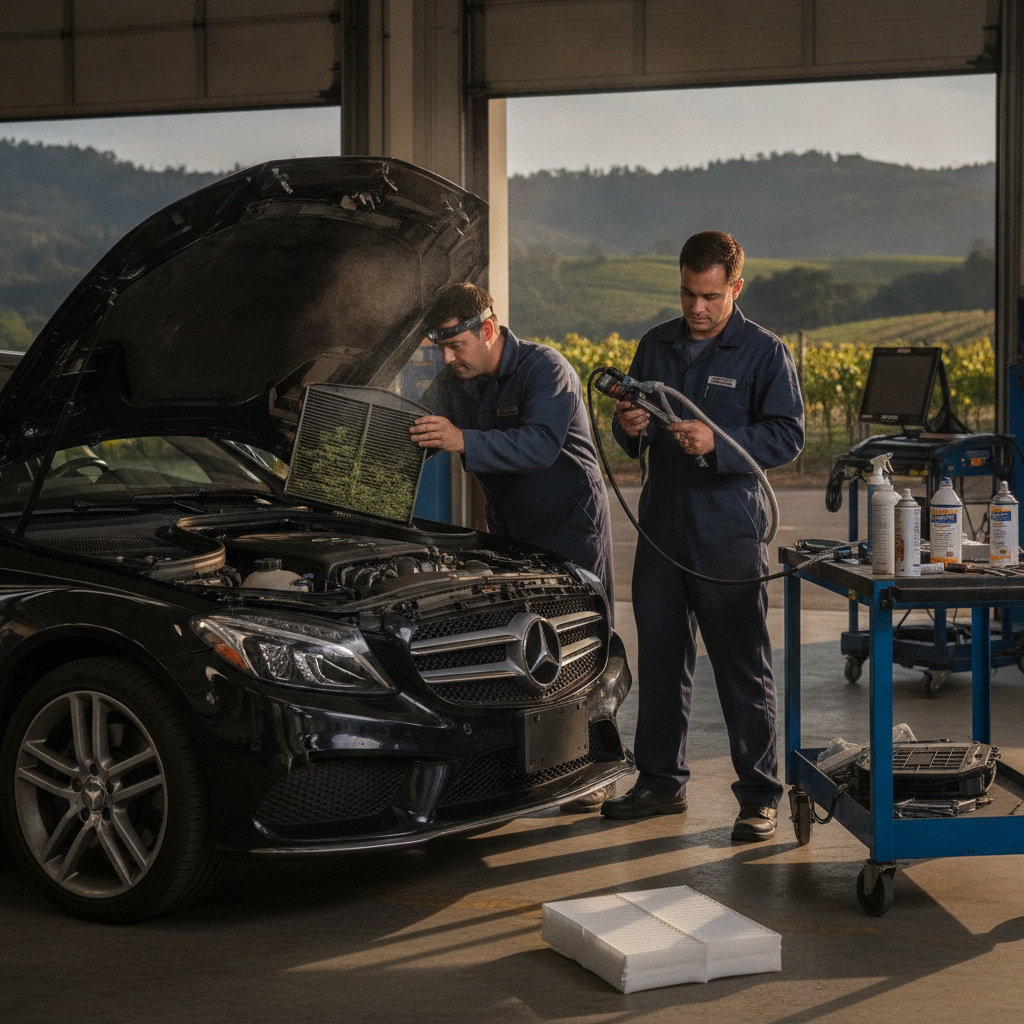
Why Is My Mercedes-Benz or BMW’s Cabin Smelling Like Mildew in Sebastopol — and What Does a Cabin Air Filter and HVAC Service Actually Fix?
That musty, locker-room smell rolling out of your vents when you turn on the A/C is one of the most common complaints we hear from Mercedes-Benz and BMW owners driving through Sebastopol and West Sonoma County — and it’s almost never solved by swapping the cabin air filter alone. The filter is part of the answer. The evaporator core, the drain line, and the way your climate control system manages moisture are the rest of it. Here’s what’s actually happening inside your HVAC system, why the coastal fog belt from Bodega Bay through Forestville and Graton makes this problem worse for local drivers, and what a proper service involves.
Where the Smell Is Actually Coming From
Your HVAC evaporator core sits inside the dash, usually behind the glovebox or center console depending on the platform. When your air conditioning runs, the evaporator gets cold, air passes over it, and moisture condenses on the core’s fins — exactly like condensation on a cold glass. That moisture is supposed to drain out through a small rubber drain tube routed through the firewall and onto the ground beneath the car.
When that drain gets partially blocked — by debris, organic material, or years of accumulated particulate — water sits on the evaporator. Add a saturated cabin air filter that’s never been replaced, a dark enclosed housing with no airflow, and the persistent moisture of West County fog, and you have a textbook environment for mold and mildew growth. Every time you switch on the fan, you’re blowing air directly over that colony and into the cabin.
On BMW platforms — particularly E90-generation 3 Series, F10 5 Series, and the G-chassis cars — the evaporator housing and drain routing are known to trap debris more readily than some competitors. Mercedes-Benz W205 C-Class and W213 E-Class owners deal with similar evaporator drain issues, and the microfilter housing on these cars is tucked under the cowl cover, making it easy to defer and easy to miss on a cursory inspection.
Why Sebastopol and West County Drivers See This More Often
This isn’t a coincidence. The stretch from Sebastopol west through Graton, Forestville, Occidental, and out toward Bodega Bay sits in a coastal fog corridor that keeps ambient humidity elevated for much of the year — particularly in the mornings and evenings that bookend your commute. When you start your car, run the A/C briefly, then park in a shaded driveway or garage without running the system long enough to fully cycle the evaporator dry, moisture stays on the core overnight. That cycle, repeated daily across weeks and months, is how a clean evaporator becomes a mold problem.
Wildfire smoke — which Sonoma County has dealt with significantly since the 2017 Tubbs Fire and subsequent fire seasons — compounds this. Fine ash particles are tiny enough to pass through a degraded or overdue cabin filter, and they carry organic compounds that accelerate microbial growth when they settle on a damp evaporator surface. If you were driving in the area during any recent smoke events and haven’t had your cabin filter and evaporator housing inspected since, that history matters.
What a Proper HVAC and Cabin Air Filter Service Actually Covers
A complete service is more than pulling the old filter and dropping in a new one. Here’s what it should include on a Mercedes-Benz or BMW:
- Cabin air filter replacement with a genuine OEM or OEM-equivalent microfilter — not a cheap aftermarket unit. On BMW and Mercedes platforms, the filter housing geometry and seal quality matter. A loose-fitting aftermarket filter bypasses unfiltered air around the element and defeats the purpose entirely.
- Evaporator drain line inspection and flush — clearing any blockage so condensation exits the vehicle instead of pooling.
- Evaporator housing inspection — looking for visible mold growth, accumulated organic debris, or evidence of standing water on the fins.
- Evaporator and housing treatment — applying an antimicrobial evaporator treatment through the intake or housing to address existing mold and inhibit regrowth. This step is skipped at most quick-service shops and by most DIYers because it requires access to the housing, not just the filter slot.
- Cowl drain and intake screen inspection — the external air intake at the base of the windshield is where leaves, pine needles, and vineyard dust enter. If that screen is packed with debris, you’re reseeding the problem every time it rains.
In more severe cases — particularly on vehicles that have sat for extended periods or show heavy evaporator contamination — the evaporator housing may need to be partially disassembled for a thorough cleaning. On certain BMW platforms, this is a labor-intensive job that involves removing significant dash components. It’s worth knowing upfront rather than discovering after a filter swap doesn’t solve the smell.
What Generic Shops and DIY Approaches Usually Miss
This is the gap that most competitors in the area aren’t addressing in their service content: the difference between replacing the cabin filter — a fifteen-minute job — and actually resolving the HVAC odor problem at its source. Changing the filter on a system with an active mold colony in the evaporator housing is like changing a furnace filter without cleaning the ducts. The smell returns within weeks, sometimes days, because you’ve addressed the symptom without touching the cause.
Generic OBD-II scan tools are irrelevant here — this is a mechanical and biological problem, not a fault code. But factory-level access to your vehicle’s climate control system does matter when resetting or recalibrating automatic climate systems after service, particularly on Mercedes-Benz THERMOTRONIC or BMW’s automatic climate systems, which store operational parameters that can affect how aggressively the system runs the after-cooling cycle designed to dry the evaporator at shutdown.
That after-cooling cycle — standard on many current BMW and Mercedes platforms — runs the blower briefly after engine-off to push residual moisture off the evaporator. If that function has been inadvertently disabled or has a fault, you’ll fight this problem repeatedly. Diagnosing that requires factory-grade software, not a generic reader.
How Often Should This Service Be Done?
Most European manufacturers specify cabin filter replacement at 12-month or 15,000-mile intervals, whichever comes first. In practice, drivers in West County, along the River Road corridor, or near Bodega Bay — where airborne pollen, coastal particulate, and agricultural dust are elevated — often see the filter saturate faster than that. If you’re overdue, or if you can’t remember the last time it was done, that’s the answer.
As part of a broader preventative maintenance service, cabin filter inspection should happen at every major service interval — not as an afterthought. A tech who pulls the filter and shows you what it looks like is doing their job. One who replaces it without inspecting the housing and drain isn’t finishing the job.
Is This Covered Under Any Warranty?
Cabin air filters and evaporator treatments are considered maintenance items, so they’re not covered under manufacturer powertrain warranties. If your car is still within a CPO warranty from a Mercedes-Benz or BMW dealer, it’s worth confirming what’s included — but in most cases, this is an out-of-pocket service. The good news is that it’s not an expensive job when caught early. Waiting until the evaporator requires disassembly is when costs climb significantly.
Frequently Asked Questions
Can I fix the mildew smell myself with a can of A/C cleaner from an auto parts store?
Aerosol evaporator treatments applied through the intake vent can help with mild cases, but they don’t address a blocked drain, a saturated filter, or heavy mold growth inside the housing. They’re a partial measure at best and will mask the symptom without resolving the underlying condition.
Why does the smell only happen when I first turn on the A/C?
That’s the most concentrated blast of air moving over the evaporator and filter housing at startup. Once the system is running and airflow is consistent, the smell dilutes. It’s not a sign the problem is mild — it’s just the nature of how the air moves through the system.
My BMW’s climate control resets after service — is that normal?
Some BMW automatic climate systems retain learned parameters that may require resetting via ISTA after certain service procedures, particularly if components near the HVAC module are disturbed. This is one reason having a specialist with factory-level diagnostic capability matters even for what seems like a simple maintenance job.
How long does a full HVAC and cabin filter service take?
A thorough service — filter replacement, drain flush, housing inspection, and evaporator treatment — typically takes one to two hours depending on the platform. A BMW that requires cowl cover removal for proper filter access takes longer than a Mercedes where the housing is more accessible.
I’m in Forestville or Occidental — do I need to drive to Santa Rosa for this?
Bavarian Performance is located in Santa Rosa and serves the full West County area including Sebastopol, Forestville, Graton, and Occidental. The drive is straightforward and the service is worth doing once, correctly, rather than treating the symptom repeatedly.
Get It Resolved at the Source
If your Mercedes-Benz or BMW cabin smells like mildew and a previous filter swap didn’t fix it, the evaporator housing and drain line are the next step — not another filter. At Bavarian Performance in Santa Rosa, we service the full HVAC system on European vehicles the right way, with genuine OEM-quality parts and the factory-level tools to diagnose anything beyond the obvious. Owners throughout Sebastopol, Graton, Forestville, Occidental, and across West Sonoma County trust us for exactly this kind of work — jobs that look simple on the surface but require the right knowledge to actually resolve.
Ready to get your cabin air quality back to where it should be? Contact Bavarian Performance to schedule a service appointment or ask us what a full HVAC inspection involves for your specific vehicle.