
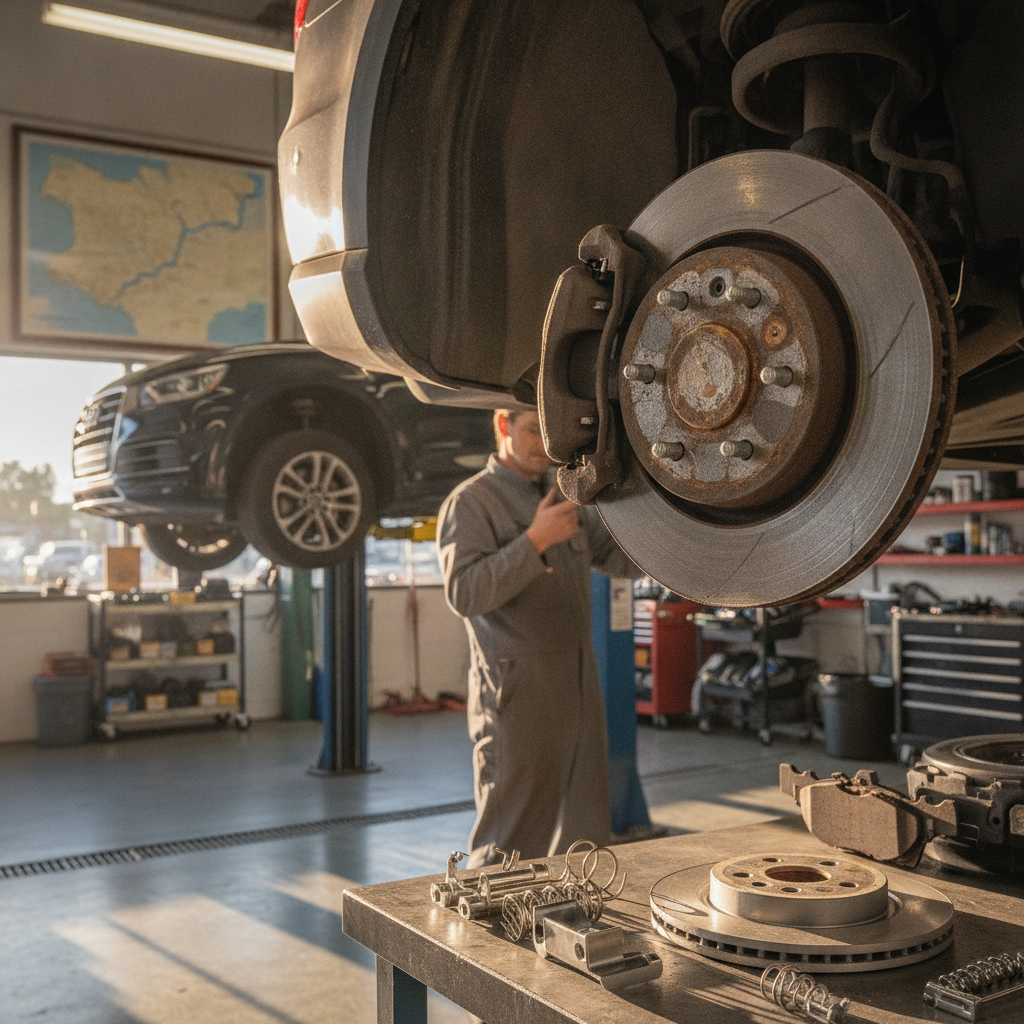
Why Are My Mercedes-Benz or Audi’s Brakes Grinding After Driving Coastal Roads Near Bodega Bay — and What Does Brake Hardware Corrosion Actually Do?
If your Mercedes-Benz or Audi is grinding, pulsating, or pulling to one side after a run along Highway 1 or through West County, brake hardware corrosion is almost certainly involved — and it goes well beyond surface rust on a rotor face. The coastal fog and salt air that blanket the Bodega Bay corridor and push inland through Occidental, Forestville, and Sebastopol create an aggressively corrosive environment for European brake systems. At Bavarian Performance in Santa Rosa, this is one of the most underdiagnosed brake failure patterns we see from West County drivers, and it’s one that generic repair shops almost universally mishandle.
What Coastal Driving Actually Does to European Brake Hardware
European vehicles — especially Mercedes-Benz, Audi, and Volkswagen — use brake system designs that are engineered for precision, not necessarily for prolonged salt-air exposure. The hardware that holds your brake pads in place (carrier brackets, abutment clips, and slide pins) is typically made from coated steel or aluminum alloy. These components are designed to allow controlled, even movement of the pad against the rotor face during every brake application. When salt-laden moisture from the Bodega Bay fog belt gets into these contact points, it doesn’t just cause surface rust — it bonds those components together.
The result is a stuck or sluggishly moving pad that drags against the rotor rather than releasing cleanly. You’ll feel this as a pulling sensation, uneven brake pedal pressure, or a grinding noise that shows up even when you haven’t worn your pads down significantly. Left uncorrected, a single seized slide pin on a front caliper can destroy a rotor in a matter of weeks — and in a vehicle like an Audi A6 or Mercedes-Benz E-Class, that’s an expensive lesson.
Caliper Slide Pins: The Hardware Most Shops Overlook
This is the specific gap that most local competitors don’t address in their content or, frankly, in their service process: caliper slide pin service is not optional on European vehicles driven in coastal Sonoma County. Slide pins are the cylindrical guides that allow the caliper body to float and apply equal pressure to both sides of the rotor. They live inside rubber boots, lubricated with a high-temperature, water-resistant grease. In a dry inland climate, those boots stay intact for a long time. In the fog and salt air that rolls in from the Pacific along the River Road and Highway 116 corridor toward Guerneville and Graton, those boots degrade faster, moisture gets in, and the pins corrode inside their bores.
On a Mercedes-Benz equipped with its four-piston front calipers — common across the C-Class, E-Class, and GLE — seized slide pins create a particularly insidious failure mode. The outer pad wears at a completely different rate than the inner pad, and because the wear sensor is often only on one side, you can get a full brake failure warning long after the rotor has already been damaged. On an Audi with its aluminum caliper carriers, corrosion between the steel hardware and the aluminum bracket creates galvanic corrosion — two dissimilar metals exchanging electrons in the presence of salt moisture — that can seize hardware so thoroughly it requires machine work to remove cleanly.
What a Proper European Brake Hardware Service Includes
A real brake service on a West County-driven European vehicle isn’t just swapping pads and rotors. When you bring your car to a specialist who understands how these systems are engineered, the service should include:
- Full hardware replacement: Abutment clips, anti-rattle springs, and pad retainer hardware should be replaced every brake service — not cleaned and reused. OEM or OEM-equivalent hardware ensures the correct spring tension and pad float are restored.
- Slide pin inspection and service: Pins are removed, inspected for pitting and corrosion, cleaned or replaced as needed, and reinstalled with fresh manufacturer-specified grease. Boots are replaced if cracked or torn.
- Caliper bore inspection: On high-mileage or coastal-driven vehicles, the caliper piston bore should be inspected for pitting. A corroded bore will tear a new piston seal and cause a slow brake fluid leak within months of a pad change.
- Rotor inspection beyond thickness: Lateral runout measurement and a check for hard spots or heat cracks matters more on a vehicle that’s been running a dragging pad. Rotors that have been cooked unevenly will cause pedal pulsation even if they still meet minimum thickness spec.
- Brake fluid condition check: Salt air environments accelerate moisture absorption in brake fluid. Hygroscopic fluid with elevated water content lowers your boiling point — relevant when you’re descending into Sebastopol from the hills above Graton on a warm afternoon.
This level of detail is what separates a factory-trained European specialist from a general shop working off a flat-rate pad-and-rotor estimate. Bavarian Performance’s brake service covers all of these inspection points as standard procedure — not as upsell line items.
Mercedes-Benz and Audi Brake Systems: Brand-Specific Considerations
Mercedes-Benz vehicles — particularly those with AMG brake packages or the larger four-piston front calipers — use a floating caliper design with a very specific hardware kit that is not interchangeable with generic aftermarket clips. Using the wrong abutment clip geometry on an E350 or GLE 450 means the pad sits at a fractionally wrong angle, and over time you’ll see an edge-wear pattern that accelerates pad and rotor wear together. OEM hardware from Mercedes is not extravagant — it’s just the right part.
Audi’s S-line and S-model brake packages introduce larger-diameter rotors with vane geometries that are particularly sensitive to thermal distortion from dragging pads. An S4 or A5 that’s been driven regularly to Bodega Bay for weekend visits and back through Petaluma on Highway 101 is working its brakes hard in both directions — coastal corrosion on the way there, highway heat cycling on the way back. That combination is a reliable recipe for warped rotors within a year if the slide pin hardware isn’t maintained properly.
How to Know If Corrosion Is Already Affecting Your Brakes
You don’t need a warning light to catch this early. Watch for these signs after driving the coastal route:
- A grinding or scraping noise when braking that wasn’t present before your West County trip
- The car pulling to one side under moderate braking
- A burning smell after normal driving — not just after aggressive stops
- One wheel that feels noticeably hotter than the others after a drive (use your hand carefully near — not on — the wheel)
- Brake pedal vibration or pulsation that develops over several weeks rather than suddenly
Any of these symptoms warrants a proper inspection, not just a visual check through the wheel spokes. A multi-point inspection that includes brake caliper and hardware assessment will tell you definitively what’s happening before a seized pin turns into a rotor replacement.
Frequently Asked Questions
Does coastal driving in Sonoma County really cause brake problems faster than normal?
Yes — significantly faster. The combination of salt-laden marine fog, moisture cycling through the night-to-day temperature swings in West County, and infrequent use patterns (weekend drives rather than daily commuting) means hardware sits in a corroded state between uses rather than cycling through the self-cleaning motion of daily braking. Vehicles driven regularly to Bodega Bay, Occidental, or Guerneville typically need brake hardware attention 20–40% sooner than their inland equivalents.
Can I just clean and regrease the old slide pins instead of replacing them?
On a vehicle with low mileage and no visible pitting, cleaning and regrease is acceptable. On any vehicle driven regularly in coastal conditions with more than 40,000 miles, replacement is the right call. Pitted pin bores allow water to re-enter almost immediately, and the cost difference between cleaning and replacing a slide pin kit is minimal compared to a caliper or rotor replacement down the line.
Does Mercedes-Benz’s brake pad wear sensor give me enough warning to avoid rotor damage?
Only if the wear is even. When corrosion causes one pad to drag and wear faster than the others, the sensor may not trigger until the damaged pad is already metal-on-metal — because the other pads still have material. This is exactly why mileage-based inspection intervals matter more than warning-light-based service on European vehicles.
Is aftermarket brake hardware acceptable, or does it have to be OEM?
For abutment clips and hardware kits, OEM or OEM-equivalent hardware from a reputable supplier (Brembo, ATE, Ate, or Bosch for most German makes) is perfectly acceptable and what Bavarian Performance uses as standard. Genuine Mercedes-Benz or Audi hardware is always an option if you prefer it. What matters most is that the spring tension, coating, and geometry match factory spec — which generic economy-grade hardware often does not.
How often should I have brake hardware inspected if I drive Highway 1 or the coast regularly?
At minimum, every brake pad service — and we’d recommend a visual caliper and hardware inspection every 12 months or 15,000 miles if coastal driving is a regular part of your routine. Catching a degraded boot or a stiff pin early is a thirty-minute job. Catching it after it’s seized and damaged a rotor is a two-hour job with significantly higher parts costs.
Brake Corrosion Isn’t Just a Cosmetic Problem — Get It Checked
If you drive a Mercedes-Benz, Audi, or any European vehicle through West County on a regular basis, your brake hardware is working harder than you think — and most shops in Sonoma County aren’t inspecting it with the thoroughness these vehicles require. At Bavarian Performance in Santa Rosa, we service European brake systems the way the factory intended: with the right hardware, the right tools, and the diagnostic knowledge to catch corrosion-related failures before they become expensive ones.
If you’ve noticed any of the symptoms described above — or if you simply haven’t had your brake hardware properly inspected in the last year — reach out to us to schedule an appointment. We serve drivers throughout Santa Rosa, Sebastopol, Occidental, Forestville, Graton, Petaluma, and across Sonoma County. Don’t wait for a warning light to tell you what a seized slide pin has been doing to your rotors for the past three months.