
Why Is My Audi or BMW’s Engine Misfiring in Sonoma — and What Does Direct Injection Carbon Buildup Actually Do to Performance?
If your Audi or BMW has been idling roughly, hesitating when you accelerate out of a roundabout in Sonoma, or throwing misfire codes that keep coming back even after new spark plugs, the problem likely isn’t the ignition system at all. It’s almost certainly carbon buildup on the intake valves — a well-documented and unavoidable consequence of gasoline direct injection (GDI) engines that affects virtually every Audi 2.0T TFSI and BMW N20, N55, or B58 on the road today. Here’s what’s actually happening inside your engine, why it gets worse under driving conditions common throughout Sonoma County’s Wine Country, and what a proper intake valve cleaning service actually does to restore performance.
The Direct Injection Problem That Every BMW and Audi Owner Should Understand
In a traditional port-injected engine, fuel is sprayed upstream of the intake valve. That constant fuel wash keeps oil vapors and combustion byproducts from accumulating on the valve face. In a direct-injection engine — which includes every modern Audi TFSI, every BMW with the N20, N55, or B58, and a wide range of Volkswagen TSI applications — fuel is injected directly into the combustion chamber, bypassing the intake valve entirely.
That sounds like a performance advantage, and it is. Direct injection allows for better fuel atomization, higher compression ratios, and improved thermal efficiency. But the intake valves are now on their own. The only thing passing over them is air, blow-by gases from the crankcase ventilation system, and trace amounts of oil vapor. Over tens of thousands of miles, those vapors bake onto the valve face and stem, building up a hardened carbon crust that disrupts airflow, reduces valve seating efficiency, and eventually causes rough idle, partial misfires, and hesitation under load.
By 60,000 to 80,000 miles on most direct-injection BMWs and Audis, this buildup is significant enough to affect engine behavior. On some 2.0T TFSI engines with known PCV system weaknesses, you may see symptoms as early as 40,000 miles — especially if the vehicle has spent time sitting, doing lots of short-trip driving, or running in stop-and-go traffic on Highway 101.
Why Sonoma County Driving Conditions Accelerate the Problem
Carbon buildup isn’t unique to any region, but certain driving patterns make it worse faster — and Sonoma County has several of them working against you simultaneously.
Short-trip driving is one of the worst contributors. If your Audi A4 or BMW 3 Series spends most of its time on runs between downtown Sonoma and the Highway 12 corridor without fully reaching operating temperature, the crankcase ventilation system produces more oil vapor per mile and deposits it more aggressively on the valve faces. The engine never fully burns off those deposits the way sustained highway driving would.
Vineyard dust and particulates from rural roads — River Road, Westside Road, the back routes through Kenwood — also put additional strain on intake air filtration. A partially clogged air filter increases intake vacuum, which can draw more blow-by vapor through the PCV system and accelerate deposit formation. And if you’ve noticed your cabin air filter getting loaded up faster after wildfire smoke seasons in the Santa Rosa area, the same dynamic affects your engine air filter on bad air quality days.
Hot, dry summers — which Santa Rosa and Sonoma see consistently from June through October — raise underhood temperatures and bake those carbon deposits harder and faster. A BMW N20 sitting in Wine Country traffic on a 95-degree afternoon is doing far more damage to its intake valves per idle hour than the same engine would in a cooler, maritime climate.
What Symptoms Actually Look Like — and What Gets Misdiagnosed
Carbon buildup on intake valves produces symptoms that are easy to misread. The most common presentation is a rough idle that comes and goes — sometimes only when the engine is cold, sometimes only under load. You might also notice:
- Hesitation or stumbling on light acceleration from a stop
- Occasional misfire codes (P030X series) that return after coils and plugs are replaced
- A slight drop in fuel economy over time with no obvious cause
- Cold-start roughness that clears up after a few minutes of driving
- A faint smell of unburned fuel at startup
What makes this particularly frustrating is that a generic OBD-II scanner will log the misfire codes but can’t tell you why those cylinders are misfiring. Shops without factory-level diagnostic capability may replace coil packs, spark plugs, or injectors — none of which address the root cause. If the misfires keep coming back after a tune-up, intake valve carbon is almost always what you’re dealing with on a direct-injection European engine with more than 50,000 miles.
At Bavarian Performance, factory-grade diagnostic tools allow us to look at fuel trim data, misfire patterns across individual cylinders, and intake manifold pressure readings that together point directly to carbon restriction — before we ever pull an intake manifold bolt. That kind of precision matters when you’re deciding whether to approve a service that involves significant disassembly. You can learn more about our engine repair services in Santa Rosa and the diagnostic depth we bring to every job.
What Walnut Blasting Actually Does — and Why It Works
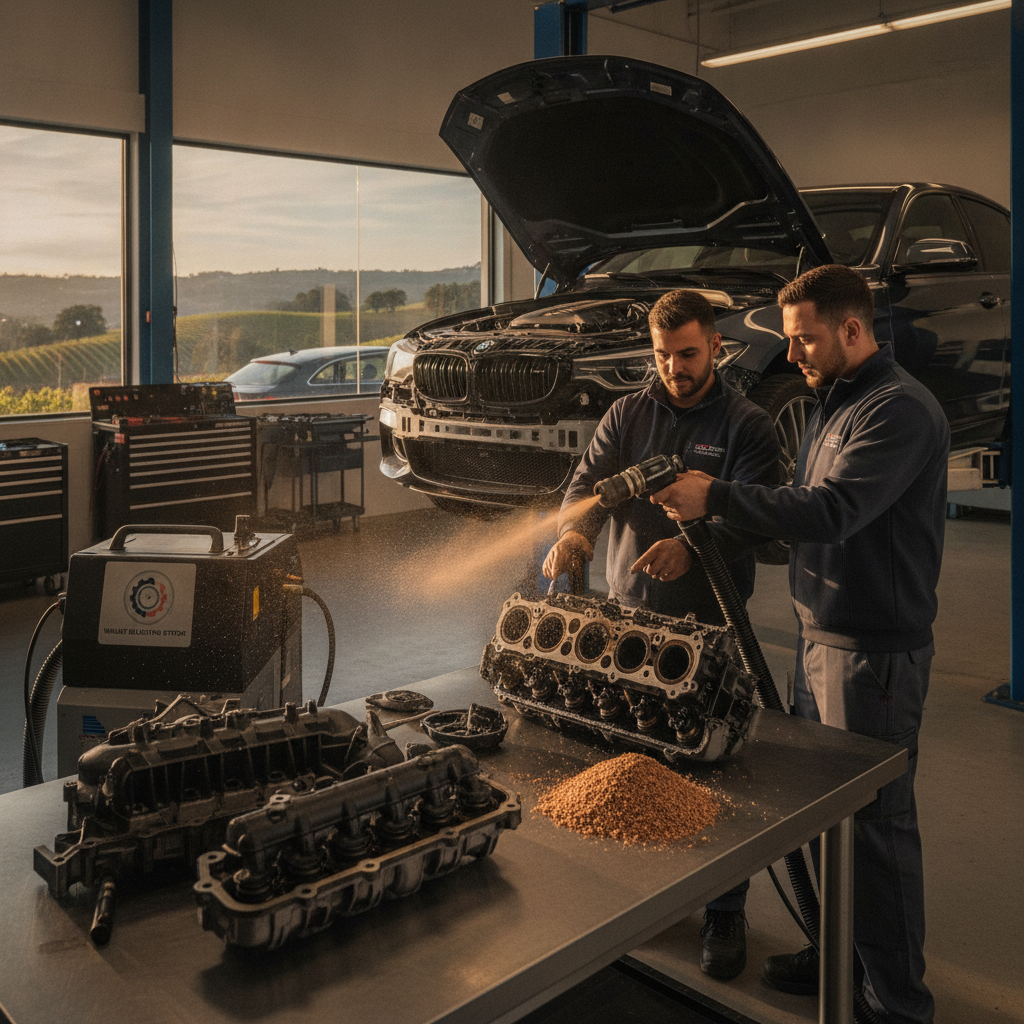
The only reliable solution for hardened carbon deposits on intake valves is walnut shell blasting — a media-blasting process performed with the intake manifold removed and a vacuum system isolating each intake port. Crushed walnut shell media is propelled into each port at pressure, aggressively stripping carbon from the valve face and stem without scratching or damaging the underlying metal. The walnut shell is soft enough to be harmless to aluminum valve surfaces but abrasive enough to remove even heavily baked deposits.
This is not a process you can replicate with fuel system additives, intake sprays, or chemical soaks. Those approaches can loosen surface deposits but cannot remove the hardened, layered carbon that accumulates over 60,000-plus miles on a direct-injection engine. If a shop recommends an additive as an alternative to walnut blasting, they either don’t have the equipment or aren’t being straight with you.
The correct process involves:
- Removing the intake manifold to expose all intake ports
- Rotating each valve to closed position (requires cam phasing or manual rotation)
- Blasting each port individually with walnut shell media under vacuum
- Inspecting the valve seats and port walls for secondary issues
- Cleaning the intake manifold itself, which often accumulates deposits as well
- Reassembling with new intake manifold gaskets — OEM spec, not generic replacements
On a BMW N20 or Audi 2.0T, the job typically takes three to four hours of shop time. Most owners notice an immediate improvement in idle smoothness and throttle response. The misfires stop returning. Cold-start behavior normalizes. Fuel economy often recovers to near-original levels.
How Often Does This Service Need to Be Done?
Most direct-injection BMWs and Audis benefit from their first walnut blast service between 60,000 and 80,000 miles, with repeat service every 40,000 to 50,000 miles after that — though your driving pattern matters. If you’re doing a lot of short-trip or city driving around Petaluma or Healdsburg, you may need it closer to the 50,000-mile mark. Highway-dominant drivers often make it to 80,000 miles without significant symptoms.
Some Audi B8 and B8.5 A4/A5 owners with the EA888 Gen 1 or Gen 2 2.0T engine have reported symptoms as early as 40,000 miles due to a less-than-ideal PCV calibration. If your Audi is in that range and you’re experiencing rough idle or hesitation, it’s worth having the intake inspected before assuming you need other work done.
Consistent preventative maintenance — including timely oil changes with the correct oil specification — reduces the rate of deposit formation. BMW and Audi spec low-ash oils for a reason: high-ash conventional or mismatched synthetic oils leave more residue in the PCV circuit, which ends up exactly where you don’t want it.
Frequently Asked Questions
Does walnut blasting damage my engine’s valves or ports?
No. Walnut shell media is specifically chosen because it’s hard enough to remove carbon deposits but soft enough not to score aluminum valve faces or port walls. The process is factory-recommended by both BMW and Audi and is performed routinely on engines in excellent mechanical condition.
Can I just use a fuel injector cleaner or intake spray instead?
Fuel additives work on injectors and combustion chamber surfaces — not on intake valves, which see no fuel in a direct-injection system. Intake sprays can soften light surface deposits but won’t remove the hardened carbon layers that cause misfires and rough idle. Walnut blasting is the only reliable fix.
My BMW N55 has 90,000 miles and has never had this done. Is it too late?
It’s not too late — walnut blasting is effective even on heavily carbonized valves. You may need a second pass on severely affected ports, but the process restores function regardless of the deposit thickness. The longer you wait, the more pronounced your symptoms will be, but the fix remains the same.
Will my check engine light come back on after walnut blasting if misfires were the cause?
If the misfires were caused solely by carbon buildup on the intake valves, they should not return after a thorough cleaning. If they do, there’s a secondary issue — coil degradation, injector fault, or a mechanical concern — that warrants further diagnosis. We don’t clear codes and send you on your way; we confirm the root cause before closing the job.
Is this service available for Audi vehicles in Sonoma or do I need to go to a dealership?
Bavarian Performance performs walnut blasting and intake valve cleaning on Audi, BMW, Volkswagen, and other direct-injection European vehicles serving Sonoma, Santa Rosa, Healdsburg, Petaluma, and across Sonoma County. You do not need to go to a dealership — and independent specialist service for this type of work is typically more cost-effective without any compromise in quality or parts specification. You can explore our full Audi repair services to see the depth of what we offer.
Get Your Engine Breathing Cleanly Again
If your Audi or BMW is running rough, hesitating, or misfiring and you’re anywhere in Sonoma County — whether you’re in Sonoma, Healdsburg, Petaluma, or right here in Santa Rosa — don’t let a shop chase symptoms without looking at the intake valves first. Carbon buildup on direct-injection engines is predictable, diagnosable, and fixable. It just requires the right equipment and someone who knows what they’re looking at.
At Bavarian Performance, we’ve cleaned carbon deposits off more BMW and Audi intake valves than we can count, and we use the same factory-grade procedures and OEM-spec gaskets that the dealership uses — without the dealership markup or the two-week wait for an appointment. Contact us to schedule a diagnostic or walnut blasting service and let’s get your engine performing the way it was designed to.