
Why Is My Mercedes-Benz or BMW’s Air Conditioning Blowing Warm in Sonoma County — and What Does a Proper European AC Recharge Actually Fix?
If your BMW or Mercedes-Benz is blowing warm air on a 95-degree afternoon in Santa Rosa, the instinct is to head to the nearest shop and ask for an AC recharge. In most cases, that instinct is only half right. Yes, refrigerant may be low — but on a European vehicle, low refrigerant is a symptom, not a diagnosis. The question a properly equipped specialist asks first is: why is it low? European climate control systems are engineered to very tight tolerances, and simply topping off the refrigerant without understanding what failed upstream is how you end up back in the same situation three months later — or worse, with a seized compressor.
Sonoma County’s climate makes this particularly relevant. Hot, dry summers stress European cooling and AC systems harder than the coastal Bay Area. Fountaingrove, Oakmont, and the inland wine country corridors regularly see temperatures that push European HVAC systems to their limits — and those systems were engineered for German autobahns, not back-to-back 100-degree weekends in the Russian River Valley.
What’s Actually Happening When Your European AC Stops Cooling
BMW and Mercedes-Benz climate control systems are more complex than what you’ll find in most domestic or Japanese vehicles. They don’t just run refrigerant through a loop — they integrate multi-zone temperature management, electronically controlled expansion valves, variable displacement compressors, and on newer models, fully digital climate control modules that communicate directly with the vehicle’s DME or control network. When something goes wrong, the failure can originate from a dozen different points.
The most common causes of warm air on a BMW or Mercedes-Benz, in order of frequency at our shop, include:
- Refrigerant loss due to a slow leak — typically at the compressor shaft seal, condenser, or a service port
- Compressor clutch or variable displacement compressor failure — the compressor may spin but produce no actual compression
- Expansion valve failure — the thermal expansion valve regulates refrigerant flow into the evaporator; when it fails, the system loses its ability to properly cool
- Condenser damage — road debris, especially on Highway 101 and Highway 12 commutes, can damage the condenser fins and cause refrigerant leaks
- Blend door actuator failure — on Mercedes-Benz models especially, the blend door actuators that control hot/cold air mixing are known to fail, producing warm air even when the AC system itself is functioning
- Climate control module or sensor faults — BMW’s IHKA (Integrated Heating and Air Conditioning) system relies on ambient temperature sensors, evaporator temperature sensors, and interior sun load sensors; a failed sensor can cause the system to modulate poorly
A generic AC recharge addresses only the first item on that list — and only partially, because it doesn’t identify or repair the source of the leak. Every other failure mode requires proper diagnosis before any refrigerant touches the system.
Why the Refrigerant Type Matters More Than Most Shops Acknowledge
Newer BMW and Mercedes-Benz models — roughly 2017 and newer — use R-1234yf refrigerant rather than the older R-134a. This is not a minor detail. R-1234yf requires different service equipment, different leak detection methods, and different handling procedures. The refrigerant itself is more expensive, and the compressor oil specification is different. Shops that don’t have R-1234yf certified equipment either can’t service your vehicle properly or will attempt a workaround that voids any warranty coverage and can damage system seals.
If you’re driving a newer 5 Series, E-Class, or C-Class and a shop quotes you a standard R-134a recharge, that’s worth questioning immediately. At Bavarian Performance, we service both refrigerant types with proper recovery, evacuation, and recharge equipment — and we confirm the refrigerant specification before opening the system.
The Diagnosis Step Most Shops Skip
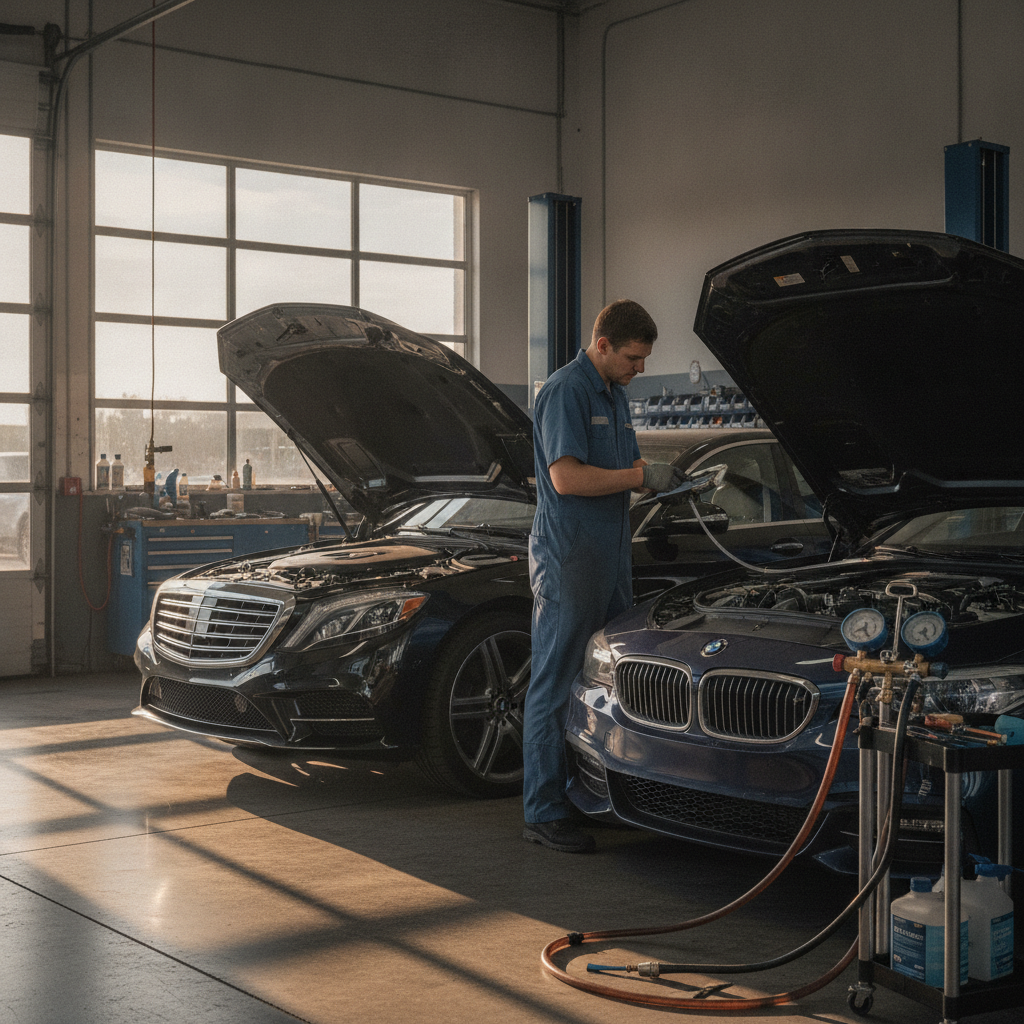
This is the gap that matters most. Before any refrigerant goes into a European AC system, a competent specialist should perform a manifold pressure test to evaluate high-side and low-side pressures, a UV dye or electronic leak detection check, a compressor output assessment, and — on BMW and Mercedes — a factory-level scan of the climate control module to identify any stored faults or sensor readings that are out of range.
That last step requires factory-grade diagnostic capability. A generic OBD-II scanner doesn’t communicate with BMW’s IHKA system or Mercedes-Benz’s climate control ECU. You need ISTA for BMW or the Mercedes-Benz diagnostic platform to read those systems properly. Without it, you’re guessing — and on a vehicle where a blend door actuator replacement on a Mercedes C-Class can run several hours of labor, guessing is expensive.
For BMW owners, it’s also worth knowing that the N20 and N55 engine families share cooling system real estate with AC components in ways that can complicate diagnosis. If your BMW has been running warmer than normal alongside an AC complaint, those two issues may be related — and separating them correctly requires someone who understands the full thermal management picture on that platform. You can read more about BMW-specific repair services at Bavarian Performance here.
How Sonoma County’s Climate Accelerates AC System Wear
The stretch from Petaluma north through Healdsburg sees temperatures that can spike dramatically between morning and afternoon, especially in late summer and early fall during fire season. That thermal cycling — cold mornings, hot afternoons — puts repeated stress on compressor shaft seals and rubber hose connections, which is where slow refrigerant leaks most commonly develop over time.
Wildfire smoke and ash, a reality for Sonoma County residents since the 2017 Tubbs Fire and subsequent fire seasons, also affects the AC system’s cabin air filtration side. A clogged cabin filter restricts airflow across the evaporator and can cause the evaporator to ice over — which produces reduced airflow and a system that seems to be underperforming even when the refrigerant charge is correct. It’s a frequently overlooked interaction that’s very relevant to vehicles driven regularly in Windsor, Healdsburg, and the inland wine country areas.
Vineyard dust on rural roads — River Road, Highway 12 west of Sonoma, and the Sebastopol backroads — also accumulates on condenser fins over time, reducing heat transfer efficiency and making the system work harder than it should. On a Mercedes-Benz with an already marginal refrigerant charge, a dust-clogged condenser can push the system over the edge into warm-air territory even if the underlying AC components are intact.
What a Proper European AC Service Actually Includes
A complete AC service on a BMW or Mercedes-Benz at Bavarian Performance involves more than a recharge. We start with a full system pressure evaluation, confirm the refrigerant specification and charge weight, perform a leak detection check, inspect the compressor, condenser, and expansion valve, check the cabin filter, and run a factory-level diagnostic scan of the climate module. Only after that assessment do we recommend and execute the repair — whether that’s a straightforward recharge, a compressor replacement, or a blend door actuator repair.
We use OEM-specified refrigerant oil and genuine or OEM-equivalent seals and components. On European AC systems, this matters — aftermarket compressor seals and expansion valves have shorter service lives and are more prone to refrigerant loss over time. Preventative maintenance that includes annual AC system checks is one of the most cost-effective ways to catch a slow leak before it becomes a compressor replacement.
Frequently Asked Questions
How often should a BMW or Mercedes-Benz AC system be serviced?
European manufacturers generally recommend an AC system check every two to three years, which includes a pressure test and cabin filter inspection. If you’re in Sonoma County, the combination of hot summers and wildfire smoke makes annual cabin filter checks particularly worthwhile.
Is it safe to drive with the AC not working?
The vehicle is drivable, but don’t ignore the underlying issue indefinitely. A refrigerant leak that goes unaddressed can eventually allow moisture into the system, which damages the compressor internally and turns what was a seal replacement into a full compressor job.
My BMW’s AC works fine in the morning but blows warm by afternoon — what does that mean?
This is a classic low-refrigerant or marginal charge symptom. As the system works harder in high ambient temperatures, a borderline refrigerant level that’s sufficient in cool conditions becomes insufficient under peak load. It’s also consistent with a failing variable displacement compressor that can’t maintain output under sustained heat.
Can a Mercedes-Benz blend door actuator failure be misdiagnosed as a refrigerant issue?
Yes, and it frequently is at shops without factory diagnostic capability. If the AC compressor is cycling correctly and pressures look normal but one zone is blowing warm, the blend door actuator is the likely culprit — not the refrigerant charge. A factory-level scan will typically show the actuator fault directly.
Does Bavarian Performance service AC systems on all European makes?
Yes. We service AC and climate control systems across the full range of European and luxury vehicles we support, including BMW, Mercedes-Benz, Audi, Porsche, Volkswagen, Mini Cooper, Land Rover, Volvo, and Italian exotics. Refrigerant type, charge weight, and component specifications are confirmed for each vehicle before any service begins.
Don’t Let a Warm AC Become a Compressor Replacement
If your BMW or Mercedes-Benz is blowing warm air this summer — whether you’re commuting through Rohnert Park, heading into Healdsburg wine country, or sitting in Oakmont traffic on a 95-degree afternoon — the right move is a proper diagnosis before any refrigerant goes in. At Bavarian Performance in Santa Rosa, we have the factory-grade equipment, refrigerant certifications, and European-specific expertise to diagnose and repair your climate control system correctly the first time.
Contact us at (707) 545-2002 or through our online contact page to schedule an AC diagnosis. We’ll tell you exactly what’s wrong, what it takes to fix it, and what you can expect — no guesswork, no unnecessary parts.