
Why Is My BMW’s or Audi’s Suspension Clunking Over Speed Bumps in Petaluma — and What Do Worn Control Arm Bushings Actually Mean?
That dull thud or sharp clunk you hear every time you roll over a speed bump on Petaluma’s D Street or navigate the uneven pavement along McDowell Boulevard isn’t just an annoyance — it’s your car’s suspension telling you something specific. On BMW and Audi platforms, the most common culprit behind that noise is worn or cracked control arm bushings. And while the sound alone is enough to send most owners searching for answers, the real problem runs deeper: degraded bushings alter your suspension geometry, accelerate tire wear, and — left long enough — begin to stress other steering and suspension components that cost considerably more to replace. Here’s what’s actually happening, what a proper inspection involves, and why this is a repair that rewards getting right the first time.
What Control Arm Bushings Actually Do — and Why German Suspension Geometry Makes Them Critical
Control arms are the rigid links that connect your front subframe to your wheel hubs, controlling how each wheel moves through its range of travel. At each mounting point, a rubber or polyurethane bushing isolates that movement from the chassis — dampening vibration, absorbing road shock, and most importantly, maintaining precise alignment geometry under dynamic loads. On a BMW 3 Series or Audi A4 with a multi-link front suspension, there are typically four to six individual bushings just in the front axle alone, each engineered to allow controlled flex within a very specific range.
When those bushings crack, collapse, or separate from their metal sleeves — which happens gradually through heat cycling, road grime, and cumulative mileage — that precision disappears. Your wheel no longer tracks exactly where the engineers intended. You get clunking under braking and acceleration. Steering feels imprecise at highway speeds. And your tires begin wearing on the inner or outer edge even though your alignment was done six months ago. That last symptom is worth paying attention to: if your tires are wearing unevenly and alignment adjustments aren’t holding, degraded bushings are frequently the reason the alignment won’t stay set.
Why Petaluma Roads — and Highway 101 Commuting — Accelerate Bushing Wear
Petaluma sits at an interesting intersection for suspension wear. The city’s older surface streets, railroad crossings on the SMART corridor, and the aggressive speed bumps in commercial parking areas put repetitive, sharp loads through suspension bushings in a way that smooth highway driving never does. Add in the daily Highway 101 commute to Marin County or San Rafael — with its expansion joints, rough lane transitions, and stop-and-go patterns — and you have a recipe for accelerated bushing fatigue on any European car, especially those running the stiffer sport suspension packages that BMW M Sport and Audi S-line trims specify as standard.
Sonoma County’s climate compounds the issue. Rubber-bonded bushings are sensitive to temperature extremes and ozone degradation. Hot, dry North Bay summers harden and crack the rubber compound over time, while the moisture from coastal fog influence — felt even this far inland from the Bodega Bay corridor — works its way into exposed bushing sleeves, accelerating corrosion at the metal interface. A bushing that looks visually intact from the outside can be fully separated from its inner sleeve, producing a clunk with every suspension cycle.
BMW vs. Audi: Different Architectures, Different Failure Patterns
On BMW’s front suspension — particularly the E9x 3 Series, F3x chassis, and G-series platforms — the lower control arm uses a hydraulically-damped front bushing (sometimes called the compliance bushing) that is notably susceptible to collapse. When it goes, you feel it as a distinct clunk under braking and a vague, floating sensation during corner entry. BMW designed this bushing to have controlled compliance for ride quality, which means when it fails, the geometry shift is measurable and the steering feedback degrades noticeably. The rear bushing on the same arm tends to crack at the rubber-to-metal bond first, producing the classic over-speed-bump thud that owners describe.
Audi’s multi-link front suspension — used across the A4, A6, Q5, and related platforms — uses a different arrangement with multiple smaller arms rather than a single large lower control arm. This design is mechanically elegant but means there are more bushings to inspect and more potential failure points. Audi owners with Quattro all-wheel drive should also know that subframe bushing wear, which is distinct from control arm bushings, can produce similar symptoms — and is often misdiagnosed at shops without factory-level alignment equipment, because the subframe shifts subtly under load rather than showing obvious play on a static lift.
The diagnostic difference matters because replacing only the control arm bushings when subframe bushings are also worn means the alignment will never fully settle. A proper inspection has to evaluate the entire front suspension architecture, not just the most obvious worn component. This is exactly the kind of nuance that gets missed when a shop relies on a quick visual inspection rather than a systematic loaded-suspension evaluation.
What a Proper Suspension Inspection Actually Involves
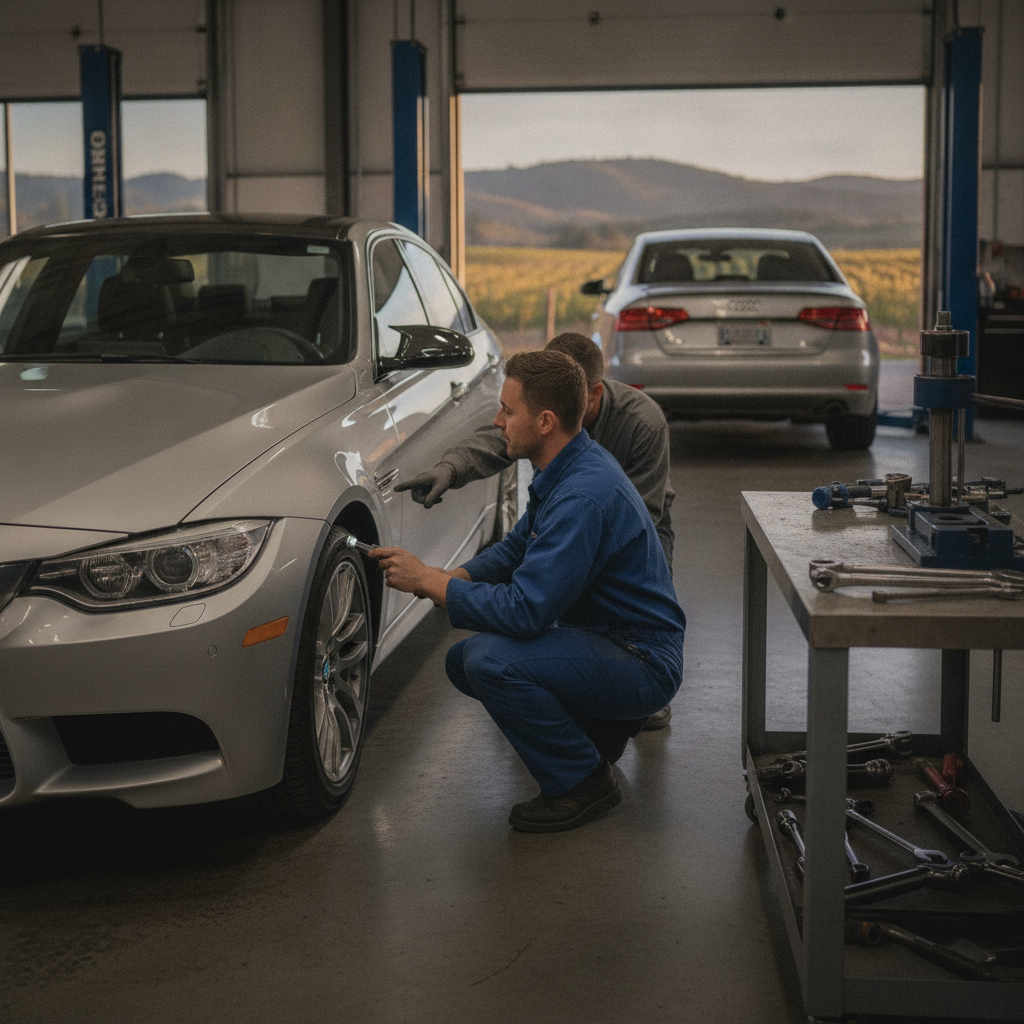
A thorough suspension assessment on a European vehicle is not a five-minute lift-and-shake exercise. It starts with a test drive to characterize the noise — does it happen over slow rolling bumps, under braking, during corner entry, or all three? Each pattern points toward different components. Once on the lift, every bushing should be evaluated with the suspension in both loaded and unloaded positions, because some failures only appear under load. Tie rod ends, ball joints, sway bar end links, and sway bar bushings all need to be checked as part of the same inspection, because on a multi-link European suspension these components interact.
After the repair, a four-wheel alignment is not optional — it’s mandatory. Replacing control arms or bushings changes your suspension geometry, and any shop that does this work without a follow-up alignment on a proper Hunter or similar alignment rack is leaving the job unfinished. If you’re in Petaluma, Rohnert Park, or Sebastopol and you’ve had suspension work done elsewhere that didn’t include an alignment check, that’s worth verifying before your next tire rotation.
At Bavarian Performance, we use OEM and genuine-specification bushings on all European suspension repairs — not the lowest-cost aftermarket alternatives. On BMWs and Audis, the durometer (hardness rating) of the bushing compound directly affects ride quality and steering feel. An incorrect bushing that’s too stiff will transmit harshness; one that’s too soft will recreate the same vague steering feel you’re trying to eliminate. Our team serving Petaluma has worked extensively across BMW’s E, F, and G chassis generations and Audi’s B8 through B9 platforms — the failure patterns are familiar, and the correct parts sourcing is not guesswork.
When to Address This — and What Happens If You Wait
Control arm bushing wear is gradual, which makes it easy to rationalize deferring the repair. But the cascading consequences are real. Worn bushings accelerate inner edge tire wear, and tires on European vehicles — especially those running run-flat specifications or staggered fitments — are not cheap to replace early. More importantly, as bushing compliance increases, lateral loads transfer more directly to ball joints and wheel bearings, which are significantly more expensive repairs. A set of front control arm bushings or complete control arms on a BMW 3 Series or Audi A4 is a manageable service cost. A wheel bearing failure that follows from deferred suspension maintenance is a different conversation entirely.
If your BMW or Audi is between 60,000 and 120,000 miles and has not had a suspension inspection — or if you’re hearing any kind of clunk, creak, or knock that correlates with road inputs — this is the right time to get a complete evaluation. Many of the out-of-warranty German cars we see at Bavarian Performance in this mileage range are carrying worn bushings that the previous owner deferred and that are now affecting multiple downstream components. Earlier is always less expensive. You can learn more about what a comprehensive vehicle check covers in our multi-point inspection service.
Frequently Asked Questions
How do I know if it’s the control arm bushings or something else causing the clunking?
Bushing-related clunks typically occur when weight transfers — braking, accelerating, or hitting a bump. Ball joint failures more often produce a clunking noise when turning. Sway bar end link failures usually produce a rattle or knock during slow maneuvering. A proper diagnosis requires an experienced technician evaluating the suspension under both static and dynamic conditions — not just a quick lift-and-shake.
Can I drive my BMW or Audi with worn control arm bushings?
You can, but it accelerates damage to other components and compromises your steering precision and emergency handling response. On a performance-oriented European vehicle, degraded suspension geometry also affects your stopping distance in ways that aren’t immediately obvious until you need the car to respond quickly.
Does replacing control arm bushings require a full alignment afterward?
Yes — without exception. Replacing bushings or control arms alters your suspension geometry, and your alignment will be off until it’s reset on a proper four-wheel alignment rack. Any shop that skips this step is not completing the job correctly.
Are aftermarket control arm bushings acceptable on a BMW or Audi?
It depends on the specific part and the source. On critical suspension geometry components, OEM or OEM-equivalent bushings with the correct durometer specification are strongly preferred. Some premium aftermarket suppliers — Lemförder and Meyle-HD, for example — produce suspension components that meet or exceed OEM spec. Cheap generic bushings with the wrong compliance rating will recreate the original problem in less time and may affect steering feel noticeably.
What does a suspension inspection and control arm bushing service typically involve at Bavarian Performance?
We begin with a road test and a comprehensive suspension inspection on the lift, evaluating all major suspension and steering components — not just the obvious wear points. We provide a written assessment of what needs immediate attention versus what to monitor. Any bushing or control arm replacement is followed by a four-wheel alignment check, and we use OEM or genuine-specification parts throughout. Contact us for current service estimates specific to your vehicle.
Schedule a Suspension Inspection at Bavarian Performance
If your BMW or Audi is clunking over speed bumps in Petaluma, pulling to one side, or just not driving with the precision it used to, don’t let a manageable suspension repair turn into a more expensive problem. Bavarian Performance serves Petaluma, Sonoma County, and the surrounding North Bay — including drivers coming in from Novato and Marin County — with factory-trained expertise and genuine OEM parts. Contact us today to schedule your suspension inspection and get a clear picture of what your car actually needs.