
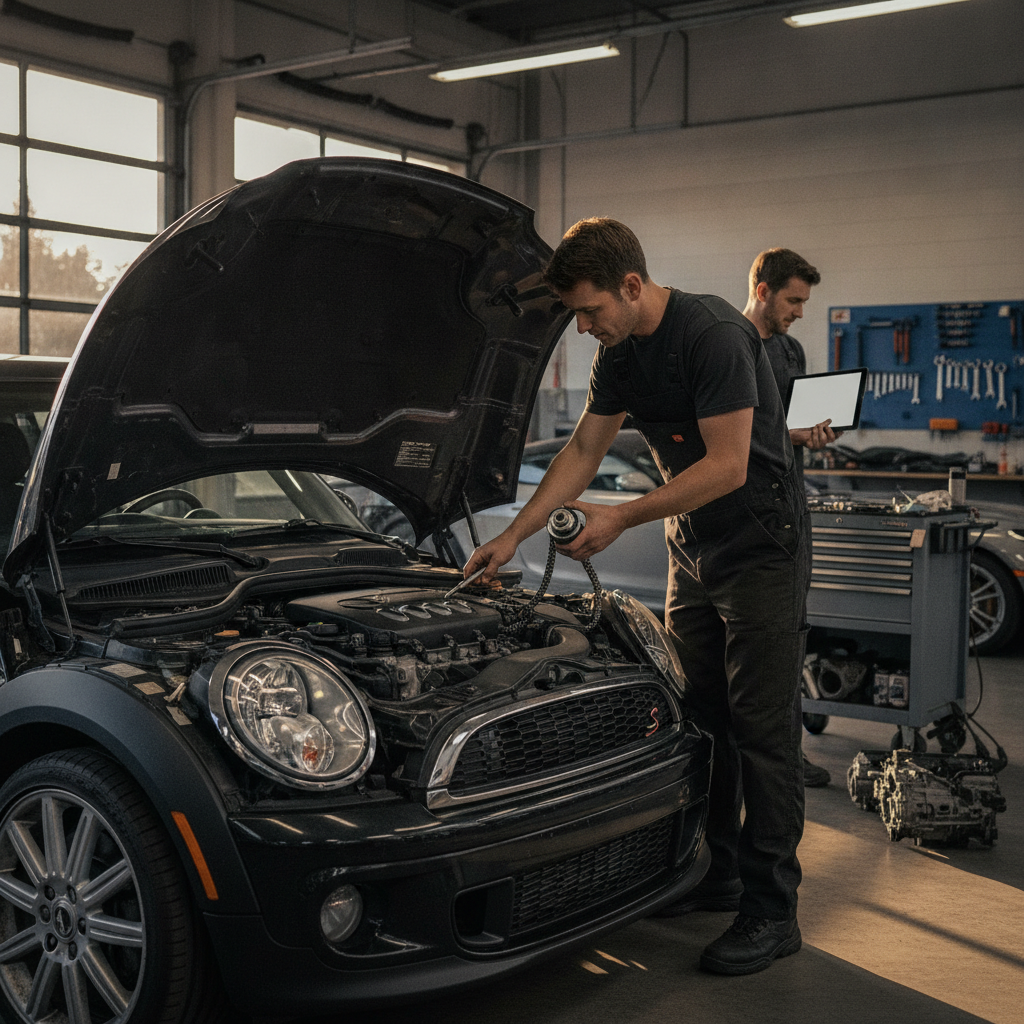
Why Is My Mini Cooper’s Timing Chain Making Noise in Rohnert Park — and What Does an N14 Tensioner Failure Actually Mean?
If your first-generation turbocharged Mini Cooper — a 2007 through 2010 Cooper S or JCW with the N14 engine — rattles or ticks for a few seconds at cold startup, that’s not a quirk you learn to live with. It’s almost certainly a failing timing chain tensioner, and it’s one of the most well-documented engineering weaknesses in the modern Mini lineup. Drivers in Rohnert Park and throughout Sonoma County who ignore this noise are rolling the dice on an engine that can jump time, bend valves, and turn what was a manageable repair into a total engine rebuild. Here’s exactly what’s happening mechanically, how urgent it is, and what proper service looks like.
What the N14 Engine Actually Is — and Why It Has This Problem
The N14 is a BMW-sourced turbocharged 1.6-liter four-cylinder that powered the R56 Cooper S and the John Cooper Works from roughly 2007 to 2010. On paper, it’s an enthusiastic little engine — torquey, rev-happy, and genuinely fun on winding roads like those out toward Sebastopol or up into the Sonoma hills. In practice, it arrived with two significant known issues that every informed Mini owner should understand before the warranty clock runs out: water pump and thermostat housing failures, and timing chain tensioner failure.
The timing chain tensioner on the N14 uses a plastic ratcheting mechanism to maintain chain tension, and the design was simply not robust enough for long-term real-world use. Over time — typically somewhere between 60,000 and 100,000 miles, though it can happen earlier — the tensioner loses its ability to hold adequate pressure. The chain develops slack. At cold start, before oil pressure fully builds, you hear that characteristic rattle from the front of the engine. Some owners describe it as a brief maraca shake; others describe it as a diesel-like clatter that goes away after a few seconds. Both are telling you the same thing.
What Happens If You Keep Driving on a Slack Timing Chain
A stretched or insufficiently tensioned timing chain doesn’t just make noise — it can skip a tooth on the camshaft or crankshaft sprocket. When that happens on the N14, you’re looking at valve-to-piston contact in some cases, or at minimum a significant timing event that the DME (the engine control module) may or may not catch before damage is done. What started as a tensioner replacement — a repair that is real money but very much survivable — becomes a cylinder head inspection, potential valve replacement, and in worst cases, a short block replacement.
The Highway 101 corridor between Rohnert Park, Cotati, and Santa Rosa is hard on engines that are already stressed by cold-start conditions. Stop-and-go commute traffic means more frequent cold starts, more pressure fluctuations in the oiling system, and more thermal cycling of engine components. If you’re driving your Mini Cooper daily on 101 and the tensioner is already compromised, every morning commute is compounding the wear.
How a Proper Diagnosis Works — and Why Generic Scanners Miss This
Here’s something worth understanding before you take your Mini to a shop that isn’t familiar with the platform: a failing N14 timing chain tensioner often won’t trigger a check engine light in the early stages. The DME may log a cam or crank correlation fault if timing has shifted significantly, but by the time that code appears, you’re already past the point where a simple tensioner swap solves the problem cleanly.
A proper evaluation involves a factory-capable scan using BMW’s ISTA diagnostic software — the same platform used at dealerships — combined with a physical inspection of the timing cover area and an assessment of how the chain behaves at cold idle versus warm idle. Shops using generic OBD-II readers don’t have access to the live data parameters that tell you whether cam timing is drifting, or whether the tensioner is holding pressure between cold-start events. At Bavarian Performance, we use factory-level diagnostic tooling specifically because issues like this live below the threshold of what generic scan tools can see. You can read more about our Mini Cooper repair services to understand the depth of platform-specific work we do.
What a Complete N14 Timing Chain Service Actually Involves
If the diagnosis confirms tensioner failure — or significant chain stretch — the correct approach is not to replace just the tensioner and call it done. The timing chain, the tensioner, the chain guides, and in many cases the sprockets should be evaluated as a system. Replacing a worn chain on an old tensioner, or a new tensioner on a stretched chain, is a shortcut that brings the car back in sooner than it should.
Genuine OEM parts matter here. The replacement tensioner must be the updated specification — BMW and Mini released revised tensioner designs that addressed the original failure mode. Using an aftermarket unit of unknown specification, or the original-style design, is not a proper fix. This is one of those jobs where the parts source directly determines whether the repair lasts.
Expect the job to require significant labor time — this is not a quick-access component on the N14, and doing it correctly means the engine needs to be at the right position, the timing verified precisely after reassembly, and the system confirmed with a live data check before the car leaves the lift. A complete engine repair service of this nature takes time to do right, and any shop that quotes you a suspiciously short turnaround should be asked exactly what they’re replacing and what they’re leaving in place.
What About the Water Pump and Thermostat Housing?
If your N14 is in for timing chain service and it hasn’t had its water pump and thermostat housing replaced yet, this is the time. Both are known failure points on this engine — the electric water pump can fail abruptly and cause rapid overheating, and the thermostat housing is plastic and prone to cracking. Since the engine is already partially disassembled for timing work, doing both at the same visit saves substantial labor cost compared to coming back in six months when the water pump finally quits. Sonoma County summers are dry and hot, and a compromised cooling system on the N14 is a genuine risk from June through September, particularly if you’re making longer runs out toward Petaluma or up through wine country.
Why This Topic Is Missing From Most Local Shop Websites
After reviewing the online presence of most independent shops in the area, Mini Cooper-specific engine content — particularly around the N14 tensioner — is genuinely absent. Most competitors either list Mini as a brand they service without any technical depth, or they group it with generic European car content. That’s a disservice to Mini owners who are searching specifically for answers to this exact noise and deserve to understand the engineering reality before they either panic or dismiss the symptom. Informed Mini Cooper owners make better decisions, and better decisions usually start with a qualified specialist who knows this platform at a granular level.
Frequently Asked Questions
How do I know if my Mini Cooper’s N14 tensioner is failing?
The most common symptom is a brief rattle or chatter at cold startup that clears within a few seconds once oil pressure builds. It typically comes from the front of the engine. It may also present as a check engine light with cam-crank correlation fault codes if timing has already shifted, but many tensioners fail audibly before triggering any codes at all.
Which Mini Cooper models have the N14 engine?
The N14 was used in the R56 Cooper S and the JCW (John Cooper Works) from approximately 2007 to 2010. The naturally aspirated Cooper used a different Peugeot-sourced engine. If you have a turbocharged Cooper S or JCW from that generation, you have the N14.
Can I keep driving if the rattle goes away after warmup?
Technically the car will drive, but every cold start is adding wear to an already compromised tensioner. The chain slack is real whether or not you can hear it after warmup. Getting it diagnosed promptly is far less expensive than the repair required after a timing event occurs.
Does Bavarian Performance serve Mini Cooper owners outside of Santa Rosa?
Yes — we regularly see customers from Rohnert Park, Cotati, Petaluma, and across Sonoma County. Our location in Santa Rosa is centrally accessible from Highway 101 and easy to reach from the surrounding communities.
Is a timing chain tensioner replacement the same as a timing belt service?
No. Mini Cooper N14 engines use a timing chain rather than a timing belt, which theoretically lasts longer — but the tensioner that keeps the chain taut is the failure point. There is no fixed replacement interval the way there is for timing belts; it requires diagnosis and inspection rather than a mileage-based swap.
Talk to a Mini Cooper Specialist in Rohnert Park and Santa Rosa
If you’re hearing any startup rattle from your N14-equipped Mini Cooper, don’t wait for a check engine light to tell you something’s wrong. By then, the conversation changes. Bring it in for a proper factory-level inspection, and we’ll give you a clear assessment of what’s happening, what parts are needed, and what the repair timeline looks like — without the dealership markup or the dealership wait. Contact Bavarian Performance to schedule your diagnostic appointment. We’re here to keep your Mini running the way it was engineered to — reliably and on your terms.