
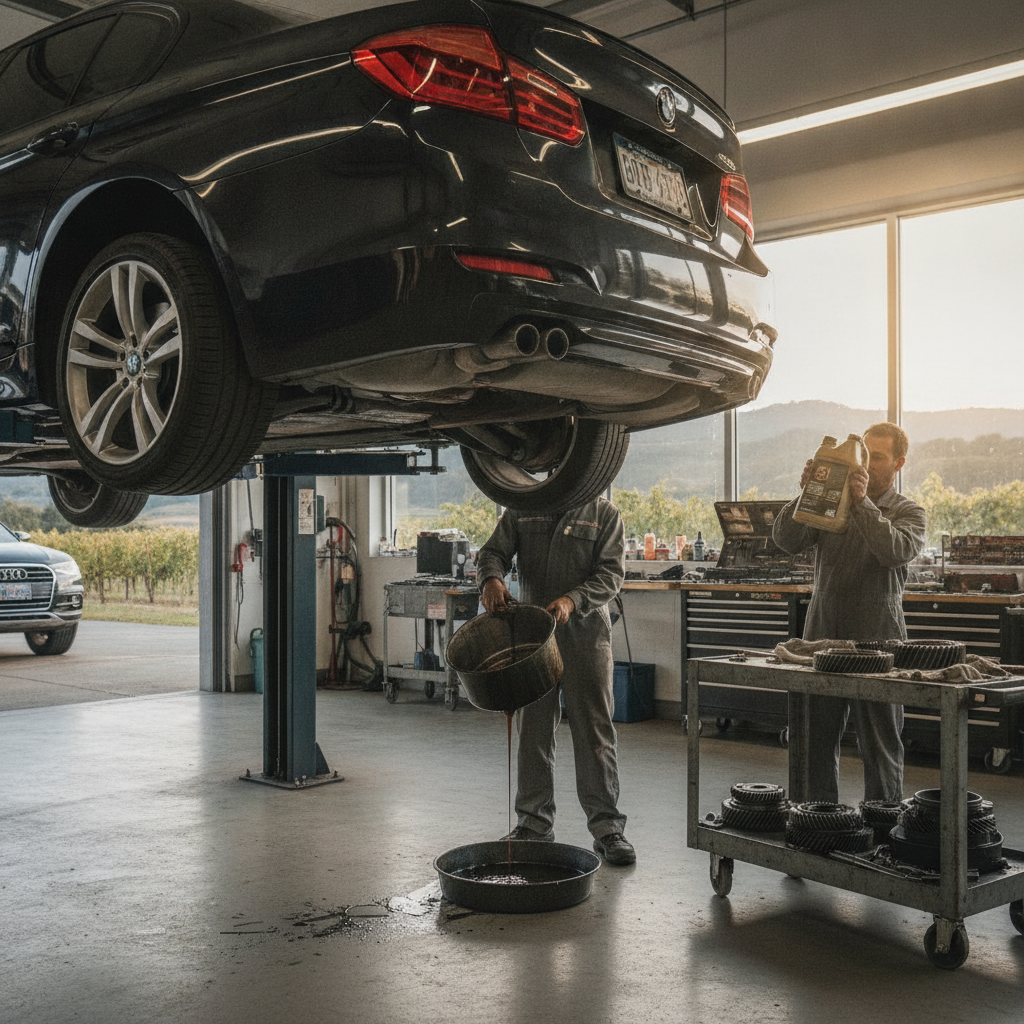
Why Is My BMW’s or Audi’s Differential Making a Whining Noise in Petaluma — and What Does a Differential Service Actually Fix?
If you’re hearing a steady whine or low hum from the rear of your BMW or Audi that changes pitch with vehicle speed — and you’re driving the hills and backroads around Petaluma or Sonoma County on a regular basis — your differential is trying to tell you something. The short answer: that sound almost always points to degraded gear oil, worn bearings, or the early stages of ring-and-pinion gear damage. A proper differential service won’t just silence the noise. Done on time, it prevents the kind of repair bill that makes even seasoned European car owners wince.
What the Differential Actually Does — and Why BMW and Audi Systems Are Different
The differential is the final link in your drivetrain. It splits power between your driven wheels and allows each wheel to rotate at a different speed through corners — something that happens constantly when you’re navigating the roundabouts on Lakeville Highway or the sweeping curves on Highway 116 through the Sonoma Valley. On a rear-wheel-drive BMW — say, an F30 3 Series or E90 M3 — you have a single rear differential. On a BMW xDrive model, there’s a front differential, a transfer case, and a rear differential, all working together. On an Audi with Quattro, the rear differential integrates with the rear axle differential and, on many models, a torsen or electronically controlled rear differential that actively biases torque.
These aren’t interchangeable with generic components, and the fluid specifications aren’t something you can eyeball at an auto parts store. BMW specifies separate fluid grades for their open differentials versus their active M Sport differentials. Audi’s sport differentials — fitted to S4, S5, and RS models — use a completely different service procedure than a standard Quattro open diff. Getting this wrong doesn’t just waste money. It accelerates wear on components that cost thousands to replace.
What Causes That Whining or Humming Sound?
Differential noise on European vehicles typically comes from one of three sources, and the character of the sound helps identify which one you’re dealing with.
- Degraded gear oil: This is the most common cause — and the most preventable. Differential fluid breaks down over time and loses its viscosity and extreme-pressure additives. When the lubricating film thins out, metal-on-metal contact between the ring gear, pinion gear, and side gears generates heat and noise. This typically presents as a smooth whine that appears above certain speeds.
- Worn pinion or carrier bearings: Bearing wear produces a rougher, more cyclical hum — sometimes felt as a vibration through the seat or floor. On higher-mileage BMW 5 Series and Audi A6 models we see regularly from Rohnert Park and Windsor, this is frequently the result of fluid that went too long between changes.
- Ring and pinion gear damage: This is the expensive one. Once the gear teeth are pitted or scoured, the differential usually needs to be rebuilt or replaced. The whine is typically louder under load — accelerating uphill — and quieter on deceleration. Catching this early makes a real difference in outcome.
Why Sonoma County Roads Accelerate Differential Wear
This is a detail that most generic auto content ignores entirely, and it’s genuinely relevant if you live and drive here. The terrain around Petaluma, Sebastopol, Sonoma, and Healdsburg isn’t flat. You’re regularly asking your differential to manage torque through grades, hairpin vineyard roads, and the kind of repeated load-unload cycles that stress gear oil far faster than a flat freeway commute would. Drivers coming down from the Fountaingrove area of Santa Rosa or making the run over Sonoma Mountain Road are putting real thermal stress on their diffs. Add the fact that many of these vehicles spend time on unpaved sections near River Road or the back routes through wine country, and you have conditions that push fluid degradation faster than factory intervals assume.
Heat is the primary enemy of differential gear oil. Once it’s been thermally cycled enough times, the film strength degrades and the extreme-pressure additives that protect hypoid gear sets under heavy load begin to deplete. That’s when wear accelerates — quietly, invisibly, until the whine starts.
What a Differential Service at Bavarian Performance Actually Involves
A differential fluid service isn’t simply draining and refilling. At Bavarian Performance, we approach it the way factory-trained technicians do — starting with understanding what’s actually in there and what the vehicle’s service history looks like.
- Drain the old fluid and inspect what comes out — color, consistency, and the presence of metallic particles on the drain plug magnet all tell a story about what’s happening inside
- Inspect the differential housing, output flanges, and seals for leaks — a leaking pinion seal, for example, can allow fluid level to drop gradually until real damage occurs
- Refill with the correct OEM-spec fluid for your specific vehicle — not a one-size-fits-all gear oil, but the correct viscosity and additive package for your BMW or Audi’s differential type
- On xDrive or Quattro AWD models, evaluate the transfer case fluid condition at the same time — these are often neglected alongside the differential and wear out in parallel
- Road-test the vehicle after service and verify the noise has resolved — if it hasn’t, that points toward mechanical wear that needs further inspection before it becomes catastrophic
If you’re already noticing noise, we’ll perform a more thorough inspection of the differential internals before recommending a fluid service alone. Sometimes the fluid service resolves it. Sometimes it reveals that you’re closer to a rebuild than a service. Either way, you’ll have an honest assessment — not a guess.
How Often Should You Service Your BMW’s or Audi’s Differential?
BMW classifies the rear differential as a lifetime-fill component in much of their owner documentation. In practice, this is one of the most misleading maintenance omissions in the European automotive world. “Lifetime” means the life of the fluid — not the life of the vehicle. Under real driving conditions in Sonoma County, most BMW differentials benefit from a fluid change every 40,000 to 60,000 miles. Audi Quattro rear and front differentials follow similar logic, with sport differentials on S and RS models often benefiting from more frequent service given the higher torque loads involved.
If you’ve purchased a used BMW or Audi and don’t have documented service history for the differential, treat it as overdue and start from a known baseline. This is one of those items where the cost of a fluid service is a small fraction of the cost of the differential rebuild it prevents. Our preventative maintenance services include a full review of which drivetrain fluids are due based on mileage and driving conditions — not just what a service reminder light tells you.
Why Generic Shops Often Miss This
Most general repair shops don’t see enough BMW xDrive and Audi Quattro differentials to develop real familiarity with how they behave, what they sound like when they’re healthy, and what the warning signs of early wear look like. The diagnostic tools matter too — factory-level software like ISTA for BMW and ODIS for Audi can pull drivetrain-related fault codes and live data that a generic OBD-II scanner won’t surface. When a transfer case or rear differential on an xDrive model is developing an issue, the DME and TCM often log relevant data that only shows up with the right software. That context is part of what shapes an accurate diagnosis.
For owners of BMW and Audi vehicles in the Petaluma, Rohnert Park, and broader Sonoma County area, working with a shop that has specific familiarity with these drivetrains — not just European cars in general — makes a meaningful difference in both accuracy and outcome.
Frequently Asked Questions
Is a differential whine always serious?
Not always — if it’s caught early and the fluid is the culprit, a proper fluid service often resolves it completely. The risk is waiting too long. Once gear surfaces or bearings are worn, a fluid change alone won’t fix it. Act on the noise when it first appears rather than hoping it goes away.
Can I just use a synthetic gear oil from an auto parts store?
You can, but you probably shouldn’t. BMW and Audi differentials — especially active sport differentials and xDrive transfer cases — have specific fluid requirements that generic gear oil doesn’t meet. Using the wrong fluid can cause chatter, wear, and in some cases void any remaining coverage on related components. OEM-spec or factory-approved fluid is the right call here.
Does the transfer case need service at the same time?
On xDrive and Quattro AWD vehicles, yes — we strongly recommend servicing both at the same time. They experience similar thermal cycles, often have similar service intervals, and the labor overlap makes it cost-effective to address them together.
My BMW or Audi has no service history for the differential. What should I do?
Treat it as overdue and bring it in for an inspection. We’ll check the fluid condition and the magnetic drain plug for metallic debris, which tells us a great deal about the current state of wear. From there, we’ll give you an honest picture of where you stand.
Is this something Bavarian Performance services for Healdsburg and Windsor drivers too?
Absolutely. We serve European vehicle owners throughout Sonoma County, including Healdsburg, Windsor, Sebastopol, and Sonoma. Our location in Santa Rosa puts us within easy reach of the full Sonoma County area, and we see a wide range of BMW and Audi models from across the region.
Don’t Wait Until the Whine Becomes a Grind
If your BMW or Audi’s rear end is talking to you, take the time to have it properly evaluated. A differential that’s caught at the fluid-service stage is a straightforward, reasonable repair. A differential that’s allowed to deteriorate into gear damage is a very different conversation. At Bavarian Performance, we use OEM-spec fluids, factory-grade diagnostic tools, and the kind of hands-on familiarity with European drivetrains that comes from working on these vehicles every day.
Reach out through our contact page to schedule an inspection or ask about a differential service for your vehicle. We’re happy to walk you through what’s involved before you commit to anything.