
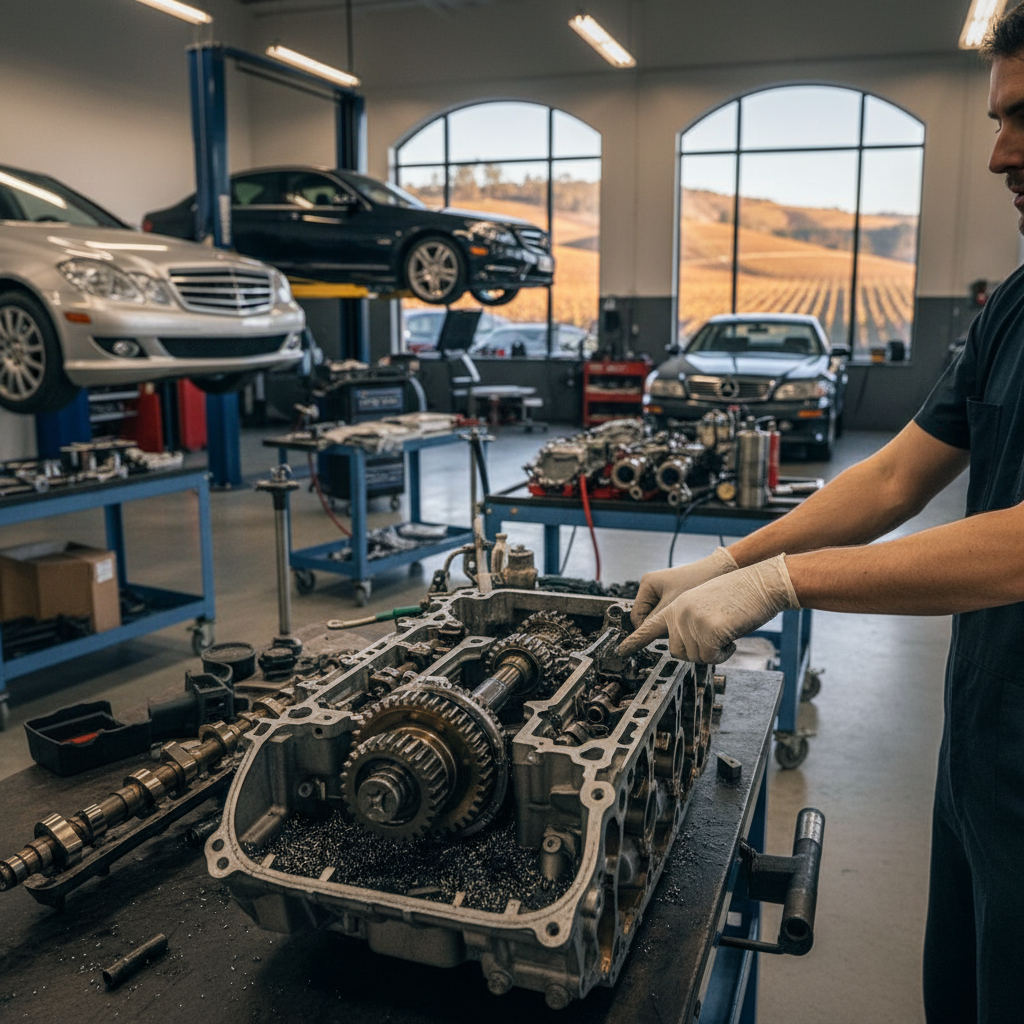
Why Is My Mercedes-Benz Making a Ticking Noise in Petaluma — and Is It a Balance Shaft Problem?
If you’re driving a Mercedes-Benz C-, E-, or S-Class — or a GL, ML, or R-Class — equipped with the M272 V6 or M273 V8 engine, and you’ve started hearing a subtle tick or rattle that wasn’t there before, your instinct to take it seriously is correct. That sound, especially when it appears at startup or during light acceleration, is one of the most well-documented design vulnerabilities in Mercedes-Benz’s modern engine lineup. The balance shaft sprocket and idler gear on these engines are prone to accelerated wear — and in Petaluma, Santa Rosa, and throughout Sonoma County, where many of these vehicles are now well past the 80,000-mile mark and out of factory warranty, this problem is showing up in the shop with increasing regularity.
What Is a Balance Shaft and Why Does It Matter?
Balance shafts are counterweighted shafts driven off the crankshaft that cancel out the secondary vibrations inherent in V-engine designs. In the M272 and M273 engines, the balance shaft unit is positioned in the front of the engine and driven by a gear and chain system that also times the oil pump and camshafts. When this system works correctly, you never think about it. When it starts to fail, the consequences move fast.
The specific failure mode Mercedes-Benz owners need to understand is the premature wear of the balance shaft sprocket’s helical gear teeth — along with the idler gear that meshes with it. These components were manufactured from a material that proved insufficiently hard for the duty cycle, and Mercedes-Benz has issued a technical service bulletin acknowledging the issue. The worn gears develop slop, which creates the characteristic ticking and rattling noise you’re hearing. Left unaddressed, the worn gear teeth can shed metal debris into the oil circuit, damage the timing chain, or cause the chain to jump a tooth and throw off camshaft timing entirely — at which point you’re looking at a far more expensive repair, or in severe cases, internal engine damage.
Which Mercedes-Benz Models Are Most Affected?
The M272 and M273 engines were used across a wide range of model years and body styles. If you’re driving any of the following, this failure mode applies to you:
- C300, C350 (W204, 2008–2011)
- E350, E550 (W211, W212, 2006–2011)
- S350, S450, S550 (W221, 2007–2012)
- ML350, ML550, GL450, GL550 (W164, X164, 2006–2012)
- R350, R500 (W251, 2006–2010)
- CLK350, CLK550, CLS350, CLS550
- SLK350, SL550
If your vehicle falls in these years and you haven’t had the balance shaft assembly inspected, it’s worth scheduling a diagnostic — particularly if it has more than 70,000 miles on it. Many vehicles with the updated sprocket design (revised after 2008 production) are less susceptible, but not immune. A factory-grade scanner and a trained eye on the physical components are the only reliable ways to assess where yours stands.
What Does the Repair Actually Involve?
This is not a quick fix, and anyone telling you otherwise hasn’t done the job. Accessing the balance shaft assembly requires removing the front of the engine — which means pulling the valve covers, timing covers, and in some configurations partial engine removal to gain adequate clearance. The labor investment is significant, but the alternative is far worse.
At Bavarian Performance, the repair involves:
- Removal of the timing cover and front engine components
- Replacement of the balance shaft sprocket with the updated, hardened-gear design
- Replacement of the idler gear and, depending on wear, the timing chain and tensioners
- Inspection and cleaning of oil passages that may have received metal debris from the worn gears
- Full oil flush and OEM-spec oil and filter service before startup
- Post-repair verification with Mercedes-specific diagnostic tooling to confirm correct timing and no stored fault codes
Using genuine OEM or OEM-equivalent parts here is non-negotiable. The aftermarket balance shaft components available online vary widely in metallurgy and tolerancing — this is precisely the scenario where a cheap part creates the same problem you just paid to fix. Our Mercedes-Benz repair work uses the correct updated sprocket specification, not a repackaged version of the original flawed part.
Why Sonoma County Drivers Are Seeing This More Often Now
The M272/M273-era Mercedes-Benz vehicles are now firmly in the 10-to-18-year range. A significant number of them in Petaluma, Sonoma, Rohnert Park, and Windsor have been well-maintained but are hitting the mileage and age window where this failure accelerates. Sonoma County’s climate doesn’t help — hot, dry summers stress engine oil viscosity and accelerate wear on marginal components, and the stop-and-go traffic on Highway 101 between Petaluma and Santa Rosa puts repeated cold-to-hot thermal cycling on the front engine assembly every single day.
There’s also a contributing factor that rarely gets discussed: extended oil change intervals. Mercedes-Benz factory service indicators can allow intervals beyond what’s appropriate for older engines or high-heat driving conditions. If a vehicle has been running 10,000-to-15,000-mile oil change intervals on conventional or low-quality synthetic oil, the lubrication film on those gear surfaces has been less than ideal — and wear accelerates accordingly. If you’ve acquired a used Mercedes-Benz and don’t have complete service records, that’s worth discussing at your next inspection.
Why Generic Diagnostics Miss This Problem
One of the most frustrating aspects of this failure is how poorly it presents on generic OBD-II scanners. The early stages of balance shaft wear don’t always throw a check engine light — the noise is the primary symptom, and it’s mechanical, not electronic. A shop running a $50 Bluetooth scan tool will tell you there are no codes and send you on your way. By the time the wear is severe enough to trigger a fault code for camshaft timing deviation, you’ve already got debris in the oil and potentially timing chain stretch.
Factory-level diagnostic access — which Bavarian Performance uses for every Mercedes-Benz diagnostic — allows us to look at live camshaft and crankshaft correlation data, evaluate the actual degree of timing deviation, and cross-reference it with known failure thresholds. That’s the difference between catching a repair at $2,000–$3,500 versus discovering it at $8,000 or more when a timing chain has jumped and bent valves.
Don’t Confuse This With Other Engine Noises
Not every tick on a Mercedes-Benz V6 or V8 is a balance shaft issue. There are a few other common culprits worth ruling out before you assume the worst:
- Injector tick: Mercedes direct-injection engines produce a distinctive clicking at idle that’s completely normal. It’s louder than most owners expect and is often mistaken for a mechanical problem.
- Lifter noise: Cold-start ticking that clears within 30 seconds of warm-up is often valve train lash or a sticky lifter, not balance shaft wear.
- Oil pressure delay: If the tick is loudest in the first 5–10 seconds after a cold start and disappears entirely, an oil change and inspection of the oil pressure relief valve may be all that’s needed.
The balance shaft noise tends to persist after warmup, is present at light load and idle, and often has a slightly metallic, gear-mesh character rather than the clean mechanical tick of an injector. A trained technician who knows this engine family can typically identify it within a few minutes of a test drive and targeted inspection. Our engine repair team has diagnosed this failure pattern dozens of times across the Sonoma County area.
Frequently Asked Questions
How do I know if my Mercedes-Benz has the updated balance shaft sprocket already?
If your vehicle was manufactured after approximately mid-2008 and has a production date that corresponds to the revised casting, it may have the updated part from the factory. However, the only reliable way to confirm this is a VIN-specific parts verification by a Mercedes-trained technician. Don’t assume the update was applied without checking — many vehicles in the affected range left the factory with the original design.
Can I keep driving my Mercedes-Benz if I’m hearing a tick?
If the noise is mild and consistent, you likely have some time — but weeks, not months. If the tick has gotten louder over the past few weeks, or if you’ve noticed any roughness in idle quality or a check engine light alongside it, stop driving it and get it diagnosed immediately. A jumped timing chain caused by advanced gear wear can destroy an engine in seconds.
Is this repair covered by any extended warranty or recall?
Mercedes-Benz issued a technical service bulletin but not a formal recall for the M272/M273 balance shaft issue. Coverage under extended warranties depends on the policy terms and mileage at the time of failure. In some cases, Mercedes-Benz goodwill assistance was available for vehicles under a certain mileage threshold — worth investigating with your local dealer if your vehicle is in that range. For most out-of-warranty owners in Sonoma County, an independent specialist will offer significantly better value on the repair labor.
What oil should I be using in my M272 or M273 engine?
Mercedes-Benz specifies a 229.5 or 229.51-rated synthetic oil for these engines — typically a 5W-40 or 0W-40 formulation depending on the model year. Using a spec-compliant oil matters more than brand loyalty here. Oil that doesn’t meet MB 229.5 standards can contribute to premature wear in the balance shaft assembly and the variable valve timing system. If your current shop is putting in whatever synthetic is on sale, that’s worth correcting.
How long does the balance shaft repair take?
Plan for two to three full shop days. This is an involved job — there’s no shortcut through the front of that engine. Any shop quoting a same-day turnaround either hasn’t done the job before or is planning to skip steps. At Bavarian Performance, we’ll give you an honest timeline when you bring it in for diagnosis so you can plan accordingly.
Get Your Mercedes-Benz Properly Diagnosed Before It Becomes a Bigger Problem
If you’re driving an M272 or M273-equipped Mercedes-Benz anywhere in Petaluma, Santa Rosa, Sebastopol, Sonoma, or the surrounding Wine Country area and you’ve noticed an engine noise you can’t explain, don’t guess. Bring it to a team that actually knows this engine family.
Bavarian Performance serves the entire Sonoma County region from our Santa Rosa shop — and we have the factory-level tooling, the OEM parts sourcing, and the hands-on experience with these specific failure modes to give you an honest diagnosis and a repair that lasts. Contact us today to schedule your inspection or ask about what you’re hearing. The sooner you know what you’re dealing with, the better your options.