
Why Is My Volkswagen or Audi’s Carbon Buildup Causing Rough Idle in Sebastopol — and What Does Walnut Blasting Actually Do?
If your Audi A4, A5, Q5, or your Volkswagen GTI, Jetta, or Passat is idling roughly, stumbling under acceleration, or throwing a P0300-series misfire code, there’s a very good chance the problem has nothing to do with your ignition system or fuel injectors. The most likely culprit is carbon buildup on your intake valves — a structural flaw baked into the design of every gasoline direct-injection (GDI) engine Audi and VW have built over the past fifteen years. For drivers in Sebastopol and the surrounding West County area, where rural backroads, variable stop-and-go driving, and short daily trips create exactly the conditions that accelerate this problem, it’s one of the most common engine complaints we address at Bavarian Performance in Santa Rosa.
What Direct Injection Actually Does — and Why It Creates a Carbon Problem
In older port-injected engines, fuel was sprayed into the intake manifold, directly onto the intake valves. That spray acted as a continuous solvent, washing away oil vapors and combustion deposits before they could accumulate. Gasoline direct injection changed the equation: fuel is now sprayed directly into the combustion chamber, bypassing the intake valves entirely. This improves efficiency and power — Audi and VW’s EA888 2.0T engine is genuinely excellent because of it — but it means the intake valves never get bathed in fuel. Instead, they’re exposed to oily blowby gases recirculated through the PCV system, and those vapors bake onto the hot metal surfaces of the valve heads over tens of thousands of miles.
The result is a thick, hardened layer of carbon deposits — sometimes described as resembling volcanic rock — that forms on the back of each intake valve. At 40,000 to 60,000 miles it starts causing symptoms. At 80,000 to 100,000 miles on a neglected engine, those deposits can reduce valve opening diameter enough to meaningfully strangle airflow into the cylinder.
Symptoms That Point to Carbon Buildup on Your Audi or VW
The symptom pattern is fairly consistent across EA888 and EA113 engines, whether it’s a 2.0T, 1.8T, or 1.4T TSI unit:
- Rough idle that smooths out at higher RPM — the restricted airflow matters more at low throttle openings
- Cold-start stumble or hesitation — especially noticeable on cool West County mornings before the engine reaches operating temperature
- Intermittent misfires under light load — often random across cylinders (P0300) rather than isolated to one
- Noticeable power loss or flat spot in the mid-range — the engine feels like it’s working harder than it should
- Reduced fuel economy — when the combustion cycle is disrupted, efficiency suffers
A generic OBD-II scanner will show misfire counts and codes, but it won’t tell you why those misfires are happening. That distinction matters — chasing a carbon buildup problem with new spark plugs and coil packs is an expensive way to not fix the issue. Factory-grade diagnostic access through ODIS (for VW/Audi) allows us to evaluate fuel trims, live misfire data, and adaptation values that give a much clearer picture of what the engine is actually experiencing.
What Walnut Blasting Actually Does — and Why It’s the Only Proper Fix
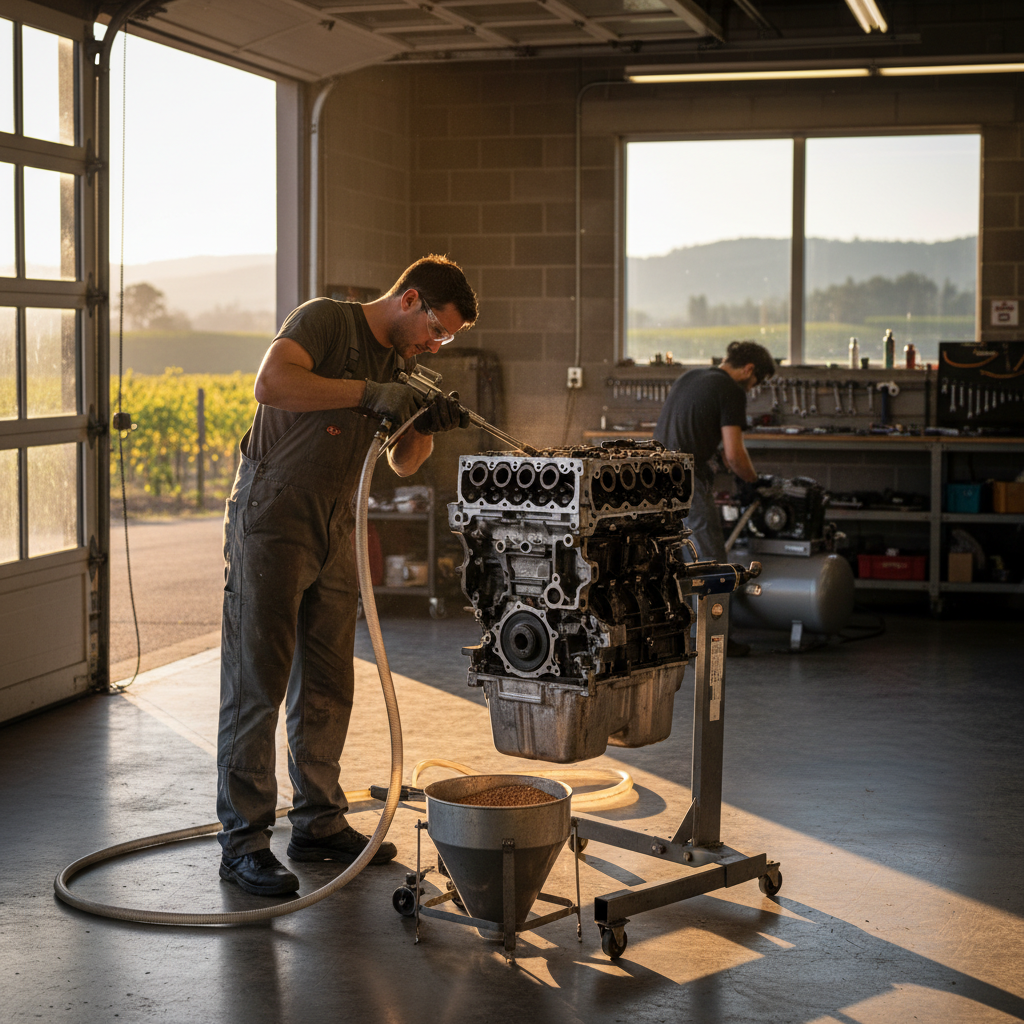
Walnut blasting — properly called abrasive media intake valve cleaning — is exactly what it sounds like: a media blaster loaded with crushed walnut shells (hard enough to scour deposits, soft enough not to damage valve seats or cylinder walls) is introduced into each intake port with the intake manifold removed. A shop vacuum simultaneously extracts the debris as it clears. Done correctly on a four-cylinder like the EA888, the process takes two to three hours of labor. On a V6 or V8 platform like the Audi 3.0T, plan for more.
The result is intake valves that look like they did at the factory — fully open, smooth-faced, and flowing air the way the engine was designed to breathe. Most owners notice the difference immediately: smoother idle, crisper throttle response, and a mid-range pull that reminds them of what the car felt like when it was new.
There is no substitute. Fuel additives marketed for carbon cleaning cannot reach deposits on GDI intake valves — the fuel never touches them. Intake sprays and chemical treatments are, at best, marginally effective on light buildup. If your deposits are significant enough to cause symptoms, physical abrasive removal is the only solution that actually works.
How West County Driving Makes This Worse — and Why Sebastopol and Graton Owners Should Pay Attention
The driving patterns common in and around Sebastopol, Graton, Occidental, and Forestville accelerate carbon accumulation in ways that Highway 101 commuters might not experience as quickly. Short trips on Highway 12 or Bodega Highway — where the engine never fully reaches operating temperature — allow oil vapors to condense more readily on cooler valve surfaces. Stop-and-go driving at low load keeps oil mist circulating through the PCV system without the high-combustion-temperature events that would otherwise burn some of it away.
Vineyard dust and particulate matter common along River Road and rural West County routes also degrade air filtration more quickly, and a degraded air filter changes the pressure dynamics in the intake system in ways that affect PCV behavior. It’s a compounding problem — which is why walnut blasting is most cost-effective when it’s treated as scheduled maintenance rather than an emergency repair.
For most EA888-powered Audis and Volkswagens, we recommend an intake valve cleaning at 50,000 to 60,000 miles and again every 40,000 to 50,000 miles thereafter, depending on how the vehicle is primarily driven. Oil change intervals matter here too: extended oil change intervals with the wrong oil specification dramatically increase blowby deposit rates. Audi and VW specify VW 502.00 or 504.00 rated oil for a reason — using a non-spec oil to save a few dollars accelerates exactly this kind of damage.
Timing Chain Tensioners and the Other 2.0T Issue Worth Knowing About
While your intake manifold is off for walnut blasting, it’s a logical time to inspect the timing chain tensioner on EA888 engines — particularly on 2008–2013 models. The plastic timing chain tensioner on early-generation 2.0T engines is a documented failure point. When it fails, you’ll hear a rattling noise on cold starts that disappears as oil pressure builds. Left unaddressed, a failed tensioner can allow chain skip, and that’s an entirely different and significantly more expensive conversation. Combining these services while the engine is already partially disassembled is straightforward and keeps total labor costs well below what two separate visits would cost.
Why This Is a Gap Most Local Shops Don’t Address Properly
Walnut blasting requires brand-specific knowledge of intake manifold removal procedures, the right media blasting equipment, and genuine familiarity with the EA888’s known failure points. A generalist shop that doesn’t work on Audi and Volkswagen platforms daily will often misdiagnose carbon buildup as a spark plug, coil, or injector problem — parts that will be replaced unnecessarily while the actual issue persists. We’ve seen Audi Q5s and VW Golfs come to us from Sonoma County after spending significant money at shops that never identified the root cause. The diagnostic path matters as much as the service itself.
See how Bavarian Performance approaches Audi engine diagnostics and repair in Santa Rosa.
Frequently Asked Questions
How do I know if my Audi or VW has carbon buildup without tearing the engine apart?
The symptom pattern — rough cold-start idle, random misfires, power loss in the mid-range — combined with mileage over 50,000 miles on a GDI engine is usually sufficient to make a confident diagnosis. A factory-grade scan with ODIS or equivalent provides additional confirmation through fuel trim and misfire data. In some cases, a borescope inspection of the intake ports can visually confirm deposit levels before committing to service.
Will a fuel injector cleaning service fix my rough idle?
Not if the cause is intake valve carbon buildup. Fuel injector cleaning addresses deposits at the injector tip inside the combustion chamber. On a GDI engine, the intake valves are upstream of where fuel enters — cleaning the injectors has no effect on valve deposits whatsoever.
How long does walnut blasting take, and will I need a loaner car?
On a four-cylinder EA888 engine, the service typically takes a full day — two to three hours of active labor plus time for inspection and reassembly. We recommend planning for the vehicle to be with us for the day. Contact us in advance and we’ll discuss your scheduling needs.
Is walnut blasting covered under any warranty?
It is not covered under Volkswagen or Audi’s standard factory warranty as a defect repair, though some extended warranty policies and certified pre-owned programs have specific provisions. Check your policy documentation carefully. That said, because it’s a maintenance service rather than a defect claim, it’s straightforwardly scheduled and priced — no warranty bureaucracy required.
Does this apply to my Audi Q5, A4, or VW Golf with the newer EA888 Gen 3 engine?
The Gen 3 EA888 (found in 2015 and later models) uses a combined port and direct injection system — sometimes called TFSI or TSI depending on the market — which partially mitigates carbon buildup by occasionally routing fuel through the port injectors to wash the valves. It is not immune, but the accumulation rate is meaningfully slower than earlier Gen 1 and Gen 2 units. We still recommend inspection at 80,000 miles on Gen 3 engines and cleaning if deposits are present.
Get Your Audi or Volkswagen Running the Way It Should
If your Volkswagen or Audi is idling roughly, misfiring, or simply not performing the way it used to — and you’re in Sebastopol, Graton, Occidental, Forestville, or anywhere in Sonoma County — the intake valves are worth a serious look before you replace another set of spark plugs. At Bavarian Performance in Santa Rosa, we use factory-grade ODIS diagnostic equipment, proper walnut blasting media equipment, and genuine OEM-specification parts and fluids to service these engines the way Audi and Volkswagen’s engineers intended.
Don’t guess at what’s causing that rough idle. Contact Bavarian Performance to schedule a diagnostic inspection and find out exactly what your engine needs — no upselling, no unnecessary parts replacements, just an accurate diagnosis and a straightforward repair plan.