
Why Is My BMW or Audi’s Check Engine Light On in Windsor — and What Does a Factory-Level Diagnostic Actually Tell You?
If your BMW or Audi’s check engine light came on while driving through Windsor, Larkfield-Wikiup, or anywhere along the Highway 101 corridor in northern Sonoma County, the first thing to understand is this: that light is not one warning — it’s a gateway to dozens of potential fault codes stored across multiple engine and emissions control modules. What separates a proper diagnosis from a wasted repair bill is the quality of the tool reading those codes and the expertise interpreting them. A generic OBD-II scanner from an auto parts store gives you a code number. A factory-grade diagnostic system tells you why that code is there — and what to do about it.
Why the Check Engine Light Means Something Different on a European Car
American drivers are conditioned to think of the check engine light as a vague inconvenience — something that might just be a loose gas cap. On a BMW or Audi, that framing is dangerously incomplete. Both brands use a network of control modules — the DME (Digital Motor Electronics) on BMW, and the ECM/ECU managed through ODIS on Audi and Volkswagen — that monitor dozens of real-time parameters simultaneously. When something deviates from factory spec, it logs a specific fault code that includes not just the system affected, but the conditions under which the fault occurred, how many times it’s recurred, and whether it’s currently active or stored.
A generic scanner reads the top-level code. Factory tools like BMW’s ISTA platform or Audi’s ODIS system read the full fault environment — freeze frame data, module communication errors, adaptive value deviations, and pending faults that haven’t yet triggered the light. That context is often the difference between correctly diagnosing a failing MAF sensor and misdiagnosing an underlying vacuum leak that will keep triggering codes after you’ve already replaced the sensor.
Common Check Engine Light Triggers on BMWs — and What They Actually Mean
BMW’s N20, N55, and B58 engines each have known fault patterns that experienced technicians recognize on sight. Here are the ones that show up most often in the Santa Rosa area:
- VANOS-related codes (P0010, P0011, P0013, P0014): These camshaft position codes are frequently triggered by oil sludge blocking VANOS solenoids, but they can also indicate timing chain wear or actual actuator failure. The fix varies significantly depending on which it is.
- Oil filter housing gasket leaks causing secondary misfires: Oil migrating into the valley of the engine can saturate ignition coil boots, causing misfire codes that look electrical until you trace the source.
- Coolant system faults: BMW’s thermostats are electronically controlled and fail in predictable ways — often logging a fault for coolant temperature rationality before the car ever shows a temp warning. On hot, dry Sonoma County summers, a failing thermostat is a cooling system emergency in disguise.
- Evaporative emission system faults (P0440–P0457): Common on older BMWs, often triggered by degraded fuel tank pressure sensors or charcoal canister issues — not the gas cap.
Common Check Engine Light Triggers on Audis — and What They Actually Mean
Audi’s direct-injection engines — particularly the 2.0T TFSI in the A4, A5, Q5, and related platforms — have well-documented fault tendencies that require factory-level interpretation to properly resolve.
- Timing chain tensioner codes: The 2.0T is known for timing chain tensioner wear, and early fault codes related to camshaft timing deviation are often the first warning. Missing these on a generic scanner is a scenario that ends in engine damage.
- MAF sensor contamination: Vineyard dust, wildfire ash, and the particulate-heavy air that moves through northern Sonoma County — especially in the corridor between Windsor, Geyserville, and the Alexander Valley — accelerates mass airflow sensor degradation. Post-wildfire seasons since 2017 have made this worse. A contaminated MAF logs lean mixture codes that mimic injector or oxygen sensor faults on cheaper diagnostic tools.
- Carbon buildup-related misfires on direct-injection engines: Heavy carbon deposits on intake valves cause rough idle and misfire codes. This is a known issue on Audi FSI and TFSI engines that no amount of sensor replacement will resolve — it requires physical cleaning.
- DSG transmission fault codes crossing into engine management: When the mechatronic unit in an Audi DSG begins to fail, it can log codes in the engine control module that appear unrelated to the transmission. Without access to full module-level data, this gets misread constantly.
What a Factory-Grade Diagnostic Actually Looks Like — and Why It Matters in Sonoma County
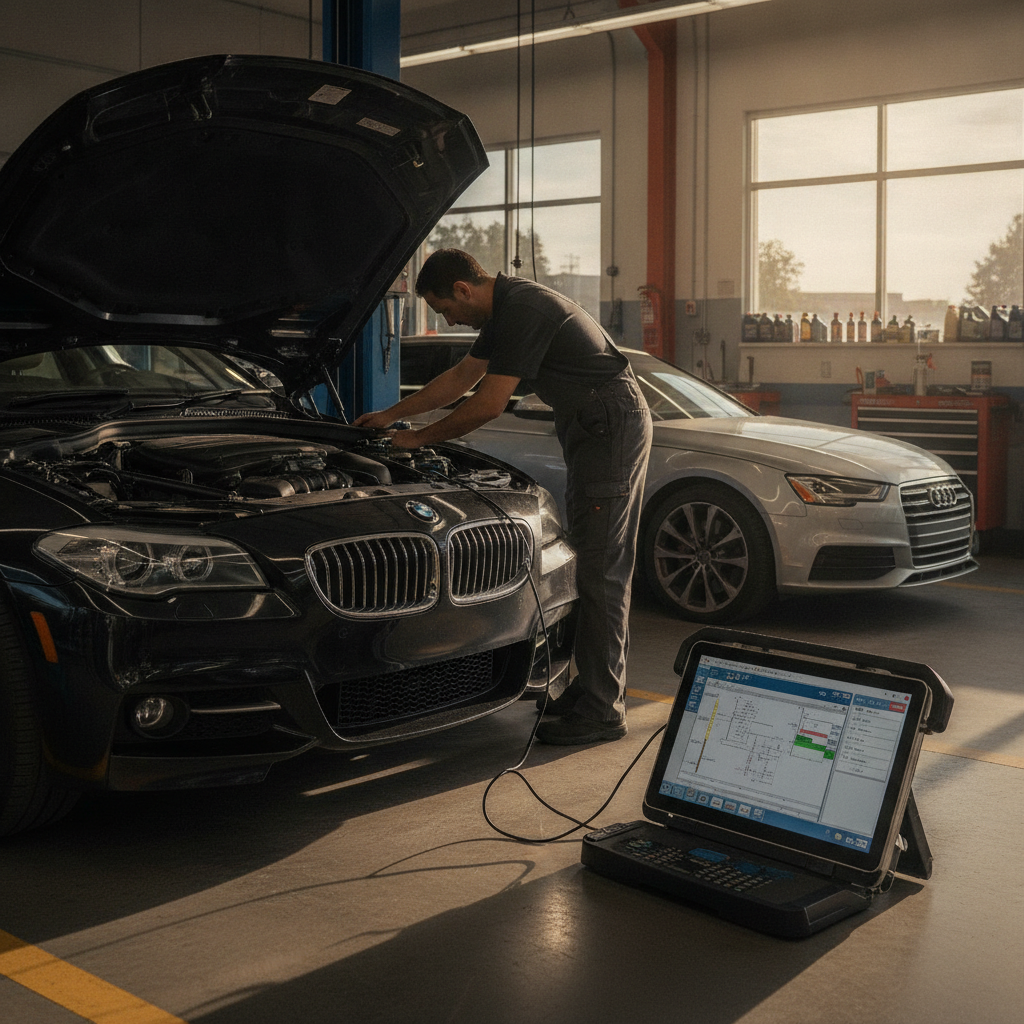
A proper check engine light diagnosis on a European vehicle is not a 10-minute code pull. It involves connecting a factory-level diagnostic platform, reviewing all stored fault codes across all accessible modules, analyzing freeze frame data to understand the operating conditions when the fault occurred, and performing live data monitoring to watch how the engine behaves in real time. For BMW, that means ISTA. For Audi and Volkswagen, ODIS. These are the same systems the dealer uses — and they’re what makes the difference between a repair that solves the problem and one that clears the code until it comes back.
Drivers in Windsor and the surrounding areas of northern Sonoma County face specific environmental conditions that feed directly into check engine light triggers. The dust off vineyard roads stresses air filtration systems. Hot summer temperatures push cooling system components toward their failure thresholds. Highway 101 commutes to the Bay Area put sustained load on engine management systems that are sensitive to small deviations in air-fuel ratio or ignition timing. If your car is also accumulating miles on winding routes like Chalk Hill Road or Eastside Road, suspension-induced vibration can accelerate sensor connector wear — another class of fault that only shows up clearly in factory diagnostic data.
You can learn more about the full range of European auto repair services available at Bavarian Performance, including complete diagnostic capability for BMW, Audi, and all major European brands.
What Competitors Aren’t Telling You: The Difference Between Code Reading and Actual Diagnosis
Most local shops in Sonoma County will offer a “free check engine light scan.” That scan reads the surface code — a P-code from the generic OBD-II layer. What it doesn’t do is access BMW’s proprietary fault architecture, Audi’s extended fault memory, or the freeze frame data that shows exactly what the engine was doing when the fault triggered. It also doesn’t perform guided fault tree analysis — the step-by-step diagnostic process that factory tools walk technicians through to rule out secondary causes before recommending parts.
The practical result of skipping true factory diagnostics is parts-swapping — replacing oxygen sensors, MAF sensors, or ignition coils based on a code number without confirming the root cause. On a European vehicle with genuine OEM sensors that cost two to three times their generic equivalents, that’s an expensive way to not fix the problem. At Bavarian Performance, diagnostics start with factory-level tools and end with a clear explanation of what’s causing the fault and what the correct repair path looks like — before any parts are ordered.
If your Audi is showing engine management faults, see what a proper Audi repair and diagnostic service involves from a team that works with these platforms daily.
When a Check Engine Light Requires Immediate Action vs. When You Have Time
Not every check engine light is an emergency, but some are. Here’s a practical framework for European vehicle owners:
- Steady light, no drivability symptoms: You likely have time to schedule a diagnostic within a few days. Don’t ignore it — stored faults can cascade — but it’s not a roadside situation.
- Steady light with rough idle, misfires, or reduced power: Schedule diagnostics promptly. Misfires can damage catalytic converters on European cars very quickly, turning a sensor replacement into a much larger bill.
- Flashing or blinking check engine light: This indicates an active misfire severe enough to damage the catalytic converter. Pull over safely when possible and have the vehicle transported — do not drive it.
- Check engine light combined with temperature warning or oil pressure warning: Stop driving immediately. This combination on a BMW or Audi can indicate a developing mechanical emergency that worsens with every mile.
Frequently Asked Questions
Can I drive my BMW or Audi from Windsor to Santa Rosa with the check engine light on?
In most cases, a steady check engine light with no other symptoms or drivability issues allows for a short drive to a shop. A flashing light, temperature warning, or any loss of power is a reason to stop and call for assistance rather than risk further damage.
Will clearing the check engine light code fix the problem?
No. Clearing the code removes the stored fault but does nothing to address the underlying cause. The light will return — sometimes immediately, sometimes after a drive cycle — and repeated clearing without repair can mask developing mechanical problems.
Does wildfire smoke and ash affect check engine light triggers on European cars?
Yes. Ash and fine particulate matter from wildfire events can contaminate MAF sensors and clog cabin and engine air filters, triggering lean mixture codes and in some cases causing rough running or reduced performance. This has been a documented concern in Sonoma County since the 2017 Tubbs Fire, and it’s worth having your MAF sensor inspected after any significant smoke event.
Is a factory-level diagnostic at an independent shop as thorough as what the dealership does?
When the shop is using the same factory platforms — ISTA for BMW, ODIS for Audi/VW — yes. The diagnostic capability is equivalent. What you gain at an independent specialist like Bavarian Performance is the same technical depth with faster scheduling, more transparent communication, and pricing that reflects the actual work — not dealership overhead.
My check engine light came on right after my last oil change at a quick-lube shop. Is that related?
Possibly. Improper oil viscosity, a loose oil cap, or a disturbed wiring harness near the filter housing can all trigger faults on sensitive European engine management systems. It’s worth mentioning the timing when you bring the car in for diagnosis — it’s often a useful clue.
Ready to Find Out What Your Check Engine Light Is Actually Saying?
If your BMW, Audi, or any European vehicle’s check engine light is on in Windsor, Larkfield-Wikiup, Healdsburg, or anywhere in Sonoma County, don’t settle for a generic code pull and a parts guess. Bavarian Performance uses factory-level diagnostic platforms to give you a complete, accurate picture of what’s happening in your vehicle’s engine and emissions systems — and a clear repair recommendation based on what the data actually shows, not what’s easiest to sell.
Schedule your diagnostic appointment through our contact page or call us at (707) 545-2002. We’re conveniently located in Santa Rosa and serve the full northern Sonoma County area, including Windsor, Healdsburg, Geyserville, and beyond.