
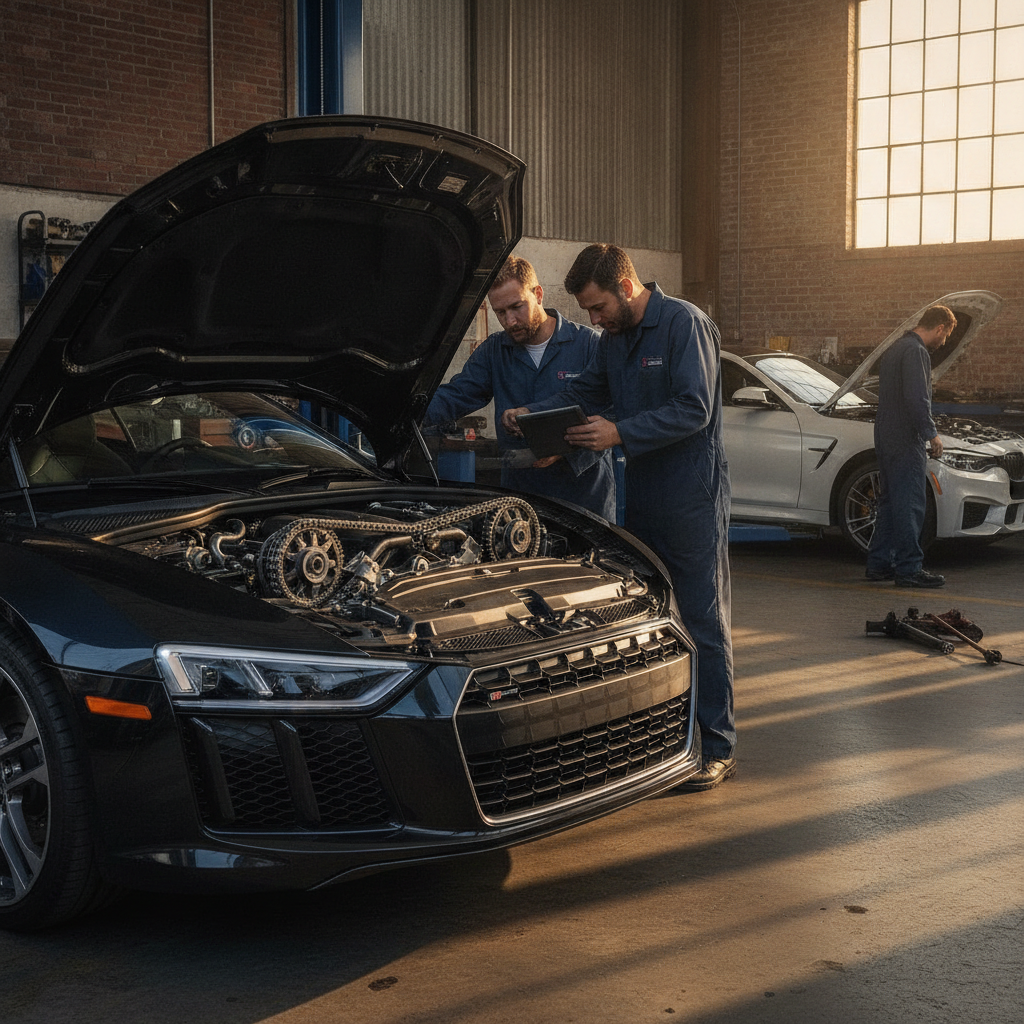
Why Is My Audi or BMW’s Timing Chain Making Noise in Healdsburg — and What Does a Tensioner Failure Actually Mean?
If your BMW or Audi is producing a brief metallic rattle or ticking sound during the first few seconds after a cold start — especially on cool Sonoma County mornings — you are not hearing a minor quirk that will work itself out. That sound is almost certainly your timing chain tensioner losing the fight, and in several of the most popular BMW and Audi four-cylinder engines produced over the last fifteen years, it is a known failure mode with well-documented consequences. For owners in Healdsburg, Geyserville, and the surrounding Wine Country corridor, where vehicles often sit overnight in cooler air and then get pushed hard on Highway 101 or the winding roads toward Cloverdale, the conditions that accelerate this failure are everywhere. Acting on the noise early is the difference between a manageable repair and a full engine rebuild.
What the Timing Chain Tensioner Actually Does — and Why It Fails
Your engine’s timing chain keeps the crankshaft and camshafts synchronized to within fractions of a degree. The tensioner’s job is to maintain exactly the right amount of tension on that chain at all times — through cold starts, heat cycles, and tens of thousands of miles of operation. It is hydraulically actuated, meaning it relies on oil pressure to hold the chain in check. When the tensioner wears out, loses its ability to hold pressure, or fails due to a design deficiency, the chain develops slack. That slack is what you hear as a rattle during cold starts, before oil pressure fully builds.
In BMW’s N20 four-cylinder engine — used extensively in the 320i, 328i, 428i, X1, and X3 from roughly 2012 to 2016 — the timing chain tensioner and timing chain guide assembly have a documented service life that falls well short of what owners expect from a modern German engine. The same applies to the earlier N13 engine in certain Mini Cooper and BMW 1 Series applications. On the Audi and Volkswagen side, the 2.0 TFSI engine in its earlier EA888 generation had a known timing chain tensioner problem that caused premature wear, and even the later-generation engines reward proactive inspection. In both platforms, the failure is progressive: the rattle appears first on cold starts, then begins to linger longer after startup, and eventually — if left unaddressed — the chain skips a tooth or snaps entirely.
When a timing chain fails catastrophically, the camshaft and crankshaft fall out of sync. In an interference engine — which most modern BMW and Audi engines are — that means pistons collide with open valves. The result is bent valves, damaged pistons, and in severe cases, a short block that cannot be saved. That is the scenario you are trying to avoid.
Why Sonoma County Driving Conditions Make This Worse
Several factors specific to Northern California Wine Country accelerate timing chain tensioner wear beyond what the factory service schedule anticipates. The hot, dry summers in the Healdsburg and Alexander Valley area put significant thermal stress on engine oil — and oil that has degraded or thinned from heat provides less hydraulic pressure to the tensioner, allowing more chain slack on startup. The same engines that idle fine on the highway can see accelerated wear if oil change intervals are stretched beyond what the conditions actually demand.
Owners who make longer drives — down Highway 101 toward Windsor, Larkfield-Wikiup, and Santa Rosa, or out toward Cloverdale on Highway 128 — tend to accumulate miles quickly, which is fine for a healthy engine but unforgiving for one that already has a marginal tensioner. And vehicles that sit for days at a time, as many second or weekend cars do in the Wine Country area, lose their oil film on critical components. That first cold start after a long sit is precisely when a weakened tensioner is most vulnerable.
The Specific Engines and Models to Watch
Not every BMW or Audi is equally susceptible, but these are the engine and model combinations that warrant the most attention:
- BMW N20 (2012–2016): The 2.0-liter turbocharged four-cylinder in the 328i, 428i, X1 xDrive28i, and X3 xDrive28i. Timing chain and tensioner failures in this engine have been widely documented; many experienced shops — including our team — treat tensioner inspection as a standard item on any N20 vehicle arriving for service past 60,000 miles.
- BMW N13 / Mini Cooper N14: Earlier Prince-family engines share similar tensioner vulnerabilities. If you own a 2007–2016 Mini Cooper S or JCW and have not had the timing chain assembly inspected, this should be on your radar — particularly if you have already addressed the water pump and thermostat housing, which tend to fail around the same mileage range.
- BMW B48 (2016–present): The current-generation 2.0-liter found in newer 3 Series, 5 Series, X3, and X5 models. While more refined than the N20, the B48 is not immune to chain wear, and the factory oil change intervals specified in BMW’s Condition Based Service system can exceed what California’s driving conditions actually warrant.
- Audi / VW 2.0 TFSI (EA888 Gen 1 and Gen 2): Widely used in the A4, A5, Q5, Passat, and GTI from approximately 2008 through 2014. The early EA888 had significant tensioner issues; later generations improved on this but still benefit from proactive inspection, especially when combined with the carbon buildup issues inherent to direct-injection engines.
If your vehicle uses one of these engines and you have not had a qualified specialist inspect the timing chain assembly, this is not a diagnosis to defer. A factory-grade scanner alone will not catch a mechanical timing chain problem — this requires a technician who knows what to listen for and how to evaluate chain stretch and tensioner integrity on a lift.
What a Proper Timing Chain Service Actually Involves
Replacing a timing chain on a modern European four-cylinder is not a minor job, but it is also not the disaster it becomes if you wait too long. A proper repair on an N20 or 2.0 TFSI involves removing the valve cover, front engine cover, and accessing the entire front-of-engine timing assembly. On most of these platforms, the responsible approach is to replace the chain, tensioner, guides, and seals as a complete assembly — not just the tensioner alone. Installing a new tensioner on a worn chain simply delays the problem.
OEM parts matter here. The tensioner and guide materials specified by BMW and Audi engineering exist for a reason; aftermarket timing components from non-OE suppliers introduce variables that no experienced European specialist is willing to accept on an interference engine. This is one of those repairs where using genuine or OEM-equivalent parts is non-negotiable. You can learn more about our approach to engine repair in Santa Rosa and the standards we apply to every job.
What Competitors in the Area Aren’t Telling You
Most local competitors cover timing chain topics only in the context of Mini Cooper — largely because the N14 failure became widely publicized. What is notably absent from the content put out by shops in this area is any detailed discussion of the BMW N20’s timing chain vulnerabilities, the Audi 2.0 TFSI tensioner history, or the specific inspection and replacement protocols that differentiate a complete repair from a shortcut that leaves you with the same problem two years later. If a shop quotes you a tensioner replacement only, without addressing the chain and guides, ask why — and be skeptical of the answer.
For Healdsburg and North Sonoma County owners who are already accustomed to driving to Santa Rosa for professional services, Bavarian Performance offers factory-level diagnostic capability — including ISTA for BMW and ODIS for Audi/VW — that allows us to evaluate timing system data and engine health far beyond what a generic OBD-II scanner can provide. Our European auto repair services for Healdsburg are built around the same standards we apply to every vehicle in our shop, regardless of where you drive in from.
Frequently Asked Questions
How long can I drive with a timing chain rattle on my BMW or Audi?
Not long, and not safely. A cold-start rattle that disappears after a few seconds indicates the tensioner is already marginal. If the rattle begins appearing at normal operating temperature, or lasts longer than a few seconds, the window for a straightforward repair may be closing. Do not treat this as a “monitor it” situation — have it inspected immediately.
Will my check engine light come on before the timing chain fails?
Sometimes, but not reliably. Cam timing deviation codes (such as P0011 or P0012 on BMW, or similar codes on Audi) can appear when chain slack becomes severe enough to affect variable valve timing. However, many timing chains fail mechanically before any fault code appears. Acoustic diagnosis from an experienced technician is often more useful than waiting for a warning light.
Is the timing chain covered under any extended warranty or recall on my BMW or Audi?
BMW issued a Technical Service Bulletin addressing N20 timing chain concerns and extended warranty coverage in some cases — but coverage depends heavily on your vehicle’s model year, production date, and mileage at the time of failure. Audi addressed some 2.0 TFSI concerns through extended warranty programs as well. A qualified specialist can help you determine whether any existing coverage applies to your vehicle before you authorize out-of-pocket repair.
How does oil change frequency affect timing chain life?
Significantly. Both BMW’s Condition Based Service intervals and Audi’s Flexible Service Intervals can push oil changes beyond 10,000 miles under certain driving conditions. In Sonoma County’s hot summers, frequent short trips, or stop-and-go driving toward the Bay Area on Highway 101, oil degrades faster than the system accounts for. Tightening oil change intervals to 7,500 miles or less with a quality full-synthetic oil is one of the most effective ways to extend timing chain and tensioner life on these platforms.
Can I drive from Healdsburg to Bavarian Performance in Santa Rosa if I suspect a timing chain problem?
If the rattle is brief and only present on cold starts, the drive south on Highway 101 is generally manageable — but call us first so we can advise based on your specific symptoms. If the noise is constant, loud, or present at operating temperature, do not risk the drive. We can discuss safe transportation options to get your vehicle to our shop without adding miles to a potentially compromised engine.
Don’t Wait Until the Chain Skips
Timing chain tensioner failure is one of the most preventable major engine repairs on modern BMWs and Audis — but only if you act on the early warning signs. If you are in Healdsburg, Windsor, Geyserville, or anywhere across Sonoma County and you are hearing that characteristic cold-start rattle, the right move is a proper diagnostic evaluation from a specialist who understands these platforms at a factory level. Bavarian Performance in Santa Rosa has the training, tooling, and genuine OEM parts to address this correctly the first time. Contact us to schedule an appointment — before an early warning becomes an engine rebuild.