
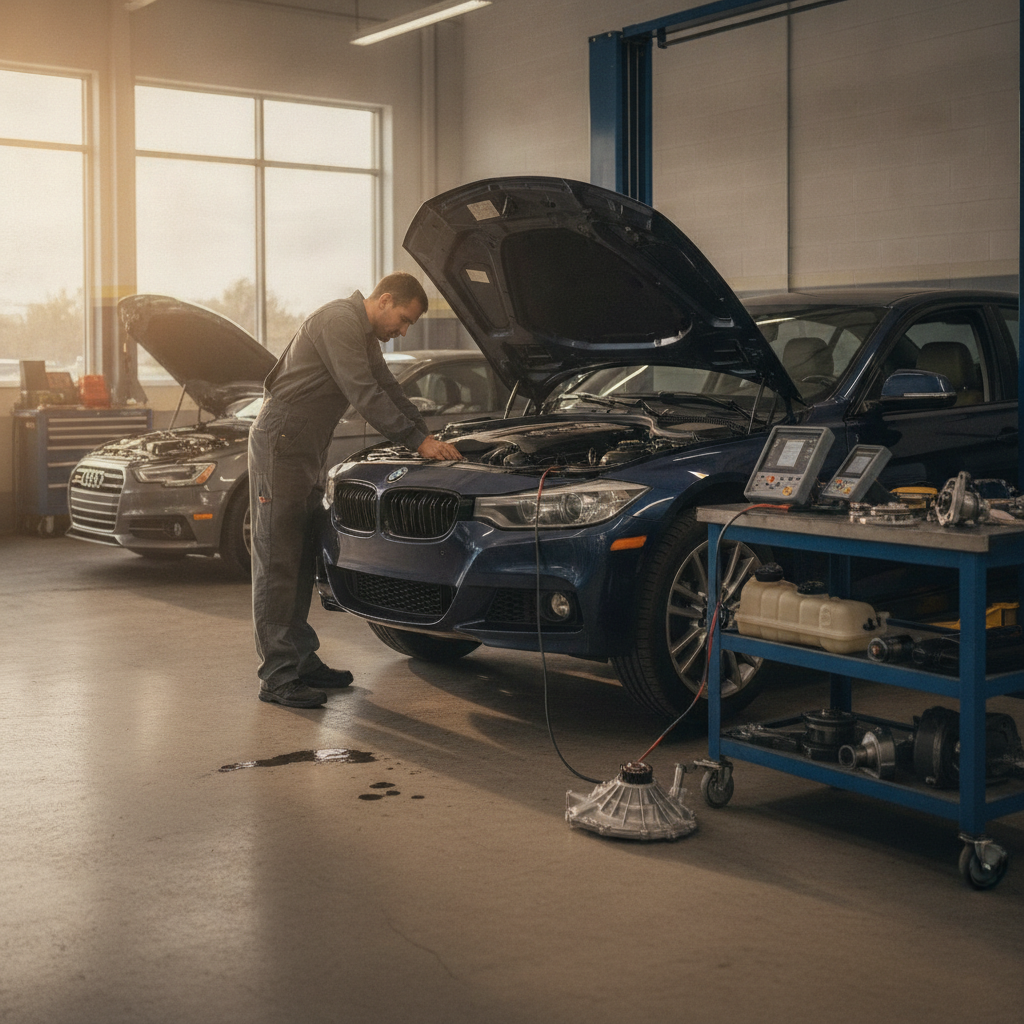
Why Is My BMW or Audi Running Hot This Summer in Fountaingrove — and What Does a Cooling System Service Actually Involve?
If your BMW or Audi temperature gauge is creeping higher than usual this summer — or you’ve noticed a sweet coolant smell after parking in Fountaingrove or anywhere in Santa Rosa — take that seriously. European cooling systems don’t fail dramatically at first. They fail gradually, with small leaks, slowly degrading coolant, and aging plastic components that hold up fine until one July afternoon when they don’t. By the time your dashboard warning light comes on, the damage is often already in progress. Here’s what a proper cooling system service actually looks like, why it matters more in Sonoma County’s summer climate than most owners realize, and what separates a real diagnosis from a quick top-off at a generic shop.
Why Sonoma County Summers Are Hard on European Cooling Systems
Santa Rosa and the surrounding areas sit in a climate that swings hard. Mornings are mild, but by early afternoon in July and August, temperatures in inland areas like Fountaingrove, Oakmont, and the Sonoma Valley regularly push into the upper 90s. If you’re driving a BMW or Audi with a cooling system that’s even slightly past its service window, that thermal stress accelerates the timeline to failure considerably.
BMW’s N20, N55, and B58 engines all use electric water pumps — a design choice that improves efficiency but creates a specific failure mode. Unlike a belt-driven pump that fails suddenly, an electric water pump degrades gradually. Flow rate drops, coolant temperature creeps up, and by the time your iDrive shows a warning, the pump may be delivering only a fraction of its designed output. On Audi’s 2.0T and 3.0T engines, the water pump and thermostat are known wear items in the 60,000–90,000 mile range, and the upper coolant hose and plastic expansion tank on many models are made of materials that don’t love fifteen-plus years of Sonoma heat cycling.
Add to that the elevation changes on roads through Fountaingrove, Annadel Heights, and the Bennett Valley corridor — your engine is working harder on those grades, generating more heat at exactly the moment ambient temperatures are already elevated.
What a Proper Cooling System Inspection Actually Covers
A cooling system service at an independent European specialist is not a coolant flush and a smile. Done correctly, it’s a systematic evaluation of every component in the circuit — and on a BMW or Audi with 60,000–120,000 miles, there’s usually more than one item approaching end of life simultaneously.
Here’s what a thorough inspection should include:
- Coolant condition and pH testing: BMW’s blue coolant and Audi/VW’s G13 formula degrade over time, becoming acidic and corrosive to aluminum components. Color alone tells you nothing — the fluid needs to be tested, not eyeballed.
- Pressure testing the system: A cold-static pressure test holds the system at spec pressure and watches for decay. This catches leaks at the expansion tank cap, hose connections, and head gasket seams that aren’t visible during a visual inspection.
- Expansion tank and cap inspection: The plastic expansion tanks on BMW E90, F30, and Audi B8/B9 platforms crack at the seams. The cap’s pressure-holding capability degrades independently. Both are inexpensive to replace; ignoring them is not.
- Water pump operation: On BMWs with electric pumps, the factory ISTA diagnostic tool can command the pump to full output and measure actual flow against spec — something a generic OBD-II scanner cannot do. If you’re not using factory-grade diagnostic equipment, you’re guessing.
- Thermostat function: BMW uses map-controlled thermostats that can be opened and closed on command via ISTA. A stuck-closed thermostat on a hot day in Rohnert Park or on Highway 12 through the Sonoma Valley is a head gasket event waiting to happen.
- Radiator, hoses, and auxiliary pump: On turbocharged Audis and BMWs, there’s often a secondary electric pump for turbo coolant circulation after shutdown. These fail quietly and are easy to overlook.
The Parts Question: OEM vs. Aftermarket on Cooling Components
This is where a lot of owners — and a lot of shops — cut corners that cost more later. Cooling system components on European cars are one area where genuine OEM or OE-equivalent parts are not optional. Here’s why:
The aftermarket is full of water pumps for BMW N-series engines that look identical to the OEM unit but use brushes and impeller materials that fail within 20,000–30,000 miles. The OEM electric pump from Pierburg (BMW’s supplier) is engineered to the thermal and electrical tolerances of the DME. A cheap substitute that flows 85% as well as spec on a 100-degree afternoon in Windsor or Healdsburg is not adequate.
Similarly, Audi coolant flanges, thermostat housings, and upper coolant pipes are made from reinforced plastics with specific expansion coefficients. An aftermarket equivalent that doesn’t match those specs will leak — usually right after you paid labor to install it. Genuine OEM sourcing is a core part of what Bavarian Performance brings to every Audi repair.
What This Actually Costs — and Why Waiting Costs More
A proactive cooling system service on a BMW or Audi — water pump, thermostat, coolant flush, expansion tank, and hoses — is a significant service. It’s not cheap. But it is predictable, it’s scheduled, and it’s done on your terms.
A head gasket replacement on an Audi 2.0T or a BMW N55 is not cheap, not predictable, and definitely not on your terms. The math is straightforward: a proactive cooling system service typically costs a fraction of what head gasket repair runs, and it eliminates the risk entirely. For a vehicle with 80,000–100,000 miles driven on Highway 101 commutes from Petaluma or Sonoma County wine country roads, the question is not whether these components will need service — it’s whether you’ll address them on a maintenance schedule or in a tow truck.
Why Generic Shops and Quick-Lube Chains Underdeliver Here
Most general repair shops in Sonoma County can replace a radiator or flush coolant. What they can’t do is interrogate a BMW’s DME for thermal management fault codes, command the electric water pump through its duty cycle range, or read the live data from an Audi’s coolant temperature sensor array against factory tolerances — because they don’t have ISTA or ODIS, the factory diagnostic platforms for these vehicles.
That matters because modern European cooling systems are not purely mechanical. BMW’s thermal management module communicates with the engine control unit to vary coolant flow based on load, speed, and ambient temperature. When something is wrong, the fault is stored in the DME, not the generic OBD-II system. A shop working with a $200 scan tool and a general knowledge of how cooling systems work is operating blind on these vehicles. A specialist with factory-level diagnostic capability can tell you exactly which component is underperforming before it causes collateral damage.
Frequently Asked Questions
How do I know if my BMW or Audi’s water pump is failing before it causes overheating?
Early signs include a temperature gauge that takes longer than usual to stabilize, intermittent coolant warnings on cold mornings, or a faint sweet smell from the engine bay after a drive. On BMWs, ISTA can detect reduced pump output well before the gauge shows anything abnormal. Don’t wait for a dashboard warning — that’s often the last signal before serious damage.
How often should coolant be replaced on a European vehicle?
BMW recommends coolant changes every 4 years or 60,000 miles, whichever comes first. Audi and VW specify similar intervals for G12/G13 coolant. Many vehicles we see in Santa Rosa are well past these intervals — and old coolant is acidic coolant, which means it’s actively corroding your aluminum engine components.
Can I just add coolant if the level is low?
Topping off is a temporary measure, not a fix. If your expansion tank is losing coolant, there’s a leak somewhere in the system. Adding fluid buys you time to get to a specialist — it does not address the source of the loss. Adding the wrong coolant type (mixing G11 blue with G13 violet, for example) also creates a chemistry problem that can damage seals and deposits over time.
Is the BMW electric water pump really a common failure point?
Yes — it’s one of the most well-documented wear items on N20, N52, N54, and N55 engines. Many BMW specialists, including our team, recommend proactive replacement at 60,000–80,000 miles regardless of symptoms, particularly on vehicles driven in hot-climate areas. The cost of the pump is modest; the cost of what it protects is not.
Do you service cooling systems on other European brands, not just BMW and Audi?
Absolutely. We service cooling systems across all European and luxury platforms — Mercedes-Benz, Porsche, Volkswagen, Land Rover, Volvo, Mini Cooper, and Italian exotics including Ferrari, Maserati, and Lamborghini. Each brand has its own failure patterns and OEM part requirements, and we work with factory-level diagnostic equipment for all of them.
Don’t Wait Until Your Temperature Gauge Tells You It’s Too Late
If your BMW or Audi has more than 60,000 miles and hasn’t had a cooling system service, Sonoma County’s summer heat is the wrong time to find out the hard way. Fountaingrove, Oakmont, and the surrounding hillside communities are some of the most thermally demanding driving environments in the region — and that’s before you factor in a daily Highway 101 commute or a weekend run through the Sonoma Valley on Highway 12.
Bavarian Performance brings factory-trained expertise, OEM-grade parts, and dealer-level diagnostic tools to every cooling system service — without the dealership wait time or pricing. Contact us to schedule a cooling system inspection or book a multi-point evaluation and know exactly where your vehicle stands before summer peaks.