
Why Is My Volkswagen’s or Audi’s DSG Acting Up After a Long Highway 101 Commute in Rohnert Park — and What Does a Mechatronic Service Actually Fix?
If your Volkswagen Golf, GTI, Tiguan, or Audi A3, A4, or Q5 has started hesitating at low speeds, jerking during first-to-second gear transitions, or throwing a transmission fault code after stop-and-go Highway 101 commuting, you’re dealing with one of the most misdiagnosed conditions in European auto repair. The DSG — Volkswagen and Audi’s Direct Shift Gearbox — is an engineering achievement, but it’s also a precision system that wears in very specific and predictable ways. Near Rohnert Park and throughout the Santa Rosa area, the combination of daily Highway 101 stop-and-go traffic and warm summer temperatures creates conditions that accelerate exactly the kind of wear the mechatronic unit is most vulnerable to. Here’s what’s actually happening, what a mechatronic service does, and why the diagnosis has to be right before any repair begins.
What the DSG Mechatronic Unit Actually Does
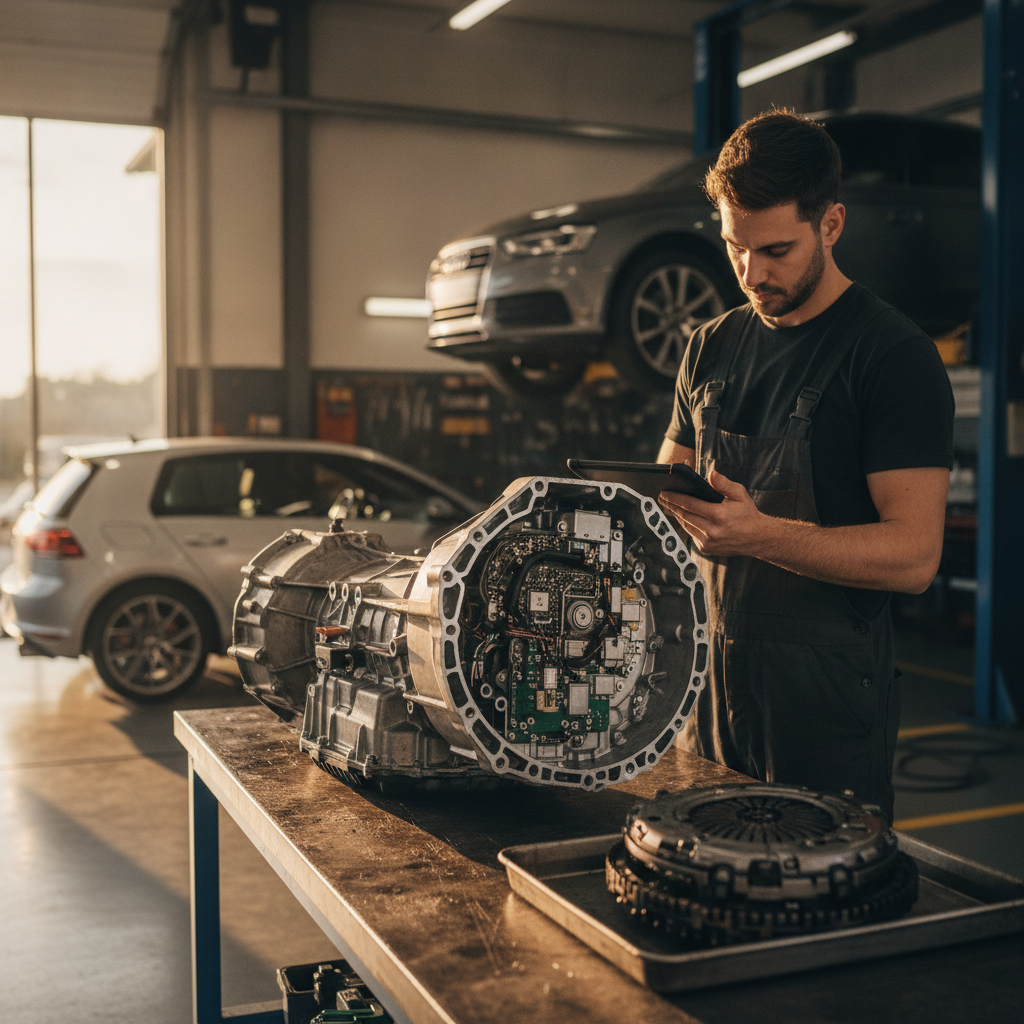
The DSG transmission in most Volkswagen and Audi applications is a dual-clutch design — two separate clutch packs (one for odd gears, one for even gears) that operate simultaneously to enable near-seamless gear changes without a torque converter. What makes it work is the mechatronic unit: a combined hydraulic control module and transmission control module housed inside the gearbox itself. It manages clutch engagement pressure, solenoid operation, gear selection logic, and fluid distribution — all in real time, all based on sensor feedback.
When the mechatronic unit develops a fault, the transmission doesn’t know how hard to clamp the clutch or how quickly to shift. What you feel is hesitation off the line, a shudder or jerk at low speeds (especially in first and second gear), delayed engagement from Park or Neutral, or an outright limp-mode event with a dashboard warning. Many owners — and more than a few shops — mistake this for clutch pack failure and quote a full transmission rebuild. In a significant percentage of cases, the mechatronic unit is the actual problem, and the clutch packs have life remaining.
Why Highway 101 Commutes Are Especially Hard on the DSG
The stretch of Highway 101 between Rohnert Park, Cotati, and Santa Rosa sees the kind of low-speed, high-frequency engagement that a dual-clutch transmission handles less gracefully than a traditional torque-converter automatic. Every time you inch forward in stop-and-go traffic, the DSG’s odd-gear clutch is partially engaging and releasing — generating heat and hydraulic pressure cycling that accumulates over thousands of commute miles. Add Sonoma County’s hot dry summers, where ambient temperatures can push gearbox fluid temps higher than engineers anticipated for Bay Area-style driving patterns, and you have a recipe for accelerated mechatronic wear.
The DQ250 — the six-speed wet-clutch DSG found in most Golf, GTI, Tiguan, Jetta GLI, and Audi A3 applications — uses a shared oil bath for both the clutch packs and the mechatronic hydraulics. Fluid condition is therefore critical. Volkswagen Group extended service intervals on these transmissions in ways that real-world driving does not support, and owners who commute on Highway 101 and push to 40,000 or 60,000 miles on the original DSG fluid regularly report mechatronic and solenoid faults that wouldn’t have developed with timely fluid service. The DQ500 — the seven-speed wet-clutch unit in heavier applications like the Tiguan Allspace and some Golf R variants — shares similar vulnerabilities at higher mileage.
What a Mechatronic Service Actually Involves
A proper mechatronic service is not just a fluid drain and fill. Depending on the fault codes present and the transmission’s service history, it may involve one or more of the following:
- Factory-level ODIS diagnostic scan: Generic OBD-II scanners cannot read the transmission-specific fault codes stored in the DSG’s TCM. You need ODIS (Off-board Diagnostic Information System) — Volkswagen Group’s proprietary diagnostic platform — to see the full fault memory, live clutch engagement data, solenoid current values, and adaptation values. Without this, the diagnosis is guesswork.
- DSG fluid and filter service: Full drain of the wet-clutch fluid, mechatronic filter replacement, and refill with the correct fluid specification (G 052 182 for most DQ250 applications). Using the wrong fluid — including many aftermarket alternatives — will cause immediate clutch shudder.
- Mechatronic unit inspection and, where warranted, replacement: The mechatronic unit itself can be replaced as a unit. In many fault scenarios, this resolves the hesitation and fault codes entirely without touching the clutch packs.
- Adaptation reset and relearn procedure: After any DSG service or mechatronic work, the transmission’s adaptation values must be reset and a specific relearn procedure completed using factory-grade tools. Skip this step and the transmission will feel wrong regardless of what else was done correctly.
This is exactly the kind of work that separates a factory-trained European specialist from a general shop with a mid-grade scan tool. If a shop can’t perform an ODIS-level diagnosis on your Volkswagen or Audi, they cannot accurately tell you whether the mechatronic unit, the clutch packs, or simply the fluid is responsible for the symptoms you’re experiencing.
The Gap Most Local Competitors Don’t Address: DSG-Specific Fault Patterns by Application
Most of the transmission content you’ll find from shops in the Sonoma County area focuses on either general automatic transmission repair or basic fluid service. What you won’t find is specific guidance on how DSG fault patterns differ between applications — and this matters because the correct repair path depends heavily on which gearbox your car has and what the fault codes actually say.
For example, a 2015–2019 Golf GTI or Audi A3 with a DQ250 and a P17BF solenoid fault code almost always needs the mechatronic unit serviced or replaced — not clutch packs. A 2012–2015 Passat with the same hesitation complaint but a different fault pattern may need the fluid refreshed and adaptations reset before any further work is justified. A Golf R or Audi S3 with a DQ381 seven-speed dry-clutch DSG presents a completely different set of wear characteristics than a wet-clutch DQ250. Treating these as interchangeable is how owners end up with incorrect repairs and recurring complaints.
At Bavarian Performance, we service the full range of Volkswagen and Audi DSG transmissions using ODIS factory diagnostics, which means the repair recommendation comes from actual fault data — not a parts-replacement guess. Owners driving in from Petaluma, Windsor, and across the Highway 101 corridor regularly find that what another shop quoted as a full transmission rebuild turns out to be a mechatronic service and fluid change when the diagnosis is done properly.
How to Know If It’s Time to Have the DSG Inspected
You don’t need to wait for a fault code to appear on the dashboard. These are the early warning signs that DSG inspection is warranted on your Volkswagen or Audi:
- Noticeable hesitation or lurch when pulling away from a stop, especially when the transmission is cold
- A juddering or vibration through the drivetrain at low speeds in first or second gear
- Delayed engagement when shifting from Park or Reverse into Drive
- Unusual hunting between gears at highway speeds
- A flashing PRNDS indicator or transmission warning light
- More than 40,000 miles on the original DSG fluid — or no service record at all on a used vehicle
If you’ve purchased a used Volkswagen or Audi in Sonoma County and the DSG service history is unknown, a fluid service and ODIS inspection is a low-cost way to establish a baseline and avoid a much more expensive repair later. Our transmission service at Bavarian Performance covers DSG inspection, fluid service, mechatronic diagnosis, and adaptation procedures for all Volkswagen Group applications.
Frequently Asked Questions: DSG and Mechatronic Service Near Rohnert Park
How often should the DSG fluid be changed on my Volkswagen or Audi?
For most DQ250 wet-clutch applications, a fluid and filter service every 30,000 to 40,000 miles is appropriate for real-world Sonoma County driving — especially if you commute on Highway 101 regularly. Volkswagen’s published interval is longer, but it was not calibrated for stop-and-go Bay Area commute patterns or summer heat.
Can I just drive it in limp mode until I get to the shop?
Limp mode protects the transmission from further damage, but it shouldn’t be treated as a long-term driving condition. The underlying fault that triggered limp mode can worsen, and some fault conditions — particularly low fluid pressure — can accelerate clutch pack wear significantly if ignored.
Will a fluid service fix the hesitation, or do I definitely need the mechatronic unit?
That depends entirely on the fault codes and live data from an ODIS scan. In some cases — particularly vehicles with no prior fluid service and symptoms that started recently — a fluid and filter service with an adaptation reset resolves the issue completely. In others, the mechatronic unit has developed internal faults that fluid service won’t address. The only honest answer comes from a proper factory-level diagnosis.
Is the DSG reliable long-term if serviced correctly?
Yes — the DQ250 and DQ500 are robust transmissions when maintained on appropriate intervals. Many well-maintained examples go beyond 150,000 miles without major mechanical work. The failures you read about are almost always linked to neglected fluid service or a delay in addressing early fault codes.
Do you service DSG transmissions in cars from outside Santa Rosa?
Yes. Bavarian Performance serves Volkswagen and Audi owners throughout Sonoma County and the surrounding North Bay — including drivers from Petaluma, Cotati, Windsor, and beyond. If you’re commuting into the area or looking for a specialist closer to home than a dealership, we’re worth the drive.
Get Your DSG Diagnosed by a Factory-Trained Specialist
If your Volkswagen or Audi’s DSG has been hesitating, jerking, or throwing fault codes, don’t let a generic diagnosis push you toward a repair your transmission doesn’t actually need. Bavarian Performance uses factory-grade ODIS diagnostic equipment and genuine OEM fluid specifications to give you an accurate picture of what’s happening — and what it actually takes to fix it. Contact us to schedule an inspection and get a straight answer on what your transmission needs.
Bavarian Performance | 3069 Wiljan Ct, Suite D, Santa Rosa, CA | (707) 545-2002 | Schedule an Appointment