
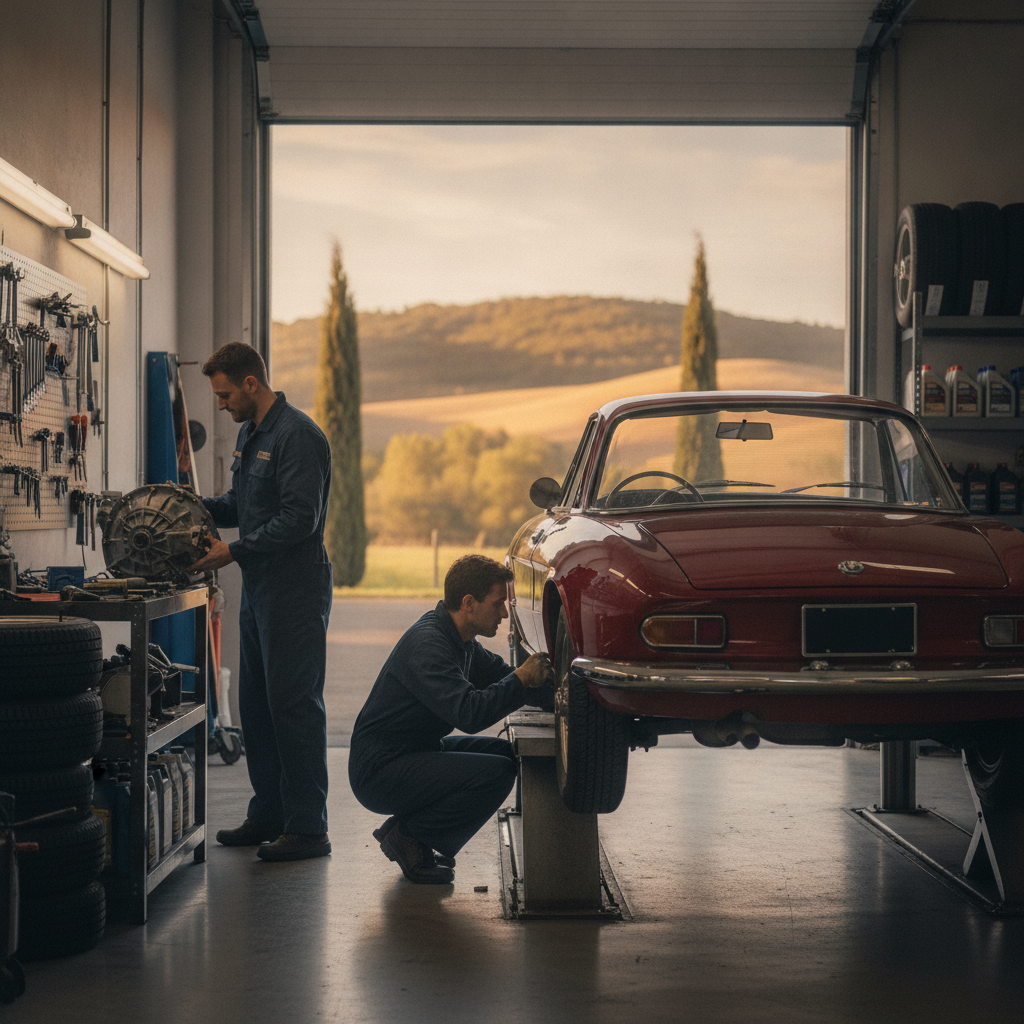
Why Is My Alfa Romeo or Fiat Making Strange Noises After Driving Sonoma’s Back Roads — and What Does a Multi-Point Inspection Actually Catch?
If your Alfa Romeo Giulia, Stelvio, or Fiat 500 has developed a new creak, knock, or shimmy after a weekend run through the Sonoma Valley or a stretch of Highway 12 between Kenwood and Glen Ellen, you’re not imagining it — and you’re not alone. The back roads that make Sonoma County one of the most beautiful places to drive in California are also genuinely punishing on Italian suspension geometry, rubber bushings, and steering components. The good news: most of what’s making that noise is entirely preventable when caught early. The not-so-good news is that most shops in the area simply don’t know these platforms well enough to find it before it becomes expensive.
What Sonoma County’s Roads Actually Do to Italian Cars
Alfa Romeo and Fiat vehicles are engineered with a driving-focused philosophy that prioritizes feedback and handling precision over compliance and isolation. That’s what makes an Alfa Giulia genuinely satisfying on a winding road — and what makes it more sensitive to road abuse than, say, a crossover SUV tuned for highway cruising.
The rural routes through Sonoma County — River Road near Guerneville, the switchbacks on Bennett Valley Road, the vineyard access lanes between Sebastopol and Forestville — all combine chip seal, uneven pavement, and washboard surfaces that transfer directly into the chassis. Vineyard dust and fine grit work into suspension bushings, CV boots, and brake hardware. If you live near the coast and occasionally take your Fiat or Alfa out toward Bodega Bay, salt air adds accelerated corrosion to brake rotors, wheel hardware, and any exposed underbody metal.
None of this is catastrophic on its own. But Italian cars, especially Alfa Romeos, have suspension geometries and component tolerances that are tighter than most German platforms. Small amounts of play in a lower control arm bushing or a worn front sway bar end link create disproportionate handling changes — and noises that seem to come from everywhere at once.
Why Most Local Shops Miss Italian Car Problems on a Routine Inspection
Here’s something most service advisors won’t tell you: a generic multi-point checklist designed for domestic vehicles or even common Japanese platforms doesn’t map cleanly onto an Alfa Romeo or Fiat. The inspection points matter, but so does knowing what failure modes are actually common on these specific platforms.
On the Alfa Romeo Giulia and Stelvio, for instance, the front lower control arm bushings and rear subframe mounts are known wear points — particularly on vehicles that see any real-world driving over imperfect surfaces. The Giulia’s DNA drive mode selector and its associated electronic chassis systems also produce fault codes that only show up on factory-compatible diagnostics tools, not generic OBD-II readers. A shop that plugs in a generic scanner, sees no codes, and sends you home with a clean bill of health hasn’t actually inspected your car.
On Fiat 500 and 500X models, the focus shifts. The 500 Abarth’s stiff suspension tuning means subframe and strut mount wear happen faster than owners expect, especially in stop-and-go driving or on rough pavement. The 500X, which shares architecture with the Jeep Renegade, brings its own set of quirks around the 9-speed ZF automatic transmission and a front suspension geometry that reacts poorly to worn tie rod ends. Knowing which version of the platform you’re actually dealing with matters enormously when the noise starts.
A proper multi-point inspection performed by a European specialist goes well beyond checking fluid levels and brake pad thickness. It means knowing the platform-specific wear schedule, having the right diagnostic tools to read manufacturer fault codes, and physically inspecting the components most likely to fail given how and where the vehicle is driven.
What a Thorough Multi-Point Inspection Catches on These Platforms
When Bavarian Performance inspects an Alfa Romeo or Fiat, the process reflects the actual engineering of the vehicle — not a generic template. Here’s what a proper inspection covers:
- Suspension and steering geometry components: Control arm bushings, ball joints, sway bar links, and tie rod ends — with specific attention to the failure patterns on Giulia/Stelvio front suspension and 500X steering rack mounts.
- Brake system condition: Pad thickness, rotor surface quality, and corrosion on caliper hardware — especially relevant for vehicles driven near the coastal fog corridor between Petaluma and Bodega Bay.
- CV axles and drivetrain boots: Torn boots and early CV joint wear are common on Fiat platforms and accelerate when vineyard dust or grit gets past a compromised boot seal.
- Engine and transmission fluid condition: Italian manufacturers have specific fluid specifications that generic shops frequently ignore. Using the wrong transmission fluid in a ZF 9-speed or the TCT dual-clutch found in some Alfa models causes accelerated wear that shows up as shift hesitation before it shows up as a hard fault.
- Factory-level electronic diagnostics: Alfa Romeo and Fiat electrical systems require manufacturer-compatible scan tools to read all fault codes. This matters for everything from TPMS calibration to DNA system faults to airbag module status.
- Cabin air filter and intake: Wildfire smoke events — a real concern in this region since the 2017 Tubbs Fire — load cabin filters and intake systems faster than normal service intervals account for. Hot, dry Sonoma summers also stress cooling systems on turbocharged Alfa Romeo engines.
- Tire wear patterns: Alfa Romeo vehicles with performance-oriented suspension geometry show uneven tire wear that reveals alignment and bushing issues before they become audible. This is one of the clearest early warning signs, and it’s frequently overlooked.
The Cost Reality of Italian Car Ownership — and Why Early Inspection Saves Money
Alfa Romeo and Fiat ownership has an undeserved reputation for unpredictable repair costs. The truth is more nuanced: these vehicles are not inherently unreliable, but they punish deferred maintenance and incorrect service more severely than German or Japanese platforms. A lower control arm bushing on a Giulia that gets caught during an inspection is a straightforward repair. The same bushing, ignored until it fails completely and introduces play into the front subframe, can turn into a significantly larger job.
Genuine OEM parts matter here more than on some other platforms. Alfa Romeo suspension components in particular are engineered to tight tolerances, and budget aftermarket substitutes introduce handling inconsistencies that are difficult to diagnose after the fact. When we source parts for Alfa Romeo or Fiat repairs, we use OEM or manufacturer-approved components — not whatever happens to be available through a generic parts distributor.
Serving Alfa Romeo and Fiat Owners Across Sonoma County
Bavarian Performance is based in Santa Rosa and serves owners throughout Sonoma County — including those in Sonoma, Glen Ellen, Kenwood, Sebastopol, and Petaluma who drive their Italian cars on exactly the kind of roads that reveal deferred maintenance. We work on the full range of Alfa Romeo models — Giulia, Stelvio, 4C, and older classics — as well as the Fiat 500 family, 500X, and 500L.
What sets our approach apart is simply that we know these platforms. We use factory-compatible diagnostic tools, genuine OEM parts, and the kind of brand-specific inspection process that dealerships charge a premium for — without the dealership wait times or service department upsell pressure. If you’re out of warranty and looking for a specialist who actually understands your car, that’s exactly what we’re here for.
If you’ve been hearing something new from your Alfa Romeo or Fiat after a run through the valley, don’t ignore it. It’s almost always cheaper to find out what it is than to find out what it became.
Frequently Asked Questions
How often should an Alfa Romeo Giulia or Stelvio be inspected if I drive Sonoma County back roads regularly?
At minimum, a thorough multi-point inspection at every oil service interval — typically every 10,000 miles or annually under Alfa’s Flexible Service schedule. If you regularly drive rural routes through the Sonoma Valley or West County, we’d recommend more frequent suspension and brake checks given the road conditions.
Can a generic OBD-II scanner read all the fault codes on my Alfa Romeo?
No. Generic OBD-II tools only access emissions-related engine codes. Factory-compatible tools are required to read chassis, transmission, airbag, TPMS, and DNA system faults on Alfa Romeo and Fiat vehicles. This is one of the most common reasons owners get a false-clean diagnosis from shops that aren’t equipped for these platforms.
My Fiat 500 Abarth has a vibration at highway speeds — is that a wheel balance issue or something more serious?
It could be either. High-frequency vibration at speed is often a tire or wheel balance issue — road-force balancing is more accurate than standard spin balancing for performance-spec tires. But vibration that changes with steering input or shows up at lower speeds is more likely a wheel bearing or CV joint issue. A proper inspection will distinguish between them quickly.
Is it worth using an independent specialist for Alfa Romeo service, or should I use the dealer?
For most service and repair work on out-of-warranty vehicles, an independent European specialist with factory-level tools and OEM parts access will deliver equivalent quality at meaningfully lower cost. Dealers carry advantages in warranty-related work and software updates tied to active recalls — but routine maintenance and most repairs are well within an independent specialist’s scope.
What’s the most common noise complaint on Alfa Romeo Giulias driven in this area?
Front suspension creaking over rough pavement is the most frequent complaint we see — usually traced to front lower control arm bushings or strut top mounts. It’s a known wear point on the Giulia platform and entirely correctable. Catching it early, before it introduces play into the steering feel, keeps the repair contained and the car driving the way it should.
Schedule an Inspection at Bavarian Performance
If your Alfa Romeo or Fiat has been telling you something’s off — through noise, vibration, or handling that doesn’t feel quite right — bring it to a shop that knows exactly what to look for. Bavarian Performance serves Italian car owners throughout Santa Rosa and Sonoma County with factory-level expertise and genuine OEM parts. Contact us to schedule your multi-point inspection — we’ll tell you exactly what’s going on and what it will take to fix it right.