
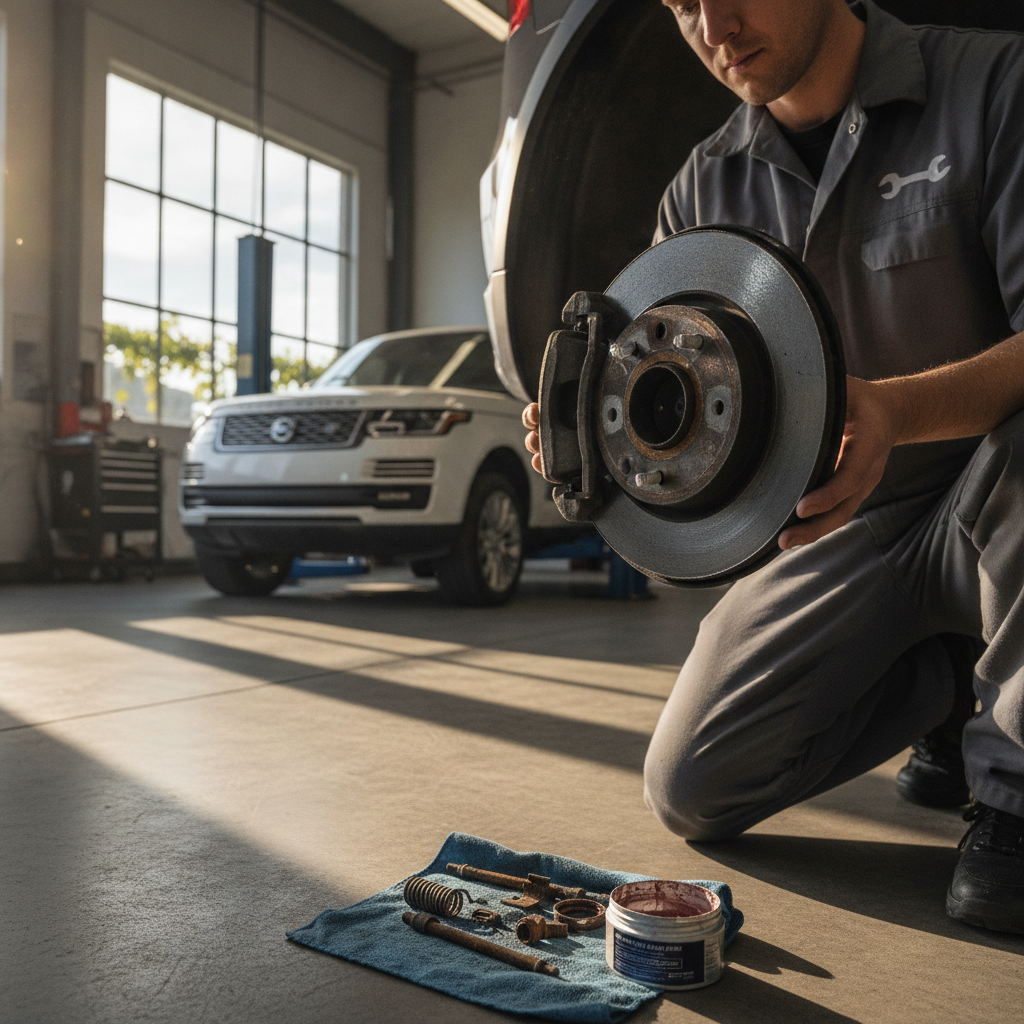
Why Is My Volvo’s or Land Rover’s Brake Pads Wearing Unevenly in Petaluma — and What Does a Caliper Slide Pin and Brake Hardware Service Actually Fix?
If you’ve noticed your Volvo XC60 or Land Rover Discovery pulling subtly to one side under braking, or your most recent pad inspection revealed one side worn to the metal while the other still had plenty of material left, the culprit is almost certainly not the pads themselves. Uneven brake pad wear in Petaluma and across Sonoma County is one of the most commonly misdiagnosed brake complaints — and one of the most underserved topics in local auto repair content. The real problem usually lives in the caliper: specifically, seized slide pins, corroded hardware abutment clips, or a caliper piston that isn’t retracting cleanly. Left unaddressed, it chews through rotors, compromises stopping power, and turns a straightforward brake service into an expensive rotor replacement job.
What Caliper Slide Pins Actually Do — and Why They Fail
Every floating brake caliper on your Volvo or Land Rover depends on two slide pins to do its job correctly. When you press the brake pedal, hydraulic pressure pushes the inner pad against the rotor. For the outer pad to contact the rotor with equal force, the entire caliper body has to slide inward along those pins. If the pins are corroded, dry, or seized — which happens more often than most drivers realize in coastal Sonoma County — the caliper can’t float freely. The inner pad does most of the work, the outer pad barely contacts the rotor, and within a few thousand miles you’ve got one pad at 2mm and one at 7mm.
Salt air from the Bodega Bay corridor is particularly aggressive on brake hardware. Drivers in Sebastopol, Occidental, and along the River Road route know their vehicles take on a lot more moisture than those parked in a Fountaingrove garage. That moisture works into the rubber boots that protect the slide pins, the boots crack or collapse, and the pins corrode inside their bores. This isn’t a defect — it’s physics acting on ferrous metal in a wet coastal climate. What matters is catching it before it damages your rotors.
Why Volvo and Land Rover Brake Systems Are Particularly Vulnerable
Both Volvo and Land Rover use sophisticated multi-piston and floating caliper designs that deliver impressive stopping performance from the factory. Land Rover’s larger platform vehicles — the Defender, Discovery, and Range Rover Sport — carry significant curb weight, which means the brake hardware is working hard on every stop. When you factor in the hilly terrain around Petaluma’s east side, Sonoma Mountain, or the grade changes along Highway 12 and West County roads, that hardware takes repeated thermal cycles that accelerate corrosion and grease breakdown inside the slide pin bores.
Volvo’s XC-series vehicles share a similar story. The XC90 and XC60 are genuinely heavy for their class, and Volvo’s reputation for safety engineering extends to its brake systems — but only if those systems are properly maintained with the right lubricants and hardware. Many general repair shops apply whatever caliper grease they have on hand, which can be incompatible with the rubber compounds Volvo specifies for its pin boots. That accelerates boot failure and brings you right back to a seized pin situation faster than you’d expect.
What a Proper Caliper Slide Pin and Brake Hardware Service Actually Involves
When a technician who actually knows European brake systems performs this service, it’s not simply swapping pads and calling it done. Here’s what a thorough job looks like:
- Slide pin removal and inspection: Both pins come out completely. If they show corrosion pitting, scoring, or if the rubber boots are torn or hardened, the pins and boots are replaced — not cleaned and reinstalled.
- Bore cleaning: The caliper mounting bracket bores are cleaned of oxidation and old grease before fresh, specification-correct lubricant is applied. Using the wrong grease here will eat rubber and negate the entire service.
- Abutment clip and hardware replacement: The spring clips that hold the pads in their channels wear, corrode, and lose their tension. Reusing old clips is false economy — new hardware ensures the pads can retract cleanly after each brake application, which is what prevents residual drag and premature wear in the first place.
- Caliper piston inspection and service: A sticking piston is often the root cause behind what looks like a slide pin problem. The piston must be fully retracted, inspected for corrosion or boot damage, and evaluated for rebuild or replacement if it doesn’t move freely.
- Rotor inspection for lipped wear: Uneven caliper function almost always leaves a wear lip on the rotor’s outer edge. Depending on rotor thickness and how long the problem went unchecked, resurfacing or replacement may be necessary.
Genuine OEM hardware matters here. The abutment clips, pin boots, and lubricant specified by Volvo and Land Rover are engineered to specific tolerances and material compatibility. Aftermarket hardware kits sourced from generic suppliers often look identical but use cheaper alloys or incompatible rubber compounds. For something as safety-critical as your brake system, that’s not a trade-off worth making.
The Gap Most Local Shops Miss: Residual Drag and Pad Knockback
Here’s the detail that separates a knowledgeable European brake specialist from a quick-lube shop doing brake work on the side: pad knockback. On Land Rover and Volvo models with certain suspension geometries, particularly those with larger front anti-roll bars and stiffer suspension links, the rotor can experience lateral runout that causes the pads to be physically pushed back into the caliper slightly during cornering. This is normal engineering behavior — but it means that the next time you touch the brake pedal, there’s a brief moment of soft pedal feel before full pressure builds.
When slide pins are seized and the caliper isn’t floating properly, pad knockback becomes dramatically worse. What should be a barely-perceptible quirk becomes a genuinely soft first brake application. Many drivers adapt to this unconsciously, pressing the pedal harder before the brakes fully engage — which is exactly the kind of degraded safety margin that shouldn’t be acceptable in a vehicle designed to stop a two-and-a-half-ton SUV on a Petaluma back road in the rain.
Addressing knockback properly requires checking rotor runout with a dial indicator, confirming caliper float is fully restored, and verifying that pad retraction is clean and consistent. A proper European brake service at Bavarian Performance includes all of these checks — not just pad thickness measurement and a quick visual on the rotors.
Highway 101 Commutes Make This Worse Than You Think
Many Petaluma residents commute south toward Marin County or north to Santa Rosa and Rohnert Park via Highway 101. That corridor is stop-and-go in both directions during peak hours, which means repeated low-speed brake applications with incomplete caliper cooling between stops. This thermal cycling — heat building, partial cooling, heat building again — is exactly the condition that breaks down slide pin grease fastest and bakes moisture into the abutment clips. If your Land Rover or Volvo is a daily Highway 101 commuter, your brake hardware deserves inspection at every pad change, not just when something goes audibly wrong.
When to Address This — and What to Expect
Ideally, caliper slide pin service happens at every brake pad replacement. If you’re already past that point and you’re seeing uneven wear or feeling a pull under braking, the conversation at your next service appointment should include a full caliper hardware inspection before anyone quotes you rotors. Rotors may still be needed — but replacing them without correcting the underlying caliper issue just means you’ll be buying rotors again in 15,000 miles.
For Land Rover owners and Volvo drivers in the Petaluma, Sonoma, Windsor, and greater Sonoma County area, Bavarian Performance has the factory-level tooling and genuine parts sourcing to perform this work correctly. We don’t guess at what grease is compatible with your caliper boots — we know, because we work on these vehicles exclusively.
Frequently Asked Questions
How do I know if my caliper slide pins are seized and not something else?
The clearest signs are uneven pad thickness between the inner and outer pad on the same corner, a vehicle that pulls to one side under moderate braking, or a rotor that shows a prominent wear lip on only one edge. A proper inspection will confirm whether the slide pins move freely in their bores or whether one or both are stuck.
Can I just regrease the existing slide pins instead of replacing them?
If the pins themselves are smooth and undamaged, and the boots are intact, cleaning and regreasing with the correct specification lubricant is acceptable. But if the boots are cracked or the pins show corrosion scoring, reinstalling them is a temporary fix at best. Replacement pins and boots are inexpensive insurance compared to a warped rotor caused by a stuck caliper.
How often should brake hardware be replaced on a Land Rover or Volvo?
At minimum, abutment clips and hardware should be replaced with every pad change. Slide pins and boots should be inspected at every pad change and replaced whenever there’s any sign of boot damage, corrosion, or restricted movement. In coastal Sonoma County environments near Bodega Bay or Sebastopol, that inspection matters even more.
Does this service require dealer-level diagnostics?
Not typically — but it does require a technician who understands the specific caliper designs and hardware specifications for your vehicle. Where diagnostics become important is if Electronic Brake Distribution (EBD) or Dynamic Stability Control (DSC) faults are stored alongside the mechanical symptoms, which can indicate the ABS module has compensated for caliper drag and needs a reset after the hardware is corrected.
Is this covered under any kind of warranty on a newer Land Rover or Volvo?
Brake hardware wear is generally considered a maintenance item and falls outside powertrain or bumper-to-bumper coverage. CPO warranty coverage varies — it’s worth reviewing your documentation, but most owners in the 50,000–100,000 mile range are outside coverage and benefit most from an independent European specialist on cost versus a franchised dealer.
Get a Proper European Brake Inspection at Bavarian Performance
Uneven pad wear isn’t a nuisance — it’s your brake system telling you something is mechanically wrong with the caliper. If you’re in Petaluma, Rohnert Park, Sonoma, Windsor, or anywhere across Sonoma County and your Volvo or Land Rover is due for brake service, don’t settle for a shop that just measures pad thickness and hands you a rotor quote. Bavarian Performance uses genuine OEM hardware, specification-correct lubricants, and the hands-on knowledge that comes from working exclusively on European and luxury vehicles. Contact us today to schedule an inspection or request a free consultation — we’ll tell you exactly what your brake system needs and what it doesn’t.