
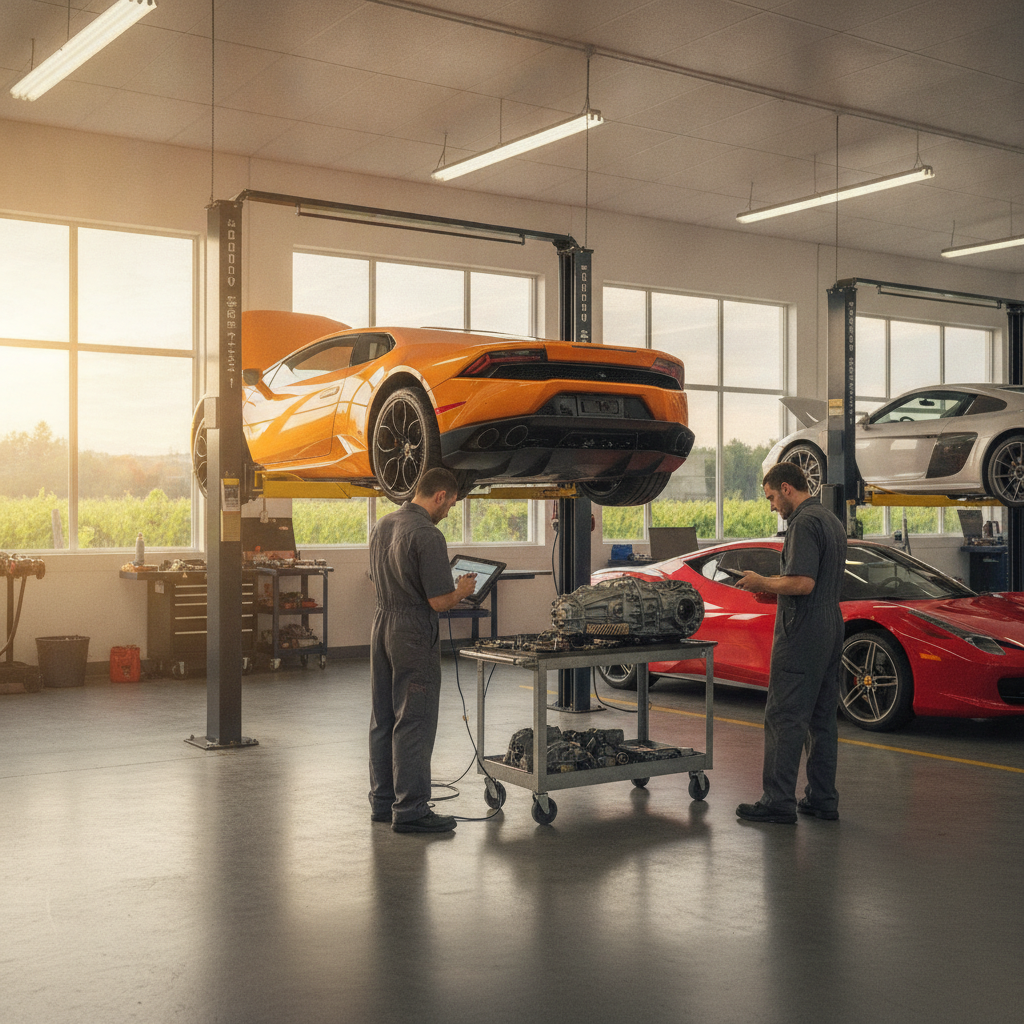
Why Is My Lamborghini’s or Ferrari’s Transmission Jerking or Refusing to Shift in Windsor — and What Does an Exotic DCT or Single-Clutch Gearbox Service Actually Involve?
If your Lamborghini Huracán or Ferrari 458 is lurching between gears, hesitating on upshifts, or dropping into limp mode somewhere between Windsor and Geyserville, you’re not imagining a problem — and it’s not a driving technique issue. Exotic Italian gearboxes, whether a Lamborghini dual-clutch (DCT) or a Ferrari single-clutch automated manual (e-gear or F1 transmission), are extraordinarily sophisticated systems that require factory-grade diagnostics and precise OEM-spec service. A generic scan tool and a bottle of aftermarket fluid won’t touch what’s actually wrong. Bavarian Performance in Santa Rosa works on these systems with the kind of depth and equipment most shops in Sonoma County simply don’t have access to.
What Makes Exotic Gearboxes Different From Everything Else on the Road
A dual-clutch transmission in a Lamborghini Huracán or Gallardo shares its basic architecture with a VW DSG, but that’s roughly where the similarity ends. The hardware tolerances, hydraulic pressures, clutch pack materials, and shift calibration algorithms are all operating at a completely different level. Ferrari’s older single-clutch automated gearbox — the e-gear or F1 system found on the 360, 430, and early 458 variants — operates on an electrohydraulic actuator that controls both clutch engagement and gear selection without a traditional torque converter or a second clutch pack. It’s fast when it’s healthy. When it’s not, it’s brutal.
Both systems are extraordinarily sensitive to fluid condition, actuator health, sensor calibration, and software state. And neither responds well to being diagnosed with a generic OBD-II reader. When a Lamborghini DCT or a Ferrari e-gear starts misbehaving, the fault codes stored in the transmission control module are often layered — one underlying cause spawns four or five secondary codes, and without factory-level diagnostic software, you’re chasing ghosts.
Common Symptoms That Bring Windsor and Healdsburg Exotic Owners In
The complaints we hear most often from owners driving Highway 101 north through Windsor or on the back roads toward Geyserville fall into a few consistent patterns:
- Hard or lurching gear changes — especially noticeable at low speeds or when pulling away from stops
- Hesitation or delay between paddle input and actual gear change
- Refusal to engage reverse — a classic early sign of hydraulic pressure issues in Ferrari e-gear systems
- Transmission warning lamp and limp-home mode activation
- Clutch slippage under hard acceleration — often misread as a mechanical clutch wear issue when the actuator calibration has simply drifted
- Grinding or clunking on downshift — particularly concerning in a DCT where clutch packs are sharing load management
None of these symptoms should be ignored, and none should be addressed without proper diagnostic data. These are not issues where waiting to see if it clears itself is a viable strategy.
What a Proper Exotic Transmission Diagnosis Actually Looks Like
When a Lamborghini or Ferrari comes into Bavarian Performance with a transmission complaint, the diagnostic process starts with factory-grade scan equipment — not a consumer-grade OBD tool. Reading live data from the transmission control module (TCM) means watching actual clutch engagement pressures, solenoid duty cycles, input and output shaft speeds, and actuator response times in real conditions. That data tells a completely different story than a simple fault code list.
From there, the most common culprits break down into a few categories:
Fluid Degradation and Contamination
Both DCT and single-clutch systems use proprietary hydraulic fluids that degrade with heat, moisture, and time. Many manufacturers specify relatively long fluid change intervals, but in practice — especially in a car that sees spirited driving on the Wine Country back roads or track days at Thunderhill — fluid condition deteriorates well ahead of the published schedule. Degraded fluid changes the hydraulic pressure characteristics across the entire shift system, and the TCM begins compensating in ways that eventually exceed its calibration range. The result is exactly the lurching and hesitation owners describe.
Actuator and Solenoid Wear
Ferrari’s electrohydraulic actuator on the e-gear system is a known wear item. The master cylinder assembly inside the actuator develops internal leakage over time, causing pressure loss that manifests as slow shifts, reverse engagement failures, and eventually fault codes for insufficient hydraulic pressure. Replacement requires proper sourcing of OEM or OEM-equivalent components — not a universal rebuild kit from an overseas supplier — and correct bleeding and calibration afterward.
Lamborghini DCT solenoids can similarly wear or develop seal issues, affecting individual clutch circuit pressure regulation. This is not a repair that benefits from improvisation.
Clutch Wear and Adaptation Reset
In dual-clutch systems, the TCM continuously learns and adapts its clutch engagement points based on wear. When clutch packs wear beyond a threshold — or when the adaptation data becomes corrupted — the shift quality degrades noticeably. Sometimes the fix is a TCM adaptation reset using factory software, followed by a proper recalibration drive cycle. Other times, the clutch packs themselves need replacement. Knowing which situation you’re in requires live data, not guesswork.
Why This Is a Job for a Specialist, Not a Generalist
Most shops in Sonoma County — including those that competently service German vehicles — don’t have meaningful depth with Italian exotic drivetrains. The tooling, software access, and parts sourcing networks are different. A shop that works on DSG transmissions daily is not automatically equipped to handle a Ferrari e-gear actuator replacement or a Lamborghini DCT clutch adaptation. The margin for error on a car worth six figures is not the place to find out the difference.
At Bavarian Performance, we work on Lamborghini and Ferrari drivetrains with the same commitment to OEM parts and factory-equivalent diagnostics we apply to every European brand we service. That means genuine or manufacturer-approved components, not cheap substitutes that compromise shift quality or longevity.
The Local Factor: How Sonoma County Driving Stresses Exotic Gearboxes
It’s worth being honest about what the North Bay does to these systems. The Highway 101 corridor between Santa Rosa and Windsor involves enough stop-and-go commute traffic that DCT clutch packs absorb significantly more low-speed engagement cycles than they would on an open freeway. The same applies to winery visits along Highway 128 toward Geyserville — rolling hills, slow-moving wine-tour traffic, and lots of low-speed maneuvering in parking areas that were never designed for mid-engine supercars.
Vineyard dust from the Russian River Valley and Alexander Valley also gets into everything. While a sealed gearbox is protected, the external actuator components, cooler lines, and hydraulic fittings on these systems are not immune to contamination over time, particularly on cars that see regular use on rural back roads rather than just weekend storage-to-show-floor trips.
Hot, dry Sonoma County summers are also a legitimate stress factor. Exotic DCT systems generate significant heat under spirited driving, and if the transmission cooler circuit is compromised or the fluid is already degraded, thermal protection strategies kick in — often presenting as suddenly sluggish shifts that owners misread as mechanical failure when the real issue is thermal management.
What Preventative Maintenance Actually Looks Like for an Exotic Gearbox
If you own a Lamborghini or Ferrari in the Windsor or Healdsburg area and you’re not on a documented transmission service schedule, you’re operating on borrowed time. For most DCT-equipped exotics, that means genuine transmission fluid changes on a mileage and condition basis — not just calendar intervals — along with periodic actuator inspection, software version checks, and clutch adaptation verification.
A proper preventative maintenance plan for an exotic is not the same as ticking boxes on a standard oil service. It’s a structured review of the systems that actually fail on these cars, addressed before they strand you or turn a $2,000 fluid service into a $15,000 actuator and clutch replacement.
Frequently Asked Questions
How do I know if my Ferrari’s e-gear actuator is failing or if it’s just a calibration issue?
The distinction requires live hydraulic pressure data from the actuator circuit — something only factory-grade diagnostic software can provide. Symptoms like slow reverse engagement or low-speed lurching can point either way, and the repair approach is completely different depending on which it is. A proper diagnosis first saves significant money.
Can I drive my Lamborghini in limp mode back to Santa Rosa from Windsor?
Limp mode limits shift range and load specifically to prevent further damage. Short distances are generally survivable, but continuing to drive in limp mode without knowing the underlying cause risks converting a manageable repair into a full gearbox replacement. Have it trailered if the distance is significant or the symptoms are worsening.
How often should DCT fluid be changed on an exotic?
Manufacturer intervals vary, but for cars that see regular use — including spirited driving on the Sonoma County back roads — we typically recommend inspection no later than every 30,000 to 40,000 miles, with fluid changes based on condition. Hot climates and aggressive driving accelerate degradation significantly beyond what the owner’s manual assumes.
Does Bavarian Performance work on Lamborghini and Ferrari transmissions, or just German brands?
Yes — Italian exotics are a genuine specialty, not an afterthought. We service Ferrari, Lamborghini, Maserati, and Alfa Romeo drivetrains with factory-equivalent tooling and OEM-sourced parts. Our team has hands-on experience with e-gear actuators, DCT clutch adaptation, and the specific failure patterns these cars develop in real-world use.
Is an independent specialist appropriate for exotic transmission work, or should I go to a dealer?
For most exotic transmission work outside of active warranty coverage, an independent specialist with genuine factory-grade tooling and documented experience is the right choice. You get the same depth of diagnosis and OEM-quality parts without dealership wait times or the markup structure that comes with a franchise service department.
Ready to Get Your Exotic’s Gearbox Sorted?
If your Lamborghini, Ferrari, or other exotic is shifting poorly, dropping into limp mode, or showing transmission warning lights anywhere in Sonoma County — Windsor, Healdsburg, Santa Rosa, or beyond — Bavarian Performance has the tools, training, and experience to diagnose it correctly and repair it properly. Don’t let a shifting issue sit or get handed to a shop without specific exotic drivetrain experience. Contact us today to schedule your diagnostic appointment or ask about our exotic vehicle service program.