
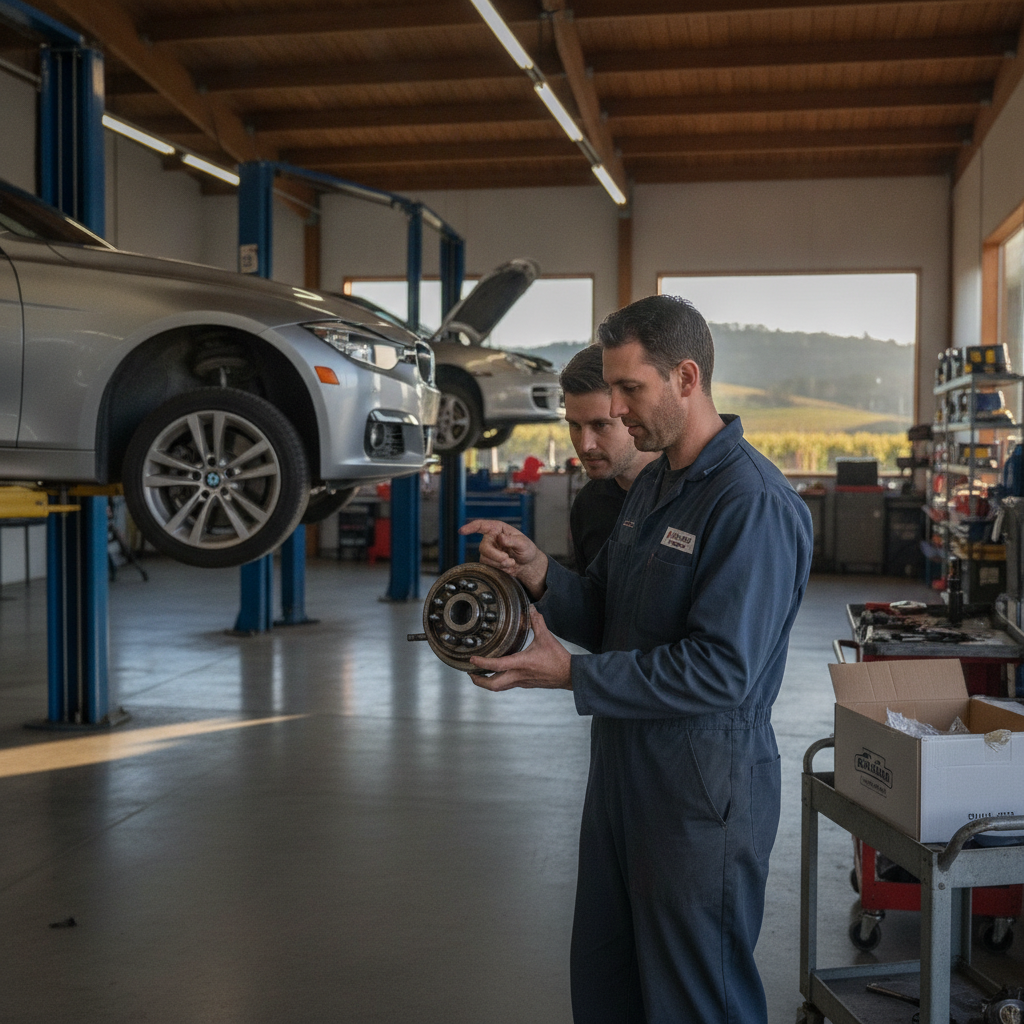
Why Is My BMW’s or Porsche’s Wheel Bearing Humming or Grinding in Petaluma — and What Does a Hub Bearing Replacement Actually Fix?
If you’ve noticed a low, persistent hum coming from somewhere beneath your BMW or Porsche — one that rises and falls with vehicle speed and sometimes shifts pitch when you change lanes or take a sweeping on-ramp — you’re almost certainly dealing with a failing wheel bearing. For drivers around Petaluma who regularly put miles on Highway 101, deal with the rough pavement transitions on East Washington Street, or commute south toward Novato and Marin County, wheel bearing wear is a more common issue than most people realize. The good news is that early diagnosis is straightforward when done with the right equipment. The bad news is that a lot of shops get it wrong — and the cost of missing it is a lot higher than the cost of fixing it properly.
What a Wheel Bearing Actually Does — and Why European Designs Fail Differently
Every wheel on your vehicle rotates around a hub, and the wheel bearing is the precision-machined assembly that allows that rotation to happen with essentially zero friction and zero play. On a healthy bearing, you feel nothing — no vibration, no noise, no resistance. When the bearing begins to fail, the steel balls or roller elements inside start degrading, and the race surfaces develop pitting and wear. That’s when the humming starts.
On BMW vehicles — particularly the F-series 3 Series, 5 Series, and X3/X5 platforms — wheel bearings are pressed into the hub carrier and integrated with the ABS sensor ring. On many Porsche models, including the 911, Macan, and Cayenne, hub bearing units are similarly integrated with the speed sensor circuit. This matters because a worn bearing on these vehicles doesn’t just create noise and vibration. It can generate erratic ABS signals, trigger stability control interventions, and in some cases cause the DSC or PSM system to behave unpredictably at highway speeds. That’s not a theoretical risk — it’s something a factory-grade scan tool will confirm when you pull the wheel speed sensor data.
Why Petaluma Driving Conditions Accelerate Bearing Wear
Wheel bearings wear faster under specific conditions: heavy lateral loading during cornering, sustained highway speeds, repeated impacts from road imperfections, and contamination from water or road debris. Petaluma checks most of those boxes. The Highway 101 corridor between Petaluma and Santa Rosa sees stop-and-go traffic that generates repeated stress cycles on the bearing seals. Country roads around Penngrove and the Sonoma Mountain foothills expose suspension components to rough pavement and the occasional pothole that delivers a sharp, concentrated load spike — exactly the kind of event that accelerates bearing race damage.
Add the fact that Sonoma County’s coastal influence means seasonal moisture, and you have conditions that can compromise bearing seals earlier than the mileage alone would suggest. Once water gets past a degraded seal, contamination accelerates pitting dramatically. A bearing that might last 80,000 miles in a dry inland climate can show advanced wear at 55,000 miles under these conditions.
How to Actually Diagnose a Failing Wheel Bearing — What Generic Shops Get Wrong
The classic field test — lifting the vehicle and rocking the wheel at 12 and 6 o’clock to feel for play — catches obvious, late-stage failures. But on BMW and Porsche, you can have a bearing that’s significantly degraded, generating audible noise, and producing measurable runout without any detectable play in a hand-check. This is where shops without the right diagnostic approach misdiagnose the problem entirely.
A proper diagnosis involves a road test to confirm the noise character and identify which corner it comes from — noise that intensifies when you load the right side (steering left) points to the left front bearing, and vice versa. It also involves spinning each hub by hand with the vehicle on a lift, listening and feeling for roughness through the rotation. On vehicles with integrated ABS rings, factory-level diagnostic software can reveal irregular wheel speed signals that correlate with bearing wear long before the noise becomes severe.
At Bavarian Performance in Santa Rosa, we use the same factory-grade diagnostic tools your BMW or Porsche dealer uses — not generic OBD-II readers that can’t access suspension and chassis control modules. That’s the difference between confirming a bearing failure and guessing at it. If you’re already tracking down noises from your vehicle, a multi-point inspection is the right starting point before any parts get ordered.
What a Proper Hub Bearing Replacement Actually Involves on a BMW or Porsche
Replacing a wheel bearing on a European vehicle is not the same job as on a domestic truck. On most BMW F- and G-series platforms, the bearing is pressed into the knuckle, and the hub is pressed through the bearing. Doing this correctly requires a hydraulic press, the correct OEM press adapters for that specific knuckle casting, and a torque sequence that accounts for the aluminum or cast-iron housing material. Using the wrong adapter or pressing at an off-axis angle can distort the bearing seat — meaning the new bearing will fail prematurely even though it was just installed.
On Porsche Macan and Cayenne, hub bearing units are bolted assemblies, which simplifies the installation but still requires precise torque on the hub nut — in many cases, a stretch bolt that must be replaced rather than reused. Reusing the hub nut is a common shortcut that can result in the hub walking loose over time.
Genuine OEM bearings matter here. European hub bearings are manufactured to tighter tolerances than most aftermarket alternatives, and the ABS sensor ring integration in many BMW and Porsche units means a non-genuine bearing may produce signal irregularities that trigger fault codes even when the bearing itself seems fine. This is one area where the cost of a genuine part is worth it — the labor to access and replace a hub bearing is the majority of the job cost regardless.
What Else Gets Inspected During a Wheel Bearing Service
A wheel bearing replacement is one of those jobs that gives a technician complete access to the hub carrier, wheel speed sensor, brake rotor hat, and surrounding suspension hardware. While the corner is apart, a thorough shop will inspect the CV axle boot for cracking, check the condition of the outer tie rod end, examine the ball joint, and verify the brake rotor for heat cracks or excessive thickness variation. On vehicles from Fountaingrove or Windsor where the owner has logged significant mountain road miles, this inspection often turns up worn ball joints or axle boots that would otherwise require a separate disassembly.
If the rotor shows significant wear and the brake pads are at or near minimum thickness, combining a brake service with the bearing replacement saves significant labor, since the caliper and rotor are already removed.
When to Act — and What Happens If You Wait
A wheel bearing that’s humming at low volume is a warning. A bearing that’s grinding audibly at highway speed is an emergency. The failure mode of a severely worn bearing isn’t just noise — it’s the potential for the wheel speed sensor to go completely offline (disabling ABS and stability control), and in extreme cases, for the hub to develop enough play that it affects steering geometry. Neither of those scenarios is something you want to encounter on a fast on-ramp in Rohnert Park or descending from Sonoma Mountain.
The practical advice: if you’re hearing a speed-dependent hum that shifts when you change lanes, get it diagnosed within the next few hundred miles. Don’t wait for the next scheduled service. Most bearing replacements on BMW and Porsche, when caught at the humming stage, are a predictable, contained repair. Caught at the grinding stage, you may also be replacing the CV axle and ABS sensor that got damaged when the bearing finally collapsed.
Frequently Asked Questions
How do I know if it’s a wheel bearing or a tire noise?
Tire noise is generally consistent regardless of steering input. Wheel bearing noise changes pitch or intensity when you make slight lane changes or gently load one side of the vehicle. A shop can confirm this during a road test — or by swapping tires side-to-side and retesting, which rules out a specific tire as the source.
Can a failing wheel bearing affect my ABS or traction control?
Yes — particularly on BMW and Porsche models where the ABS reluctor ring is integrated into the bearing assembly. A worn bearing can generate irregular wheel speed signals that trigger DSC, ABS, or PSM warning lights even when the braking system itself is fine. Factory-level diagnostics will show this in the wheel speed sensor data.
How long does a wheel bearing replacement take?
On most BMW and Porsche platforms, a single corner bearing replacement is a half-day job when performed by a technician familiar with European suspension geometry. If brakes or other suspension components are being addressed at the same time, plan for a full day. We’ll give you a realistic timeline when you bring the vehicle in.
Does it matter which corner the bearing is on — front vs. rear?
Front wheel bearings are generally more complex on rear-wheel-drive BMWs and Porsches because they carry both steering and drive loads simultaneously. Rear bearings on xDrive BMW and Cayenne all-wheel-drive models also handle significant drive torque. Both front and rear failures are serious — don’t assume a rear bearing can wait simply because the steering feel hasn’t changed.
Can I drive from Petaluma to Santa Rosa with a humming wheel bearing?
A gentle hum at early stages is manageable for a short trip to get it inspected. If the sound has progressed to grinding, intermittent clunking, or you’ve noticed any pull in the steering, have the vehicle trailered or arrange pickup rather than driving it on the highway. The risk isn’t worth the savings.
Bring Your BMW or Porsche to Bavarian Performance in Santa Rosa
Bavarian Performance serves European vehicle owners across Sonoma County — from Petaluma and Rohnert Park to Windsor and beyond — with factory-trained expertise and genuine OEM parts. If you’re hearing a hum, a grind, or an unexplained noise that changes with speed, we’ll diagnose it correctly the first time and give you a straight answer on what it will take to fix it. No upselling, no guessing. Visit our contact page to schedule a diagnostic appointment or reach us directly at (707) 545-2002. Your bearing won’t get better on its own — but it’s a repair that’s completely manageable when you catch it early.