
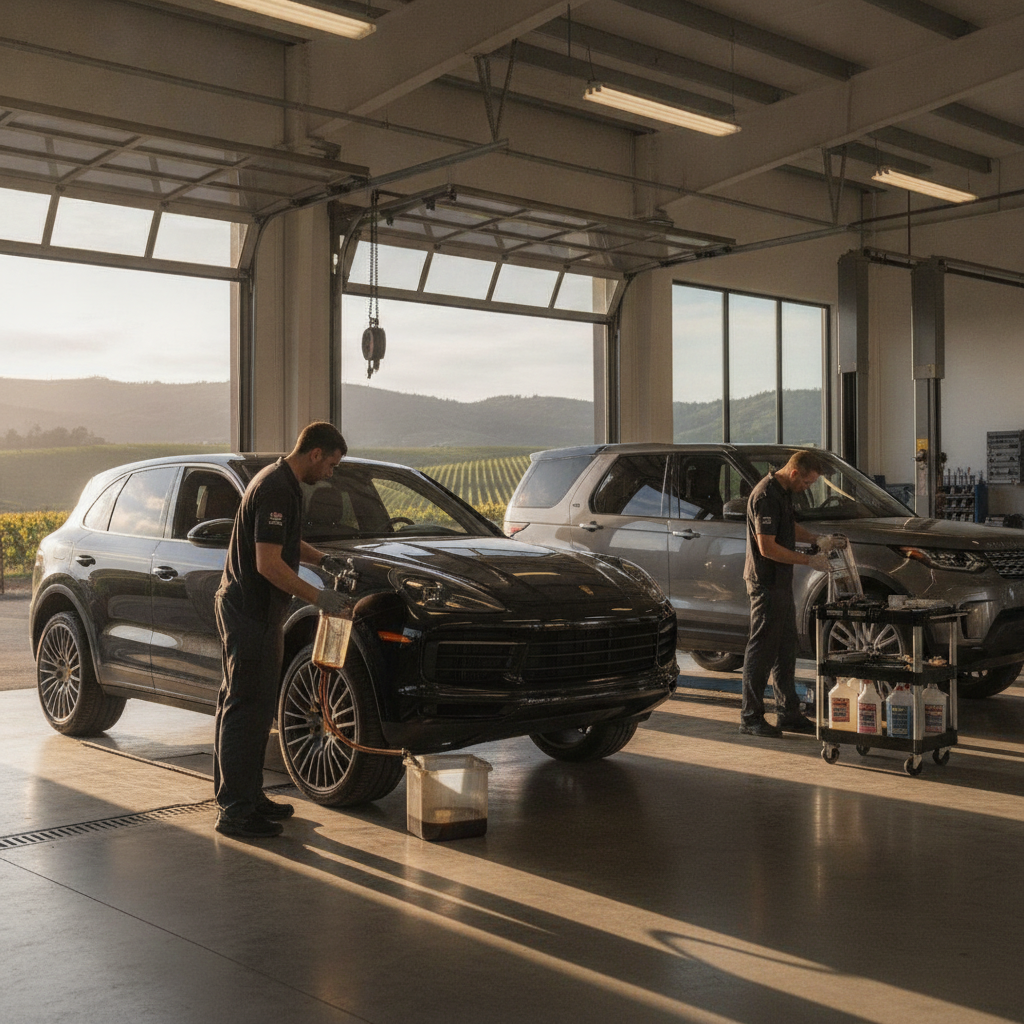
Why Is My Porsche Cayenne’s or Land Rover’s Brake System Fading on Fountaingrove Hills in Santa Rosa — and What Does a Full European Brake Fluid Flush and Caliper Service Actually Fix?
If your Porsche Cayenne or Land Rover Discovery is delivering a soft, spongy pedal or noticeably reduced stopping power on the steep descents through Fountaingrove or Bennett Valley in Santa Rosa, the answer is almost always the same: your brake fluid is saturated with moisture, your calipers are partially seized, or both. This isn’t a minor inconvenience — on grades like those found throughout Fountaingrove, Oakmont, and the Sonoma Mountain foothills, degraded brake performance is a genuine safety issue. Here’s exactly what’s happening, what a proper European brake fluid flush and caliper service actually addresses, and why this particular maintenance item is almost universally overlooked until something goes wrong.
What Brake Fade Actually Means — and Why European SUVs Are More Susceptible
Brake fade comes in two forms, and both affect Porsche Cayennes and Land Rovers more acutely than most owners expect. The first is fluid fade, caused by moisture absorption in your brake fluid raising the boiling point low enough that the fluid vaporizes under heavy braking — creating compressible gas in the lines and that characteristic soft, unresponsive pedal. The second is caliper fade, where sticky or partially seized pistons generate uneven, excessive heat that compounds the problem.
Both the Cayenne and Land Rover Discovery or Range Rover platforms carry significant curb weight — often between 4,800 and 5,600 pounds — and both use sophisticated brake-by-wire and stability management systems that rely on accurate, consistent hydraulic pressure. When brake fluid degrades, those systems can’t function as designed. Brake fluid is hygroscopic: it absorbs moisture from the atmosphere continuously, and in Sonoma County’s coastal-influenced microclimate — where morning fog rolls in from the Bodega Bay corridor — that absorption process happens faster than in drier inland climates. Most European manufacturers specify brake fluid replacement every two years regardless of mileage, precisely because of this chemistry. Most owners are on year four or five.
Why Fountaingrove, Oakmont, and Sonoma Valley Roads Are Particularly Demanding on Brake Systems
The terrain throughout north Santa Rosa and into Sonoma Valley puts brake systems under a specific kind of sustained stress that flat-road driving simply doesn’t replicate. Descending Fountaingrove Parkway, the grades off Montecito Heights, or Highway 12 through the Sonoma Valley corridor forces your brakes to manage repeated heat cycles across a single drive. Even with a healthy rotor-to-pad interface, if the fluid is already close to its boiling threshold, that repeated thermal loading can push it over the edge.
Land Rovers are particularly vulnerable here because their standard-equipment electronic air suspension lowers ride height at highway speeds and raises it for off-road use — but regardless of ride height setting, the brake calipers on Discovery and Range Rover models are known to develop piston seal stickiness over time, especially when brake fluid maintenance has been deferred. A partially retracted piston creates what technicians call caliper drag: the pad never fully releases from the rotor, generating continuous heat that accelerates both rotor wear and fluid degradation. It’s a cycle that compounds quickly on hilly terrain.
Porsche Cayenne owners face a slightly different risk profile. Cayenne brakes — particularly on the S and Turbo variants — are genuinely capable systems, but Porsche engineers designed them assuming the fluid is being changed on the factory two-year interval. The PCCB (Porsche Ceramic Composite Brake) option found on higher-spec models is even more sensitive to fluid quality because of the extreme thermal loads the system is designed to handle. If you’re running standard iron rotors and the fluid hasn’t been touched in three years, you’re running a system that is measurably below its design specification.
What a Proper European Brake Fluid Flush and Caliper Service Actually Involves
A brake fluid flush on a European vehicle — done correctly — is not the same as bleeding a few lines at a generic shop with a hand pump. Here’s what a complete service at a European specialist should include:
- Fluid moisture content testing: A refractometer or electronic test strip checks the current water percentage in the fluid before and after service. This gives you a documented baseline, not just a guess.
- Full system evacuation and pressure flush: All four corners are flushed under pressure until fresh fluid runs clear at each bleeder — not just until the reservoir looks clean.
- OEM-spec fluid selection: Porsche specifies Pentosin or equivalent DOT 4 LV (low viscosity) fluid on newer Cayenne models; Land Rover requires DOT 4 across most Discovery and Range Rover platforms. Using a DOT 3 fluid or generic DOT 4 with incorrect viscosity characteristics can compromise ABS and stability control response times.
- Caliper piston inspection and retraction: Each caliper is inspected for piston retraction smoothness and boot integrity. If a piston is sticking, the caliper requires a rebuild kit or replacement — not just a fluid change.
- Slide pin lubrication: Caliper slide pins are cleaned and re-lubricated with high-temperature brake grease. Seized slide pins are one of the most common causes of uneven pad wear on Land Rovers in Sonoma County’s variable climate.
- Rotor thickness and pad depth measurement: Documented with actual specs, not a visual estimate.
If your Cayenne or Land Rover is also due for brake pad replacement, combining that service with the fluid flush and caliper inspection is the most cost-effective approach — you’re not paying for duplicated labor to disassemble the same components twice.
The Interval Most Owners Miss — and Why Local Conditions Make It More Urgent
This is the content gap that almost no local shop communicates clearly: brake fluid is a time-based service, not a mileage-based one. Your Cayenne might only have 18,000 miles on a three-year-old fluid fill. That fluid is still overdue for replacement. Owners who drive infrequently — wine country weekend cars, vehicles that sit during rainy season — often have the worst fluid condition because low-mileage driving doesn’t generate enough heat to drive moisture out of the system, but time still allows atmospheric absorption to proceed.
For Land Rover owners in Healdsburg, Sebastopol, or Petaluma who use their vehicles on unpaved vineyard roads or rural west county routes, there’s an additional factor: brake dust and debris from gravel driving can accelerate caliper seal wear, and the seasonal transition from dry summer conditions to wet fall roads changes braking distances in ways that amplify any existing system deficiency.
A complete preventative maintenance review that includes brake fluid moisture testing at every service interval is one of the most straightforward ways to stay ahead of this failure mode — and it costs a fraction of the rotor replacement or caliper rebuild that deferred maintenance eventually demands.
Why Factory-Grade Diagnostics Matter for ABS and Stability System Integration
Modern Cayenne and Land Rover brake systems are not purely mechanical. The ABS modulator, electronic brake force distribution, hill descent control, and — on Land Rovers — Terrain Response all interact with the brake hydraulics through software that requires factory-grade scan tools to properly diagnose and reset. If a caliper has been sticking or if air entered the system during a poorly executed flush, the ABS module may log faults that a generic OBD-II reader won’t surface. PIWIS (Porsche’s factory diagnostic platform) and the Land Rover-compatible IDS/SDD tools give technicians the full picture — not just the codes a consumer scanner can read.
This is precisely why a specialized European independent shop delivers something a quick-lube chain or general repair shop cannot: the combination of model-specific technical knowledge, OEM-spec fluids, and factory-level diagnostic capability that these vehicles were engineered to receive.
Frequently Asked Questions
How often should I flush brake fluid on a Porsche Cayenne or Land Rover in Sonoma County?
Both Porsche and Land Rover specify brake fluid replacement every two years regardless of mileage. In Sonoma County’s fog-influenced climate, adhering to that interval — or even being slightly ahead of it — is worthwhile, especially if you drive regularly on hilly terrain like Fountaingrove or Oakmont.
What does a brake fluid flush cost on a European SUV?
Cost varies depending on vehicle, fluid specification, and whether caliper work is needed alongside the flush. A straightforward fluid flush is a relatively modest service; if calipers need rebuilding or slide pins are seized, labor increases accordingly. Contact Bavarian Performance for an accurate estimate on your specific model and year.
Can I tell if my brake fluid is degraded without testing it?
Not reliably. Dark-colored fluid is a rough indicator of age, but moisture content — the actual failure metric — is invisible to the eye. An electronic moisture tester or refractometer gives you an actual percentage reading. Any fluid above 3% water content is functionally overdue for replacement.
Is caliper drag always noticeable while driving?
Often not — at least not initially. A mildly sticky caliper piston may only manifest as uneven pad wear, slightly increased fuel consumption, or a faint burning smell after extended braking on grades. By the time you feel brake pull or hear grinding, the rotor is usually already damaged.
Should I use OEM brake fluid or is aftermarket acceptable?
For the fluid itself, a reputable premium DOT 4 or DOT 4 LV fluid meeting the manufacturer’s viscosity and boiling-point specification is acceptable — the chemistry is well-standardized. What matters most is using the correct specification for your vehicle’s ABS system and ensuring the flush is performed completely. Your technician should document the fluid spec used.
Schedule a Brake Fluid and Caliper Service at Bavarian Performance
If your Porsche Cayenne or Land Rover is due — or overdue — for a brake fluid flush, or if you’ve noticed any softness in the pedal, uneven wear, or pulling under braking on Santa Rosa’s hillier roads, Bavarian Performance has the factory-trained expertise, model-specific diagnostic tools, and OEM-spec fluids to service your vehicle correctly. We serve owners throughout Sonoma County, including Fountaingrove, Oakmont, Bennett Valley, Sonoma, Healdsburg, Sebastopol, and Petaluma. Contact us to schedule a service appointment — we’ll test your fluid, inspect your calipers, and give you an honest assessment of what your brake system actually needs.