
Why Is My Porsche Cayenne or Panamera’s Air Suspension Dropping Overnight in Sonoma — and What Does a Full Airmatic Diagnosis Actually Involve?
If you walk out to your Porsche Cayenne or Panamera in the morning and notice one corner — or the entire vehicle — sitting noticeably lower than when you parked it, the air suspension system has a leak. This isn’t a quirk or a sensor glitch you can ignore. The Porsche Active Suspension Management (PASM) system and its associated air struts, compressor, and valve block are a pressurized circuit. When that circuit bleeds down overnight, you’re either looking at a failing air strut bladder, a faulty valve block solenoid, a leaking air line, or a compressor that can no longer hold system pressure. In most cases, it’s more than one of these things working against you at the same time — and for Porsche owners in the Sonoma area, the local environment makes the failure timeline considerably shorter than Porsche’s engineers may have anticipated.
What’s Actually Happening Inside a Porsche Air Suspension System
The air suspension on a Cayenne or Panamera isn’t simply a set of inflatable bags bolted to the frame. It’s a closed-loop system with a dedicated compressor, a distribution valve block (which routes pressurized air to individual corners), rubber-bladder air struts at each corner, pressure sensors, height sensors, and the PASM control module that ties everything together. When you start the vehicle, the compressor checks ride height at each corner and adjusts accordingly. When you shut it off, the system holds static pressure — or it’s supposed to.
Overnight drop is almost always one of three things: a cracked or delaminated air strut bladder that slowly leaks through the rubber, a faulty solenoid in the valve block that doesn’t fully close and allows air to bleed back through the system, or a combination of both. The compressor itself may still run — but if it’s running excessively trying to maintain pressure, that’s a sign the system is fighting a leak, and running a compressor past its duty cycle will destroy it in short order. Many Cayenne owners discover the compressor has already failed by the time they bring the vehicle in, simply because they didn’t catch the early warning signs.
Why Sonoma County Terrain Accelerates Air Suspension Wear
Porsche designed the Cayenne and Panamera air suspension to perform beautifully under a wide range of conditions — but the roads around Sonoma Valley, the Highway 12 corridor, and the elevated terrain in areas like Kenwood and Glen Ellen put these systems through cycles that flat-road environments simply don’t. Every time your Cayenne crests a hill, drops into a dip on Arnold Drive, or navigates the uneven pavement on the backroads between Healdsburg wine country and the valley floor, the air suspension is actively adjusting pressure across all four corners.
More adjustment cycles mean more wear on the valve block solenoids and compressor motor. Add to that the overnight temperature swings that are common throughout the Sonoma Valley — warm dry afternoons dropping to cool, damp mornings — and you have a recipe for accelerated rubber bladder degradation. Temperature cycling causes the bladder material to expand and contract repeatedly, and micro-cracks develop over time. Porsche air struts on second-generation Cayennes (958 body, 2011–2018) commonly start showing bladder failures between 70,000 and 100,000 miles, though Wine Country driving conditions can move that window forward significantly.
Owners in Oakmont and Fountaingrove who regularly navigate hilly neighborhood roads are especially familiar with this pattern — the suspension is working constantly, and it shows in service intervals.
What a Proper Diagnosis Actually Looks Like — and Why It Matters
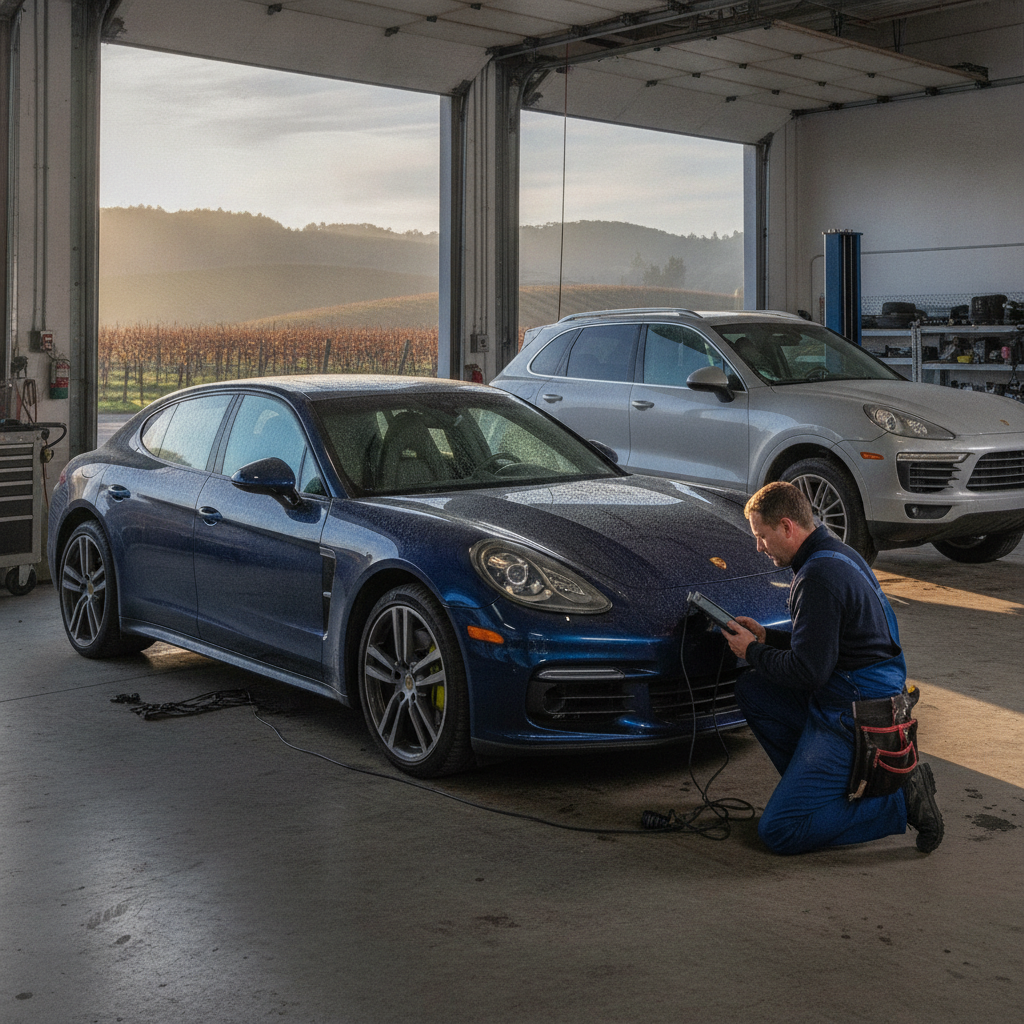
This is where independent repair shops in the area often fall short. A proper Porsche air suspension diagnosis is not a visual inspection and a guess. It requires a factory-grade scan tool — in Porsche’s case, PIWIS — to pull live ride height sensor data, read compressor run-time logs, and check for stored fault codes in both the PASM module and the chassis control systems. A generic OBD-II reader will not access this data. If a shop is diagnosing your Cayenne’s suspension with a universal scan tool, they are not seeing the full picture.
A thorough diagnosis at Bavarian Performance includes reading fault history from the PASM control module, performing a static leak-down test on each corner with the system at operating pressure, inspecting the air lines and fittings for micro-cracks (particularly at connection points near the valve block), testing the compressor’s output pressure and duty cycle under load, and verifying that all four height sensors are reading accurately. Only after that data is in hand can you make an informed decision about what components actually need replacing.
Replacing only the failed strut without addressing a marginal compressor is a common and expensive mistake. If the compressor has been overworked compensating for a slow leak, it’s usually operating near the end of its service life regardless of how it tests at rest. Addressing both together on first entry saves the labor cost of pulling the system apart a second time six months later. You can learn more about our approach to Porsche repair in Santa Rosa and what factory-level diagnostics actually involve for these systems.
OEM Parts vs. Aftermarket Air Struts: Where This Decision Actually Matters
For Porsche air suspension, the OEM versus aftermarket question deserves a direct answer: the quality gap is significant, and it shows up in service life. Genuine Porsche air struts and OEM-spec replacements from suppliers like Continental (who manufactures the original units) are engineered to the tolerances Porsche’s PASM module is calibrated to read. Third-party budget struts often produce ride height sensor readings that are slightly off from factory spec, which causes the PASM module to run the compressor more frequently to compensate — accelerating compressor wear and, in some cases, triggering fault codes that can’t be cleared without relearning the system through PIWIS.
This doesn’t mean every aftermarket part is inferior — for filters, brake pads, and wear items, premium aftermarket products are often a sensible value choice. But for a system as tightly integrated as Porsche PASM, where the strut, the sensor, and the control module are calibrated together, genuine parts are the right call. It’s one area where cutting costs upfront consistently creates more cost later.
What Cayenne and Panamera Owners Should Watch For Before It Gets Worse
The overnight drop is the most obvious symptom, but there are earlier warning signs that are easy to dismiss:
- The compressor audible after a cold start: A brief compressor run on startup is normal. If it’s running for more than 30–45 seconds, or if you can hear it cycling during normal driving, there’s a leak the compressor is working to compensate for.
- One corner sitting slightly lower than the others: Before the full overnight drop appears, you may notice subtle asymmetry — one rear corner a finger-width lower than the other side, particularly after the vehicle has sat for several hours.
- A suspension fault warning in the instrument cluster: The PASM module will log faults before it disables the system, and some owners are surprised to learn their vehicle has been accumulating fault history for weeks before the warning light appears.
- Rougher ride quality at highway speeds: If the strut bladder has partially failed, the air volume is reduced and the suspension loses its ability to properly absorb road input — you’ll feel it as a firmer, less controlled ride even before the height drop becomes obvious.
If you recognize any of these signs, a multi-point inspection with a PIWIS-capable technician can catch the system’s actual condition before a small leak becomes a compressor replacement on top of strut replacement.
Frequently Asked Questions: Porsche Air Suspension in Sonoma County
How long does a Porsche Cayenne air strut replacement take?
In most cases, replacing one or two air struts on a Cayenne is a full-day job when done correctly. If the valve block is also being serviced or the compressor replaced at the same time, plan for the vehicle to be in for a day and a half. Rushing an air suspension job increases the chance of leaks at the line fittings — which means the car is back in the shop shortly after.
Can I drive my Cayenne or Panamera with a dropping air suspension?
Short distances in an emergency, yes. Regularly, no. When the system drops, the compressor runs continuously trying to restore pressure — and compressors are not designed for that duty cycle. A slow overnight leak turns into a compressor failure quickly if you continue driving without addressing the root cause. A dead compressor on a Cayenne is a significantly more expensive repair than the original strut would have been.
My Porsche dealer quoted me a very high price for this repair. Is an independent specialist a real option?
Yes — and for out-of-warranty Cayennes and Panameras, an independent specialist with PIWIS access and genuine parts sourcing delivers the same diagnostic capability and parts quality at a materially lower labor rate than the dealership. The work is the same. The overhead structure is not.
Does the Porsche air suspension on a Cayenne GTS or Turbo differ from the base model?
Yes. The GTS and Turbo variants often include PDCC (Porsche Dynamic Chassis Control), which adds hydraulic roll stabilization on top of the air suspension. These systems are diagnosed and serviced differently, and not all independent shops have the tooling to work on PDCC properly. It’s worth asking explicitly whether the shop has PIWIS access and PDCC experience before committing.
Are Porsche Panamera air suspension failures similar to the Cayenne?
The failure modes are closely related — bladder degradation, valve block leaks, and compressor wear — though the Panamera’s rear air struts are packaged differently and can be more labor-intensive to access. Diagnosis procedure is the same: PIWIS, live data, leak-down test by corner, then a prioritized parts plan based on what the data actually shows.
Bavarian Performance: Factory-Level Porsche Air Suspension Diagnosis in Santa Rosa
If your Porsche Cayenne or Panamera is dropping overnight, cycling its compressor excessively, or showing early signs of air suspension wear, the right next step is a proper PIWIS diagnosis — not a guess and a parts swap. At Bavarian Performance in Santa Rosa, we work on these systems regularly and understand the difference between a strut leak, a valve block issue, and a compressor on its last legs. Serving Porsche owners throughout Sonoma County, from the hillside neighborhoods of Kenwood and Glen Ellen to Healdsburg and Petaluma, we bring dealership-grade diagnostics without the dealership wait or overhead.
Contact us to schedule a diagnosis or ask a question about your Cayenne or Panamera’s suspension system. Reach out to Bavarian Performance here — we’ll give you a straight answer about what your vehicle actually needs.