
Why Is My Porsche’s or BMW’s Coolant Light On in Healdsburg — and What Does a Full Cooling System Pressure Test Actually Find?
If your coolant warning light has come on in Healdsburg, the short answer is this: don’t top off the reservoir and keep driving. On a Porsche or BMW, a coolant warning is rarely just low fluid — it’s almost always a symptom of something actively failing inside a pressurized system that operates at tighter tolerances than most vehicles on the road. A cooling system pressure test is the diagnostic step that reveals exactly where the system is compromised, before a minor leak becomes a warped cylinder head or a destroyed engine.
Why BMW and Porsche Cooling Systems Fail Differently Than Most Vehicles
European performance engines run hot by design. Tighter combustion chambers, higher compression ratios, and thermostats calibrated to open at higher temperatures mean that BMW and Porsche cooling systems are operating close to their limits under normal conditions — especially in Sonoma County’s dry summer heat. A small leak that might go unnoticed for months in a pickup truck can cause catastrophic overheating in a turbocharged BMW N55 or a Porsche 911 within minutes of sustained highway driving.
The materials don’t help longevity either. Both BMW and Porsche have leaned heavily on plastic and composite components in their cooling systems to save weight. The result is a system that performs beautifully when new but has predictable failure points as mileage accumulates — usually between 60,000 and 100,000 miles. On BMWs, this means the plastic-bodied water pump impeller, the expansion tank, the thermostat housing, and the oil filter housing gasket are all on a collision course with failure. On Porsche Cayennes and Panameras, the notorious coolant crossover pipes and plastic coolant tees carry their own history of cracking under thermal cycling.
What a Cooling System Pressure Test Actually Does
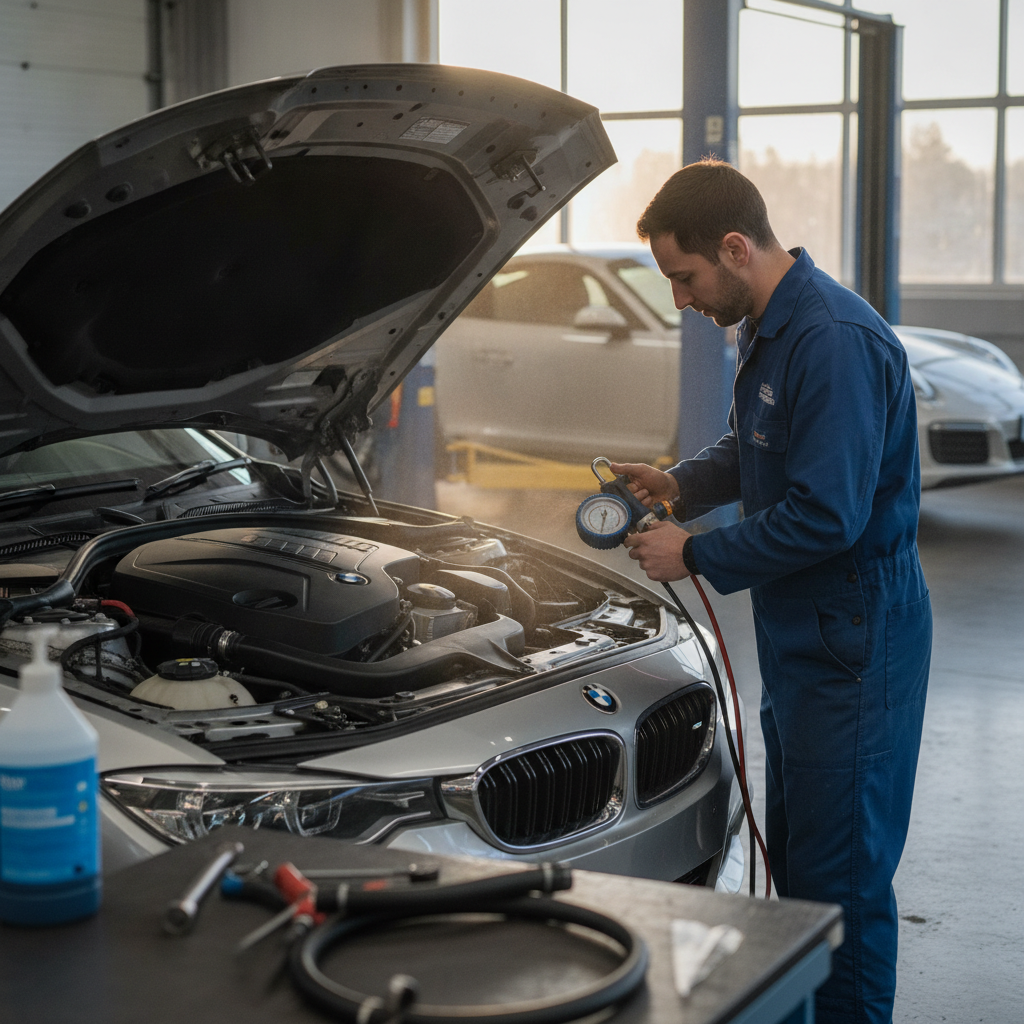
A cooling system pressure test is straightforward in concept and essential in practice. A calibrated pressure tester is attached to the coolant reservoir or radiator cap fitting, and the system is pressurized to its specified operating pressure — typically 16 to 20 PSI depending on the vehicle. The technician then monitors the gauge over several minutes while inspecting the entire system for any pressure drop, weeping coolant, or signs of moisture.
What makes this test genuinely useful is what it can catch that a visual inspection cannot. A hairline crack in an expansion tank may show no external wetness until pressure is applied. A weeping water pump seal might be invisible when the engine is cold and at rest. A compromised head gasket — one of the more expensive failures you want to catch early — will cause the gauge to drop steadily as combustion gases enter the coolant passages. None of these are visible from the outside. The pressure test forces the failure to reveal itself on the bench rather than on the road.
For Porsche owners specifically, the pressure test is also how a shop confirms whether a slow coolant loss on a Cayenne or Boxster is coming from the known-problematic plastic coolant pipes or from something deeper. Guessing costs you money. Testing tells you exactly what needs to be replaced.
The Healdsburg and Wine Country Heat Factor
Healdsburg and the surrounding Alexander Valley corridor experience some of the hottest summer conditions in Sonoma County. Temperatures regularly push into the high 90s and above, and vehicles sitting in traffic on Healdsburg Avenue or making repeated runs along Geyserville’s vineyard roads in peak afternoon heat are placing their cooling systems under sustained stress. For a BMW with an aging plastic-bodied water pump or a Porsche with a factory coolant hose approaching 80,000 miles, this kind of heat is exactly what pushes a marginal component over the edge.
Owners in Windsor and throughout the northern Sonoma County corridor regularly see cooling system calls spike in July and August for exactly this reason. By the time a warning light comes on during a weekend drive along the Russian River, the system has already been operating degraded for longer than most drivers realize.
BMW-Specific Cooling Failures: What to Expect by Mileage
If you’re driving a BMW — particularly one powered by the N20, N52, N54, or N55 engine — there is a well-established sequence of cooling system failures that a factory-trained technician has seen dozens of times. The electric water pump is typically the first to go, often between 60,000 and 80,000 miles. It fails electronically before it fails mechanically, meaning your iDrive may log a fault before you ever see a temperature spike. The thermostat and thermostat housing follow a similar timeline. The expansion tank, which is made of polypropylene and subject to constant pressurization cycles, typically shows cracking or weeping around the same mileage window.
The smart approach — and the one that avoids a roadside breakdown in Geyserville or an emergency tow from the Highway 101 corridor — is to address these components proactively as a group when the first failure appears, rather than replacing them one at a time over several years. The labor cost to access these components is substantial, and doing them together saves significantly over separate visits. BMW cooling system service at Bavarian Performance is handled this way as a matter of standard practice.
Porsche-Specific Cooling Concerns: Beyond the Cayenne Coolant Pipe
The Porsche Cayenne coolant crossover pipe failure is well-documented and has been covered extensively online. What gets less attention — and what several local competitors don’t address in their content at all — is the broader pattern of thermal management issues that affect air-cooled-to-water-cooled transition-era Porsches and the more modern 981/982-generation Boxsters and Caymans.
On the 981 Boxster and Cayman, the intermediate coolant pipes that route fluid between the engine and the front-mounted heat exchangers are a known vulnerability. They’re tucked away from casual visual inspection, they don’t leak dramatically until they fail, and a pressure test is often the only way to confirm early degradation. Porsche’s water-cooled engines are also sensitive to coolant specification — running the wrong mix accelerates corrosion in aluminum passages, and a pressure test combined with a coolant condition check can reveal whether the fluid has broken down to the point where it’s actively damaging internal surfaces.
For Porsche owners in Sonoma County, the combination of hot summer driving and the multi-year intervals between coolant flushes that some shops still recommend is a recipe for avoidable internal corrosion. The correct factory interval for most modern Porsches is two years for coolant replacement, regardless of mileage. Porsche cooling system service at Bavarian Performance follows factory specifications, not generic intervals.
Why a Generic OBD-II Scanner Doesn’t Cut It Here
A standard OBD-II reader from an auto parts store can tell you a fault code is present. It cannot tell you whether your BMW’s electric water pump is operating at correct flow rates, whether the thermostat is opening at the correct temperature, or whether a pressure drop in the cooling system is coming from a head gasket or an expansion tank crack. Diagnosing European cooling systems correctly requires factory-level scan tools — ISTA for BMW, PIWIS for Porsche — that can read live coolant temperature data, pump duty cycle, and logged fault histories with the granularity needed to make a confident diagnosis.
This is one of the most meaningful differences between a specialist shop and a general repair facility. The pressure test is the mechanical component of the diagnosis. The software side of the diagnostic is equally important, and it requires investment in equipment and training that most shops simply haven’t made. You can learn more about how factory-level diagnostics work at our preventative maintenance service page.
Frequently Asked Questions
How long does a cooling system pressure test take?
Typically 30 to 45 minutes for the test itself, though a thorough inspection of all cooling system components — hoses, expansion tank, water pump, radiator, and connections — adds time. Plan for a minimum of an hour if you want a complete assessment rather than just a pass/fail result.
My coolant reservoir looks full. Can I still have a cooling system problem?
Yes. A system can be losing coolant internally — into the combustion chamber or oil passages via a failing head gasket — without showing an obvious drop in the reservoir. External slow leaks may also only manifest under operating pressure, not when the engine is cold and at rest. A full reservoir is not a clean bill of health.
How often should coolant be replaced on a Porsche or BMW?
Factory recommendations vary, but most BMW and Porsche engineers call for coolant replacement every two years or roughly every 30,000 miles, whichever comes first. Many owners push far beyond this, which allows the corrosion inhibitors in the fluid to degrade and accelerates internal aluminum damage — a problem that compounds over time.
Is it safe to drive to a shop with a coolant warning light on?
It depends on whether the temperature gauge is reading normal. If the temperature gauge is at or approaching the red zone, stop immediately — further driving risks warping the cylinder head, a repair that can cost several times what the original cooling system service would have. If the temperature is normal and you’ve simply seen a low coolant warning, drive cautiously and get to a shop the same day.
Why should I use a European specialist rather than a general shop for cooling system work?
BMW and Porsche cooling systems require brand-specific torque specs, OEM-spec coolant formulations, and factory software to properly bleed air from the system after service. A generic bleed procedure on a BMW can leave an air pocket that causes localized overheating and accelerated water pump failure. The repair is only as good as the process used to complete it.
Don’t Wait Until It’s a Roadside Emergency
If your Porsche or BMW has a coolant warning light on — or if you’re approaching 70,000 miles and haven’t had a cooling system inspection — the right move is a pressure test before the Sonoma County summer takes another toll on an already-stressed system. Bavarian Performance serves Healdsburg, Windsor, Santa Rosa, Geyserville, and the broader Sonoma County area with factory-trained European specialists and the diagnostic equipment to find the problem the first time.
Contact us to schedule a cooling system inspection or request an appointment online. We’ll tell you exactly what your system needs — and what it doesn’t — so you can make an informed decision before a warning light becomes an engine failure.