
Why Is My Volvo’s Electrical System Throwing Random Faults in Sonoma — and What Does It Take to Actually Diagnose Them?
If your Volvo is lighting up the dashboard with warnings that seem to appear and disappear at random, you’re dealing with one of the most misunderstood diagnostic scenarios in European auto repair. For owners in Sonoma, Glen Ellen, Kenwood, and throughout the Sonoma Valley, these intermittent faults are especially common — and they almost never yield to a generic OBD-II reader at an auto parts store. Volvo’s architecture is deeply networked, meaning a single failing module or corroded ground point can trigger a cascade of unrelated warning lights across multiple systems simultaneously. Getting to the actual cause requires factory-grade diagnostic software, a methodical approach to the module network, and genuine familiarity with how Volvo’s Central Electronics Module actually communicates.
How Volvo’s Electrical Architecture Actually Works
Modern Volvos — whether you’re driving an XC90, S60, V60, or XC60 — don’t operate on a simple sensor-to-ECU relationship. Every major system communicates over a high-speed CAN bus network, with the Central Electronics Module (CEM) acting as the primary hub. The CEM controls and monitors everything from power windows and sunroof to the instrument cluster, exterior lighting, and charging system. Alongside it sits the Body Control Module (BCM), which manages interior functions, and a network of secondary modules for the transmission, DSTC stability system, SRS, and more.
When the CEM has a fault — whether from a bad connection, software corruption, or a failing power supply — it doesn’t just generate one code. It can flood the network with ghost faults that implicate systems that are otherwise working perfectly. This is precisely why Volvo owners who get their car scanned at a chain shop walk away with a list of twelve codes and no real diagnosis. Those codes are symptoms. Finding the source requires reading the entire module network simultaneously and understanding which faults are primary and which ones are echoes.
Why the Sonoma County Environment Makes This Worse
Volvo ownership in the Sonoma Valley comes with some specific environmental pressures that accelerate electrical issues in ways that owners from drier climates don’t always anticipate. The coastal fog that rolls in from the Bodega Bay corridor and settles through Sebastopol, Petaluma, and down into the Sonoma Valley carries salt-laden moisture that penetrates door seals, trunk gaskets, and connector housings over time. Corroded ground straps and connector pins are one of the most common root causes of intermittent CEM faults on P2-platform and SPA-platform Volvos — and corrosion is a natural consequence of years spent parked in Wine Country humidity.
Wildfire smoke and ash events — a reality in this region since the 2017 Tubbs Fire — also contribute to accelerated electrical degradation. Fine particulate matter infiltrates HVAC systems and electrical enclosures, and the acidic nature of ash accelerates oxidation on exposed connector terminals. If your Volvo started throwing random faults in the years after a major fire season, that’s not coincidental. It’s physics.
What a Factory-Level Volvo Diagnosis Actually Involves
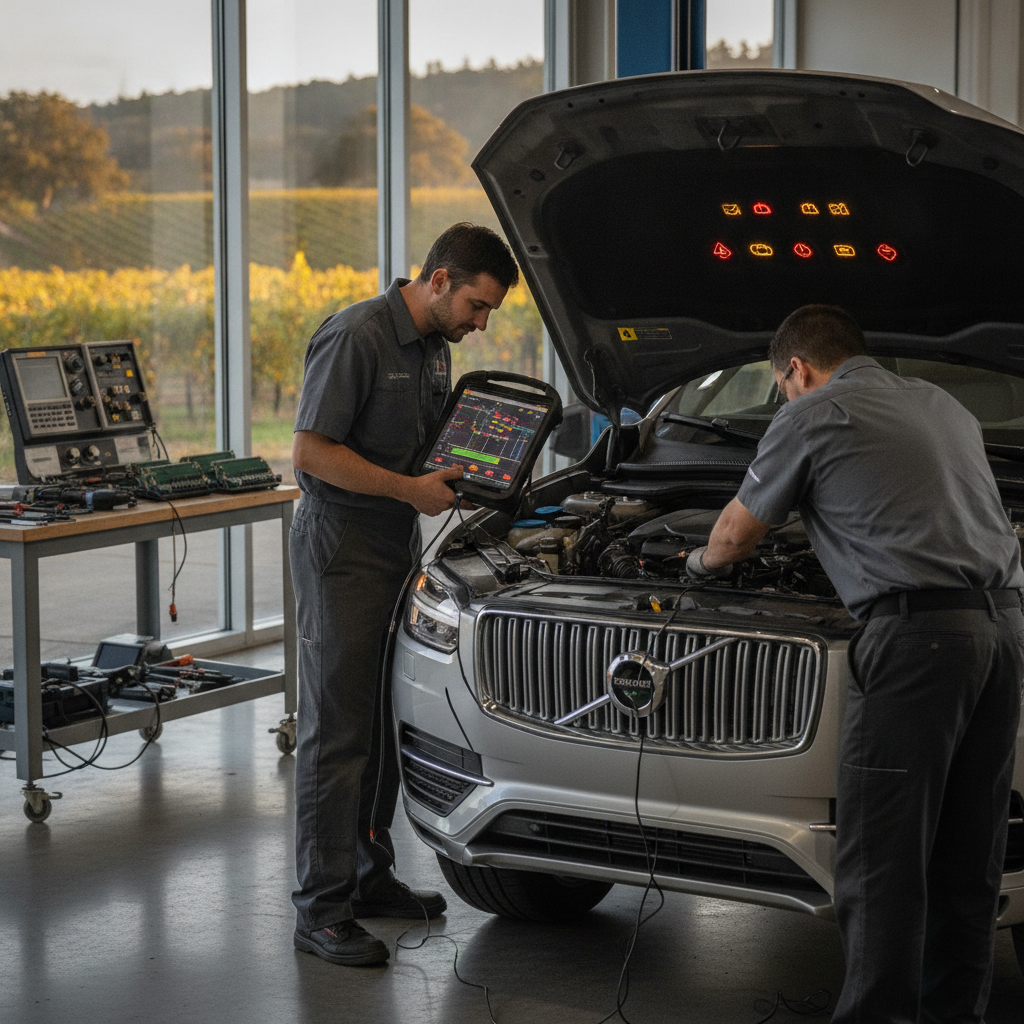
Diagnosing a Volvo electrical complaint properly starts with VIDA — Volvo’s factory diagnostic platform — which gives a technician full visibility into every module on the car, not just the powertrain. A proper inspection goes through each module individually, identifies which fault codes are active versus stored, and cross-references the code timestamps and conditions under which they triggered. That last detail matters enormously: a code that only sets at startup in cold temperatures tells a completely different story than one that appears at highway speed on a hot day.
From there, a trained technician will check the CEM’s power and ground supply quality, inspect known connector failure points (several P2-platform Volvos have notorious issues with connector X41 and the battery positive distribution block), test the alternator’s output voltage under load, and evaluate whether any prior DIY wiring work has introduced a fault into the network. If the car has had aftermarket accessories installed — a common situation with Wine Country vehicles that have seen tow packages, aftermarket stereos, or remote start systems added — those integrations can also corrupt module communication.
None of this is visible through a generic scanner. Without VIDA or an equivalent factory-level tool, you’re reading a summary of what the car wants you to know — not what’s actually happening across all 15 to 25 modules simultaneously.
Common Volvo Electrical Fault Patterns Worth Knowing
Not every Volvo electrical issue is a mystery. There are patterns that experienced technicians recognize immediately, and being aware of them helps you have a more informed conversation about what your car actually needs:
- CEM replacement vs. repair: On older XC90s and S60s, the CEM itself can fail internally. Before replacing it, a proper diagnosis confirms whether the module is genuinely faulty or whether it’s responding to a bad input — such as a failing sensor, a shorted accessory circuit, or a weak battery. CEMs are expensive, and unnecessary replacement is a common outcome of inadequate diagnosis.
- Battery-related module faults: Volvo modules are sensitive to low voltage. A battery that’s marginal but not yet dead can cause widespread false fault codes, especially on first startup. A proper load test — not just a static voltage check — is part of any thorough electrical diagnosis.
- Sunroof and water intrusion: Blocked sunroof drains on XC90 and S60 models allow water to pool and reach the CEM, which is typically mounted in the driver’s footwell area. Water damage to the CEM is devastating and expensive. If you’re seeing intermittent faults alongside any interior moisture, this is the first place to look.
- DSTC and SRS warning combinations: A pattern of simultaneous DSTC (stability control) and SRS (airbag) warnings frequently traces back to a single bad lateral accelerometer or yaw sensor rather than independent failures in both systems.
The Gap Most Local Shops Leave Open
A review of competitor content across Sonoma County auto repair shops reveals a consistent blind spot: Volvo electrical diagnosis is either lumped into generic European repair descriptions or not addressed at all. Most local shops advertise that they service Volvos, but very few speak specifically to the module network architecture, the limitations of non-factory tools, or the environmental factors that accelerate CEM and connector issues in this region. That gap is exactly where Volvo owners end up stranded — with a car that’s been “diagnosed” multiple times without resolution, having spent money on parts that didn’t fix the underlying problem.
At Bavarian Performance in Santa Rosa, factory-grade diagnostic capability covers every European brand we service, including Volvo. That means VIDA access, full module scanning, and the kind of systematic electrical methodology that actually isolates root causes rather than guessing at symptoms. If your Volvo has been through two or three shops without a real answer, that pattern is familiar — and it’s fixable with the right tools and the right approach. Explore our Volvo repair services to see what that level of care looks like in practice.
If the issue turns out to involve the engine management system or sensors feeding the ECU rather than the body electronics network, those diagnostics follow the same factory-grade methodology — the same standard we apply to every vehicle across all European auto repair services we offer.
Frequently Asked Questions
Can I drive my Volvo if it’s showing multiple warning lights at once?
It depends entirely on which lights are illuminated. A red warning light — particularly for oil pressure, brake system, or coolant temperature — means stop driving and get the car inspected immediately. Amber warnings for systems like DSTC or a secondary electronics fault are generally less urgent but should still be diagnosed promptly, since intermittent faults have a tendency to escalate. Never dismiss multiple simultaneous warnings as routine.
Will an auto parts store scanner tell me what’s wrong with my Volvo?
In most cases, no — at least not for electrical faults outside the powertrain. Generic OBD-II scanners read powertrain codes from the engine control module, but they have no access to the CEM, SRS, ABS, DSTC, or body control modules. On a Volvo with a network-level fault, you might walk away with zero codes from a parts store scan even while six warning lights are active on your dashboard.
How much does Volvo electrical diagnosis typically cost?
A thorough factory-level electrical diagnosis is a real labor investment — typically one to two hours of diagnostic time — because doing it correctly means working through the entire module network rather than just pulling a quick code. That investment almost always saves money compared to the alternative: replacing parts based on incomplete information. Contact Bavarian Performance directly for current diagnostic rates and scheduling.
Do Volvos have known electrical problems at specific mileage intervals?
Yes. P2-platform Volvos (2001–2007 S60, XC90, V70) are well-documented for CEM issues and connector corrosion as they age past 100,000 miles. SPA-platform models (2016+ XC90, S90, V90) have seen update campaigns related to software and module communication. Staying current on Volvo software updates is genuinely important — more so than most owners realize — and it’s something that requires factory-grade programming tools to execute properly.
My Volvo is out of warranty — should I still go to the dealer for electrical issues?
Not necessarily. Once your Volvo is out of warranty, an independent specialist with factory diagnostic capability offers the same technical depth as a dealership, typically with shorter wait times and more direct communication. The key is ensuring the shop has VIDA access and genuine experience with Volvo’s module architecture — not just the ability to read generic OBD-II codes.
Schedule Your Volvo Electrical Diagnosis at Bavarian Performance
If you’re in Sonoma, Boyes Hot Springs, Kenwood, or anywhere across the Sonoma Valley dealing with unexplained Volvo warning lights or intermittent faults, don’t let the problem compound. Random electrical issues that go unaddressed have a way of becoming expensive ones. The technicians at Bavarian Performance have the factory tools, the module-level knowledge, and the regional experience to find what generic diagnostics miss. Contact us to schedule your Volvo inspection — and get a real answer, not just a code list.