
Why Is My Volkswagen’s or Audi’s DSG Transmission Hesitating to Engage in Sebastopol — and What Does a Mechatronic Unit Service Actually Fix?
If your Volkswagen Golf, GTI, Passat, or Audi A3 or TT is hesitating when you pull away from a stop, lurching unexpectedly through low-speed maneuvers, or occasionally refusing to select a gear on Sebastopol’s Gravenstein Highway, the issue almost certainly lives inside your DSG transmission’s mechatronic unit — not in the clutch packs themselves. This distinction matters enormously for your wallet and your repair timeline. At Bavarian Performance in Santa Rosa, we see this misdiagnosis routinely: a DSG that feels like it’s slipping is often a mechatronic doing exactly what a failing solenoid or deteriorating transmission fluid tells it to do. Here’s what’s actually happening, what the service involves, and why factory-level diagnostics are the only way to know for certain.
What the DSG Mechatronic Unit Actually Does
Volkswagen’s Direct Shift Gearbox — and its six-speed wet-clutch sibling the DQ250 — is a dual-clutch transmission with two separate clutch packs: one for odd gears, one for even gears. The mechatronic unit is the electro-hydraulic brain that manages both clutches simultaneously, pre-selecting the next gear while the current one is engaged. This is what gives the DSG its signature fast, seamless shifts under normal conditions. When the mechatronic begins to fail — through internal solenoid wear, fluid contamination, or seal degradation — the hydraulic pressure it applies to the clutch packs becomes inconsistent. The result is hesitation, jerking, delayed engagement, or in more advanced cases, the gearbox entering fail-safe mode and flashing a warning on the dash.
What makes this genuinely tricky is that DSG mechatronic faults don’t always generate the obvious fault codes a generic OBD-II reader will catch. You need ODIS — Volkswagen Group’s factory diagnostic software — to interrogate the transmission control module at the depth required to distinguish a solenoid fault from a fluid viscosity issue from a clutch wear pattern. A cheap scan tool will often return no faults at all, leaving the owner chasing phantom problems.
Why West Sonoma County Driving Conditions Accelerate DSG Wear
Sebastopol and the surrounding West County — Graton, Forestville, Occidental — sit at the junction of Highway 116 and a network of rural roads that demand constant low-speed maneuvering: tight turns, vineyard access roads, stop-and-go traffic through town, and the occasional steep grade. For a DSG, this is exactly the operating profile that stresses the mechatronic unit most. The wet-clutch DSG (DQ250) in most Golf and Audi A3 applications is bathed in its own dedicated transmission fluid, and that fluid degrades through heat and contamination faster than most owners realize.
Volkswagen Group originally marketed the DSG as a sealed, lifetime-fluid unit. That position has since been quietly revised. Independent specialists who service these gearboxes regularly — including at Bavarian Performance — will tell you the DSG fluid and filter should be replaced every 40,000 miles under normal conditions, and every 30,000 miles if you’re doing the kind of stop-and-start driving that characterizes Sebastopol’s downtown corridor or a daily commute down Highway 101 through Cotati and Rohnert Park. Neglected fluid is the number-one accelerant of mechatronic solenoid wear.
What a DSG Mechatronic Service Actually Involves — and What It Doesn’t
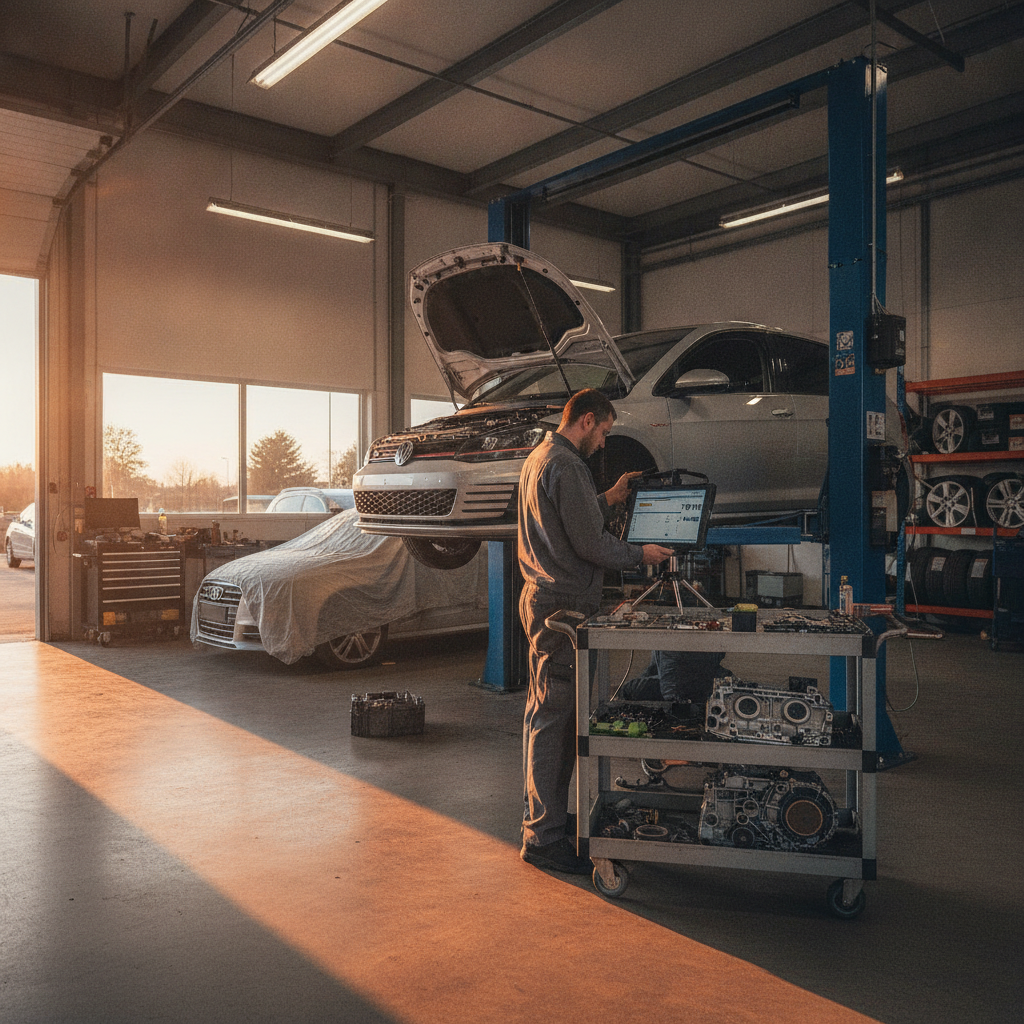
A proper mechatronic service at Bavarian Performance begins with a full ODIS scan to capture all stored and pending faults in the TCM, followed by a road test to characterize the symptoms under the actual driving conditions that trigger them. This matters: a DSG that hesitates on a cold morning in Sebastopol but shifts fine after ten minutes tells a completely different diagnostic story than one that hesitates at operating temperature.
The service itself typically involves:
- Draining and replacing the DSG fluid with VW-specified G 052 182 fluid (DQ250) or G 052 171 (DQ200 dry-clutch) — not a generic ATF substitute
- Replacing the filter and mechatronic sleeve seal kit, which degrades and allows fluid to bypass solenoid circuits
- Inspecting and if necessary replacing faulty solenoids within the mechatronic unit
- Performing a TCM adaptation reset via ODIS to recalibrate clutch engagement points after fluid change
- A final road test confirming shift quality across all operating conditions
In many cases — particularly when the fluid hasn’t been neglected past 60,000 miles — the fluid and filter service with adaptation reset resolves the symptoms entirely. Full mechatronic replacement is genuinely necessary only when solenoid resistance testing confirms an internal failure. Knowing which situation you’re dealing with is exactly why factory diagnostics come first.
For a broader look at what transmission service covers across our European vehicle lineup, see our transmission repair page.
The Content Gap Most Local Shops Don’t Cover: TCM Adaptation After DSG Service
Here’s something that almost never gets mentioned by generic repair shops — and was entirely absent from the competitor content we reviewed across Sonoma County: after any DSG fluid service, the transmission control module must be put through an adaptation procedure using factory software. Without it, the mechatronic unit continues operating on learned clutch engagement values calibrated to the old, degraded fluid. The result is that the transmission may shift worse immediately after service than it did before — a disconcerting experience that leads many owners to assume the repair failed.
The adaptation procedure re-zeros the TCM’s clutch fill values, allowing it to relearn proper engagement pressures against the fresh fluid’s viscosity. This is not a step that can be skipped, and it cannot be performed with a generic scan tool. It requires ODIS with a valid connection to Volkswagen Group’s server infrastructure, or the offline equivalent used by independent specialists with factory-equivalent tooling. At Bavarian Performance, this step is standard — not an upsell.
VW and Audi DSG: When to Repair vs. Replace the Mechatronic
Remanufactured mechatronic units for the DQ250 are available, and in cases of confirmed solenoid failure, replacement is often more cost-effective than sourcing individual solenoids. A genuine VW Group remanufactured mechatronic comes pre-adapted to the gearbox type and still requires TCM programming to match your specific vehicle. Aftermarket units vary widely in quality — this is one area where cutting corners on part sourcing introduces significant risk, since the mechatronic controls clutch pressure on every single gear change your car makes.
If your VW or Audi is still under an extended warranty or you’ve recently purchased a certified pre-owned vehicle, it’s worth confirming whether the mechatronic is a covered component before authorizing independent repair. For out-of-warranty vehicles — and most DSG-equipped Golfs and A3s between five and twelve years old fall into this category — an independent specialist typically offers meaningfully better value than a VW or Audi dealership for this service, without compromising on diagnostic capability or parts quality.
If you drive an Audi and want to understand the full range of services we provide for your vehicle, visit our Audi repair page.
Frequently Asked Questions
How do I know if it’s the mechatronic unit or the clutch packs causing my DSG to hesitate?
Clutch pack wear typically presents as slipping under load — the engine revs climb without a corresponding increase in vehicle speed. Mechatronic faults more commonly produce hesitation, judder at low speeds, or unexpected gear refusal. A factory ODIS scan and road test are the only reliable way to differentiate the two, since the fault codes and adaptation data tell very different stories.
How often should DSG fluid be changed on my VW Golf or Audi A3?
For the wet-clutch DQ250 found in most Golfs and A3s, every 40,000 miles is a reasonable interval under normal conditions. If you’re doing regular stop-and-go driving through Sebastopol, Rohnert Park, or commuting on Highway 101, 30,000 miles is more appropriate. Volkswagen’s original “lifetime fluid” claim is not supported by real-world evidence from technicians who service these gearboxes regularly.
Can I drive my VW or Audi if the DSG is hesitating?
Short distances to get the vehicle to a qualified shop are generally fine if the gearbox is engaging gears and not in fail-safe mode. If the transmission is flashing a warning and selecting only one gear, drive it minimally or have it transported — continuing to drive in fail-safe mode can accelerate clutch pack wear that would otherwise not have been affected.
Will a generic mechanic or quick-lube shop be able to service my DSG?
Most cannot perform the adaptation reset required after a DSG fluid service, and many are not familiar with the VW-specified fluid requirements. Using the wrong fluid type — particularly a generic ATF in a DSG application — can cause significant damage. This is a service that requires both the right parts and the right software.
Does Bavarian Performance service both the wet-clutch (DQ250) and dry-clutch (DQ200) DSG?
Yes. The DQ200 dry-clutch unit found in smaller displacement VW and Audi applications has its own specific service requirements and mechatronic profile. We carry the correct fluid, filter kits, and ODIS tooling for both variants.
Talk to a DSG Specialist Before the Problem Gets Worse
DSG hesitation is one of those symptoms that tends to worsen gradually until it becomes undeniable — and by that point, what might have been a fluid service and adaptation reset has become a mechatronic replacement. If your Volkswagen or Audi is feeling off in any of the ways described above — whether you’re driving through Sebastopol, commuting through Santa Rosa, or running errands in Forestville — the right move is a proper diagnosis before the situation escalates.
Bavarian Performance serves Sebastopol, West Sonoma County, and the surrounding area with factory-grade diagnostics, genuine VW Group-specified parts, and the ODIS tooling required to do this job correctly. Contact us to schedule a DSG diagnosis — we’ll tell you exactly what’s happening and what it will take to fix it properly.