
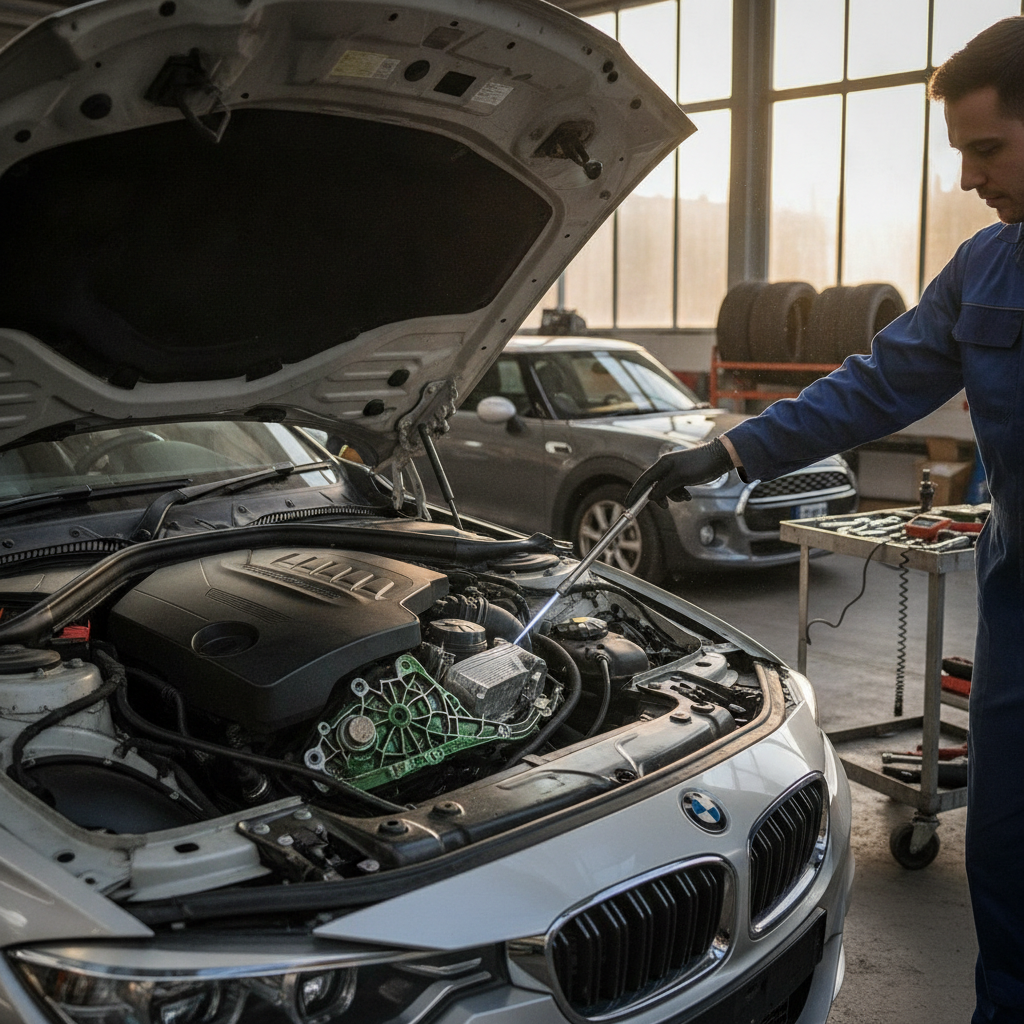
Why Is My BMW or Mini Cooper Overheating in Cotati — and When Do the Water Pump and Thermostat Actually Need Replacing?
If your temperature gauge is creeping toward the red on your way through Cotati or you’re watching the coolant warning light flicker during stop-and-go traffic on Highway 101, there’s a very good chance your BMW or Mini Cooper’s cooling system is telling you something specific — and it’s not a mystery. These engines run a plastic-impeller electric water pump and a map-controlled thermostat that both have well-documented, predictable failure windows. The good news is that this is a manageable, plannable repair when you catch it early. The bad news is that ignoring it long enough can warp a cylinder head or crack a block, at which point you’re looking at an engine replacement rather than a cooling system service. Here’s what you need to know.
The Real Reason BMWs and Mini Coopers Overheat: It’s Not Random
Most European cars don’t overheat because of a general neglect issue the way older American vehicles might. BMW and Mini cooling system failures tend to be engineering-specific and interval-predictable. On the N20, N55, and older N52 engines found in the 3 Series, 5 Series, X3, and X5, BMW specifies an electric water pump controlled by the DME rather than a traditional belt-driven unit. The impeller — the spinning component that actually moves coolant — is made of plastic. Over time, typically somewhere between 60,000 and 80,000 miles, that impeller fatigues, cracks, or separates from the shaft entirely. When that happens, the pump motor still runs and reports no fault to the DME, but coolant circulation has dropped to near zero. Your temperature gauge starts climbing, and by the time you notice, the damage may already be underway.
The thermostat on these same engines is a map-controlled unit — it opens and closes based on load signals from the DME rather than a simple wax-element design. This is clever engineering that improves fuel economy and emissions, but it also means that when the thermostat fails, it often sticks in a partially open or fully open position. The engine runs chronically cold, the heater blows lukewarm air, and fuel trims get pulled in directions they shouldn’t be. Owners frequently misread this as a heater core problem. It isn’t.
On Mini Cooper N14 and N18 engines, the failure pattern is similar but compressed — water pump and thermostat housing failures are common well before 70,000 miles, and the thermostat housing itself is a composite plastic assembly that can crack under thermal cycling stress.
Why Sonoma County Summers Accelerate This Failure
Cotati, Rohnert Park, and the inland portions of Sonoma County see genuine heat during summer months. When ambient temperatures regularly reach the upper 80s and 90s, a cooling system that’s operating at 80 percent capacity gets pushed hard. The Highway 101 corridor between Petaluma and Santa Rosa compounds this — stop-and-go commute traffic reduces airflow through the radiator at exactly the moment the engine needs it most. An electric water pump with a fatiguing impeller that handles highway driving reasonably well can show its weakness in a 45-minute crawl north on 101 on a July afternoon.
Hot dry summers in the North Bay also accelerate coolant degradation. BMW-spec coolant has a service life, and when it breaks down, it becomes acidic — attacking gaskets, seals, and the aluminum surfaces of the cooling system from the inside. If your coolant hasn’t been exchanged in the last four years or 50,000 miles, it’s worth having it tested even if you haven’t seen a temperature warning yet.
What a Proper Cooling System Diagnosis Actually Looks Like
One of the most common complaints we hear from BMW and Mini owners across Sonoma County is that a previous shop plugged in a generic OBD-II scanner, found no fault codes, and told them the cooling system checked out. This is a meaningful gap in how these cars are diagnosed. A failed water pump impeller will often produce no fault code at all because the pump motor itself is functional — it’s the mechanical component inside that has failed. Accurate diagnosis on a BMW requires factory-grade scanning tools like ISTA, which can log actual coolant temperature rise curves, compare pump current draw against expected values, and flag abnormal warm-up patterns that point directly to a thermostat stuck open.
A thorough cooling system inspection at Bavarian Performance includes a pressure test, coolant condition check, water pump current draw analysis, and thermostat response verification — not just a fault code read. Our BMW repair services in Santa Rosa are built around factory diagnostic procedures, because that’s the only way to catch these failures before they escalate.
OEM vs. Aftermarket: Why It Matters More Here Than Almost Anywhere Else
This is a topic that’s largely absent from the competitor landscape in Sonoma County, and it directly affects repair outcomes on these engines. There is a wide market of aftermarket water pumps and thermostats for BMW and Mini applications — many of them significantly less expensive than genuine BMW or OEM-supplier parts. The problem is that the failure mode for cheap aftermarket water pumps on these engines is well-documented: the replacement impeller fails under the same thermal stress that killed the original, often within 20,000 to 30,000 miles. You’ve paid for labor twice, and you’re no better off.
The OEM water pump for most N55 and N20 applications now uses an upgraded impeller design — metal rather than plastic in some variants — and that matters enormously for longevity. When Bavarian Performance replaces a water pump on a BMW or Mini, we source genuine OEM or OEM-equivalent parts from the original equipment suppliers, not the cheapest catalog option. The part cost difference is real, but so is the difference in how long it lasts.
What to Expect for Timing and Cost
Water pump and thermostat replacement on a BMW N55 or N20 engine is typically a same-day service when parts are on hand — labor ranges from two to four hours depending on the specific platform. Because the thermostat and water pump are accessed through similar areas of the engine bay on most of these applications, doing them together is standard practice. Replacing one without the other at this service interval is a false economy — the labor overlap means doing the second component later costs nearly as much as if you’d done it separately from scratch.
Mini Cooper N14 and N18 water pump and thermostat housing work is similarly compact as a job, though the thermostat housing assembly on these engines is a more involved replacement than on the larger BMW units. Expect to be without the car for a day. If coolant service is due at the same time — which it frequently is when these components are failing — that’s incorporated into the same appointment.
We’re transparent about what we find before any work begins. Preventative maintenance planning at Bavarian Performance includes tracking where your specific vehicle sits in its component service windows so you’re never caught off guard by a repair that was predictable months earlier.
Frequently Asked Questions
How do I know if my BMW’s water pump impeller has failed if there’s no warning light?
The most reliable signs are a temperature gauge that climbs slowly in slow traffic but recovers at highway speed, a heater that starts blowing cool air after a long idle, or a longer-than-normal warm-up time. Factory diagnostic software can also flag abnormal current draw from the pump motor. If you’re seeing any of these, have it inspected — don’t wait for an overheat event.
My Mini Cooper is blowing lukewarm heat. Is that the heater core or the thermostat?
On N14 and N18 Minis, a thermostat stuck in the open position is the more common cause of poor heater output. The heater core itself rarely fails on these cars. A proper diagnosis with factory scan data and coolant temperature logging will confirm which it is before any parts are ordered.
Can I drive my BMW to Sebastopol or Windsor if the temperature gauge is running slightly high?
Short answer: no. A BMW or Mini running above its normal operating temperature is at risk of head gasket failure or worse with every additional mile. If the gauge is elevated, pull over safely, let the engine cool, and arrange transport. The repair cost of a failed water pump is a fraction of a head gasket or engine replacement.
How often should BMW coolant be replaced?
BMW specifies coolant service approximately every four years or 50,000 miles, whichever comes first. In Sonoma County’s hot summers, staying on top of this interval is particularly important — degraded coolant loses its corrosion inhibitor protection and begins attacking aluminum components from the inside.
Does Bavarian Performance service Mini Coopers with the same expertise as BMWs?
Yes. Mini Cooper and BMW share engineering lineage, and our factory-trained technicians work on both. Mini Cooper repair in Santa Rosa at Bavarian Performance uses the same ISTA diagnostic platform and OEM parts standards we apply to every BMW in the shop.
Don’t Wait for the Gauge to Reach Red
The most expensive version of a cooling system failure is the one you ignored for two more months. If your BMW or Mini Cooper is showing any signs of temperature instability — or if you’re simply approaching the 60,000 to 80,000 mile window where these components are known to fail — contact Bavarian Performance in Santa Rosa for a proper diagnosis. We serve drivers throughout Cotati, Rohnert Park, Petaluma, Windsor, Sebastopol, and across Sonoma County, and we’ll give you a straight answer about what your cooling system actually needs before it becomes an engine problem. Reach out through our contact page to schedule an appointment or ask a question — no pressure, no upsell, just honest European car expertise.