
Why Is My BMW or Audi’s Cooling System Overheating in Cotati — and What Fails First?
If your temperature gauge is climbing on the drive through Cotati or you’re seeing a coolant warning light on your BMW or Audi, the cooling system is telling you something specific — and it’s almost never random. European cooling systems on modern BMW and Audi engines are engineered to tight tolerances, which means they perform exceptionally when maintained and fail in very predictable ways when they’re not. The good news: these failures follow a pattern that an experienced European specialist can diagnose and address before you’re stranded on the side of Highway 101 with a warped cylinder head.
- The Real Reason European Cooling Systems Fail — It's Not the Radiator
- Why Sonoma County's Climate Accelerates the Timeline
- What Actually Happens When You Ignore Cooling System Warning Signs
- What a Proper Cooling System Diagnosis Actually Involves
- OEM Parts Are Non-Negotiable on Cooling System Work
- When to Schedule Cooling System Service — Not Just When Something Breaks
- Frequently Asked Questions
- Don't Wait for the Temperature Gauge to Tell You
The Real Reason European Cooling Systems Fail — It’s Not the Radiator
Most drivers assume a coolant problem means a leaking radiator. On older American or Japanese vehicles, that’s often true. On BMW and Audi engines from the last fifteen years, the failure almost always originates somewhere else: the water pump and the thermostat housing.
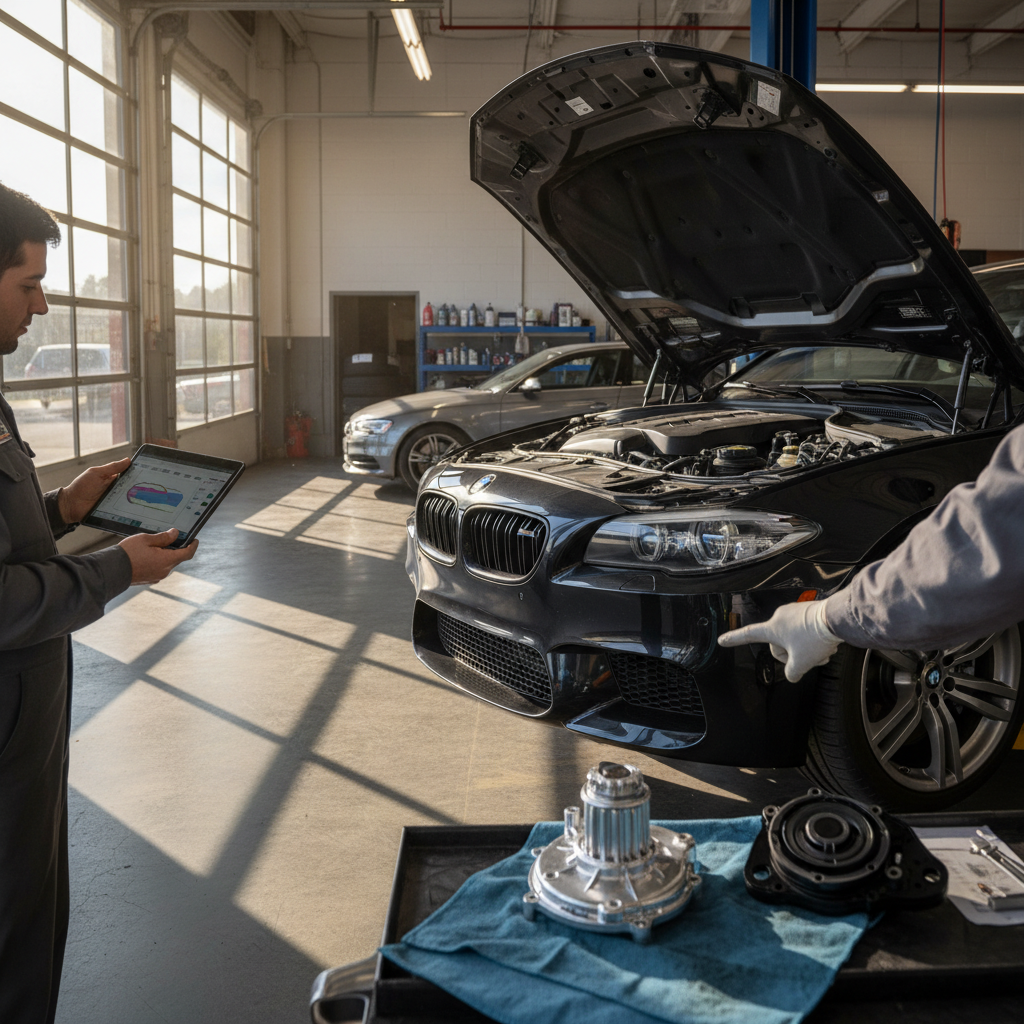
BMW’s N20, N52, and N55 engines use an electric auxiliary water pump and a map-controlled thermostat — a plastic unit that cycles between temperature thresholds to optimize fuel economy. That plastic thermostat housing is a known failure point, typically between 60,000 and 80,000 miles. When it sticks closed, your engine has no way to regulate heat, and temperatures spike fast. When it sticks open, the engine runs cold, fuel trims go rich, and you start burning excess fuel and carbon-fouling injectors.
The water pump on many BMW N-series and B-series engines is also plastic-impellered. Under sustained heat — exactly the kind generated by stop-and-go traffic on southbound 101 toward Rohnert Park on a July afternoon — the impeller can separate from the shaft. The pump spins, but coolant circulation drops dramatically. Your temperature gauge won’t always spike immediately; in some cases you’ll notice the heat output from your climate system dropping before the temp gauge catches up. That’s the tell.
Audi’s 2.0T TFSI and 3.0T engines have their own version of this problem. The coolant flange and thermostat housing on the EA888 engine family is another well-documented plastic component that cracks under thermal cycling. Audi 2.0T owners in the 2009–2016 model year range should treat thermostat housing replacement as scheduled maintenance, not a surprise repair.
Why Sonoma County’s Climate Accelerates the Timeline
Cotati sits in a stretch of Sonoma County that regularly sees summer temperatures pushing into the mid-90s, and that heat gets amplified inside an engine bay sitting in traffic. Hot, dry summers are hard on all cooling systems, but they’re particularly punishing on European vehicles that use plastic components in high-heat zones — something German engineers optimized for European climate cycles, not Northern California summers.
If you’re regularly driving Highway 12 between Sonoma Valley and Santa Rosa, or making the daily 101 run from Petaluma through Cotati, Rohnert Park, and into Santa Rosa, your cooling system is working harder than it would on a leisurely highway cruise. Sustained low-speed, high-load driving generates more heat than highway driving, and it’s the exact duty cycle that accelerates impeller and thermostat failures.
Wildfire seasons add another variable. Ash and particulate matter from wildfire smoke — a reality in Sonoma County since the 2017 Tubbs Fire changed the regional landscape — can partially block radiator fins and reduce airflow. Even a modest reduction in airflow capacity can push a marginal cooling system over the edge on a hot day.
What Actually Happens When You Ignore Cooling System Warning Signs
This is where informed ownership matters most. A cooling system that’s showing early symptoms — intermittent temperature spikes, coolant odor, milky residue under the oil cap, or heater output that varies unexpectedly — is giving you a window to act affordably. Once an engine overheats to the point of head gasket failure or, in severe cases, a warped cylinder head, you’re looking at an engine repair bill that can dwarf what the car is worth on paper.
On BMW’s N52 and N55 engines, a water pump and thermostat service done proactively — before failure — is a straightforward job for a specialist with the right factory-grade tooling. Done reactively after a full overheat, the same job can now include a head gasket, machine shop work, and potentially new head bolts. The cost difference between proactive and reactive is significant.
Learn more about engine repair services at Bavarian Performance in Santa Rosa.
What a Proper Cooling System Diagnosis Actually Involves
One section that’s conspicuously absent from most local competitor websites is a clear explanation of what a real cooling system diagnostic looks like on a European vehicle — versus a generic coolant flush and inspection. Here’s what a factory-trained specialist actually checks:
- Cooling system pressure test: A proper pressure test held for an extended period identifies leaks at hoses, the expansion tank, water pump seals, and the thermostat housing — not just obvious external drips.
- Thermostat function test via factory scan tool: On BMW and Audi, the thermostat is electronically controlled and monitored. A generic OBD-II reader won’t tell you thermostat response time or whether the map-controlled unit is opening at the correct temperature. Factory-grade tools — ISTA for BMW, ODIS for Audi/VW — read live thermostat data and flag range failures that don’t always trigger a check engine light.
- Water pump output assessment: Flow rate and pump operation can be evaluated through scanner data on electric auxiliary pumps, and through coolant temperature differential testing on mechanical pumps.
- Combustion gas test: If head gasket integrity is in question, a combustion gas test on the coolant reservoir confirms whether exhaust gases are entering the cooling system — a definitive indicator of a breached gasket.
- Coolant condition and concentration check: European manufacturers specify coolant by chemistry, not just concentration. BMW specifies its own coolant formulation; mixing universal coolant can cause silica dropout that clogs the heater core and water pump passages. A specialist checks both concentration and compatibility.
OEM Parts Are Non-Negotiable on Cooling System Work
If you’ve done any research on BMW or Audi water pump replacements, you’ve probably encountered aftermarket units at a fraction of OEM price. Some are fine. Many are not. The impeller quality on budget water pumps is notoriously inconsistent, and a failed aftermarket pump six months after the original job means the labor is paid twice. On cooling system components specifically — water pumps, thermostat housings, expansion tanks, and coolant hoses — genuine OEM or OEM-equivalent parts from suppliers like Mahle, INA, or Febi (the actual manufacturers that supply BMW and Audi on the production line) are worth the modest price difference.
See how Bavarian Performance approaches European preventative maintenance schedules.
When to Schedule Cooling System Service — Not Just When Something Breaks
If you own a BMW or Audi between 60,000 and 100,000 miles and haven’t had the water pump and thermostat serviced, that service window is now. It’s not a matter of whether these components will fail — it’s a matter of when. Scheduling proactively, rather than waiting for a warning light or a temperature spike on the way through Windsor or Sebastopol, is the difference between a maintenance appointment and an emergency tow.
Coolant itself should be exchanged on a schedule as well. BMW specifies coolant changes every two years or 30,000 miles on many models. Old coolant loses its corrosion inhibitors, which accelerates degradation of aluminum cooling system components — and both BMW and Audi use aluminum extensively throughout their engine cooling circuits.
Frequently Asked Questions
How do I know if my BMW’s water pump is failing before it causes overheating?
Watch for inconsistent heater output, a temperature gauge that fluctuates rather than holding steady, or coolant loss without a visible external leak. On vehicles with ISTA diagnostic access, a specialist can test electric water pump duty cycle and flag underperformance before the pump fails completely.
My Audi’s temperature gauge looks normal but I smell coolant. What’s happening?
A coolant odor without an obvious gauge reading often indicates a small leak at the thermostat housing, expansion tank cap, or a weeping coolant hose. On Audi 2.0T engines, the plastic thermostat housing is a common culprit. Have the system pressure-tested promptly — small leaks become large ones quickly under heat cycling.
Is a coolant flush the same as a cooling system service?
Not on a European vehicle. A coolant flush exchanges fluid, but a proper cooling system service includes pressure testing, component inspection, thermostat function verification via factory scanner, and coolant chemistry confirmation. The flush is one step in a broader service.
Can I drive my BMW from Cotati to Santa Rosa if the temperature gauge is slightly elevated?
No. A temperature gauge reading above normal is an active warning. Pull over safely, shut the engine off, and call for a tow. Continuing to drive — even a short distance — risks head gasket failure, which can turn a $600 repair into a $4,000 engine job.
Does Bavarian Performance serve drivers coming from Petaluma or Rohnert Park for cooling system work?
Yes. Bavarian Performance in Santa Rosa regularly services vehicles from throughout Sonoma County, including Petaluma, Rohnert Park, Cotati, Sebastopol, and Windsor. If your vehicle isn’t safe to drive, call ahead and we can advise on towing options.
Don’t Wait for the Temperature Gauge to Tell You
Cooling system failures on BMW and Audi engines are among the most preventable major repairs a European car owner faces — provided the warning signs are recognized early and the right diagnostic equipment is in the hands of someone who understands how these systems actually work. At Bavarian Performance in Santa Rosa, we use factory-grade diagnostic tools and genuine OEM-specification parts to service cooling systems the way the engineers designed them to be maintained.
If your BMW or Audi is between 60,000 and 100,000 miles, or if you’ve noticed anything unusual with your temperature gauge or coolant level, don’t wait for the situation to escalate. Contact Bavarian Performance to schedule a cooling system inspection — and get ahead of the repair before it gets ahead of you.