
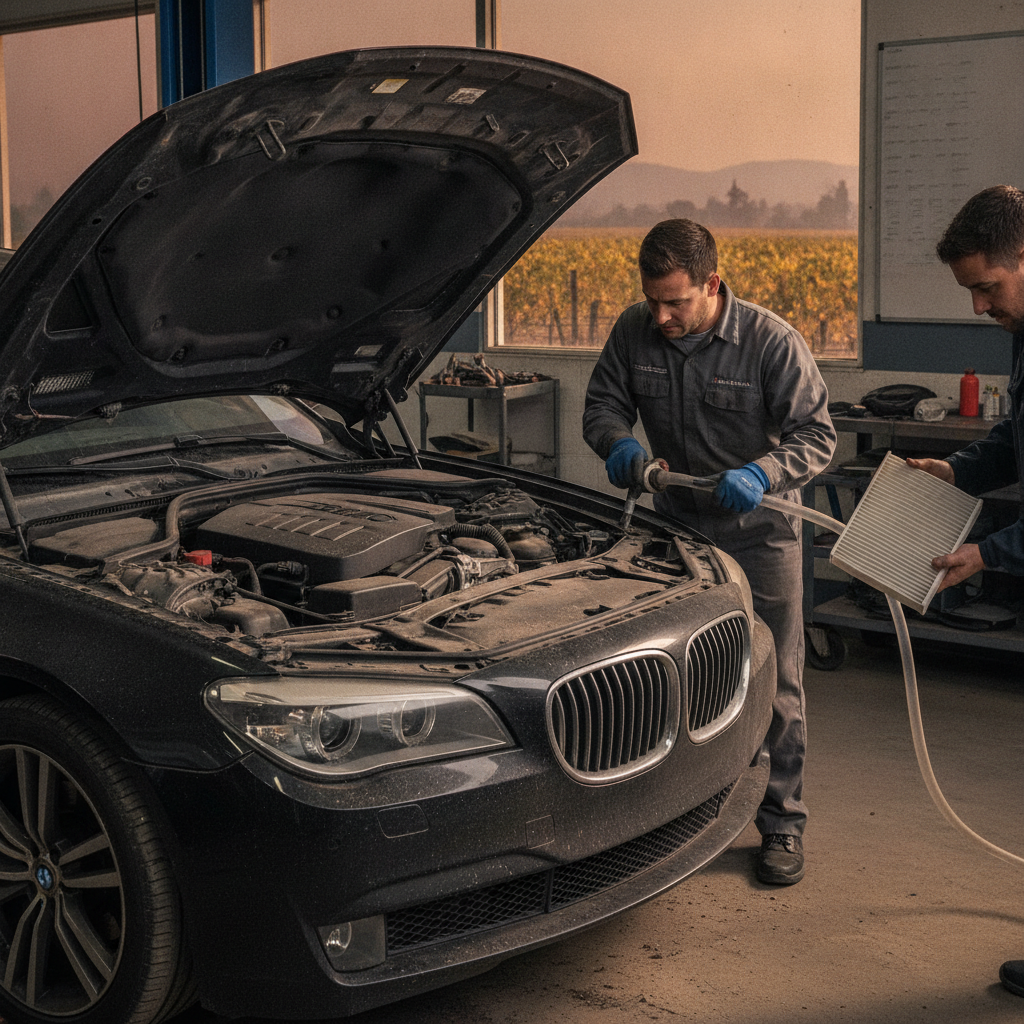
Why Is My Audi’s or BMW’s Cabin Getting Smoky or Musty After Wildfire Season in Santa Rosa — and What Does a Cabin Air Filter and HVAC Decontamination Service Actually Fix?
If the inside of your European car has smelled faintly of smoke since the last fire season — or your HVAC is pushing out a stale, musty odor when you first switch it on — a simple cabin air filter swap probably isn’t going to solve the whole problem. For Santa Rosa drivers, wildfire smoke and ash aren’t just an inconvenience. They’re a documented source of vehicle damage that most independent shops in Sonoma County have never properly addressed, and that most national chain service centers aren’t equipped to diagnose at all. Here’s what’s actually happening inside your HVAC system, and what a thorough decontamination service covers for BMW, Audi, Porsche, Mercedes-Benz, and Mini Cooper owners in this area.
What Wildfire Smoke Actually Does to a European Car’s Interior Systems
When smoke from a major fire event moves through a region — as it has repeatedly since the 2017 Tubbs Fire devastated Fountaingrove and Coffey Park — the particulate matter isn’t just floating past your car. It’s actively being drawn through every available air path. Your vehicle’s HVAC system cycles air continuously, and unless it’s running on full recirculation mode (which most drivers don’t maintain for extended periods), fine ash, carbon particles, and chemical compounds from burning structures are passing directly through your intake system.
What stays behind goes well beyond the cabin air filter. Ash and particulate settle into the blower motor housing, coat the evaporator core fins, and embed into the foam seals around ductwork junctions. In humid conditions — and Sonoma County’s morning fog patterns, especially in Sebastopol and along the coast toward Bodega Bay, create exactly these conditions — trapped particulate becomes a breeding ground for mold and bacteria. That’s where the musty smell comes from. It’s not the filter. It’s the evaporator core.
Beyond the cabin, fine ash drawn in through the engine air intake can contaminate the mass airflow (MAF) sensor. On BMW’s N55 and B58 engines, as well as Audi’s turbocharged 2.0T and 3.0T platforms, MAF sensors are precision instruments calibrated to measure air density within fractions of a percent. Even a light coating of fire residue can skew readings enough to cause rough idle, reduced throttle response, and fuel trim errors that trigger a check engine light. Many owners attribute these symptoms to something mechanical and expensive — when the actual culprit is ash contamination that accumulated during a single bad smoke week.
Why a Basic Cabin Filter Change Doesn’t Cut It
Most shops — and to be fair, this includes several local competitors — will replace your cabin air filter and call the job done. For a mild dust situation, that’s adequate. After a heavy wildfire smoke event, it’s about 20% of the actual work. The filter catches the largest particles, but everything that slipped through before the filter was swapped, and everything already deposited on the evaporator and blower components, stays exactly where it is.
European HVAC systems are more complex than most drivers realize. BMW’s automatic climate systems, for instance, use separate temperature zones with independent blend door actuators, recirculation flap motors, and in some models a separate micro-filter compartment behind the main cabin filter housing. Audi’s multi-zone climate on A6, Q5, and A7 platforms routes air through a surprisingly involved duct network behind the dashboard. Mercedes-Benz AIRMATIC-equipped vehicles circulate cabin air through additional comfort ventilation paths. All of these surfaces can retain smoke residue and ash deposits that a filter swap never touches.
A proper decontamination service addresses the full system: cabin filter replacement, blower motor inspection and cleaning, evaporator core treatment with an antimicrobial foaming agent, duct sanitization, and a recheck of airflow at each vent. If the evaporator core has significant organic buildup, the odor will return within a few weeks of a standard filter swap — a pattern that frustrates owners who’ve already paid for service once. Preventative maintenance at Bavarian Performance includes checking these components as part of a broader seasonal inspection, particularly after the peak fire season months of July through October.
MAF Sensor Contamination: The Symptom Most Shops Miss
This is an angle that’s genuinely underserved in the local repair conversation. After significant smoke events, it’s worth having your MAF sensor inspected — not just cleaned with a generic electrical contact spray, but properly evaluated with a factory-grade scan tool to review live fuel trim data and airflow readings against factory specification.
On a BMW with an N20 or N55 engine, a contaminated MAF sensor will often show fuel trim corrections of plus or minus 10–15%, which the DME is quietly compensating for without triggering a fault. You may notice slightly reduced fuel economy on Highway 101 commutes, a subtle hesitation at light throttle, or marginally slower cold-start behavior. These symptoms are easy to attribute to other causes. The right diagnostic approach is to pull live data with ISTA — BMW’s factory diagnostic system — compare against baseline airflow values, and inspect the MAF element visually under proper lighting before deciding whether a cleaning or replacement is warranted.
Audi and Volkswagen’s ODIS platform offers the same live data capability for their Bosch MAF sensors. Generic OBD-II scan tools simply don’t give you the resolution needed to catch borderline contamination before it becomes a drivability fault.
When to Address This — and Who It Affects Most
If your vehicle was regularly driven or parked outdoors during any major smoke event in Sonoma County — whether the 2017 Tubbs Fire area, the 2019 Kincade Fire corridor through Healdsburg and Geyserville, or any of the subsequent fire seasons — it’s worth a thorough inspection even if you’ve never noticed a specific symptom. Ash residue can remain biologically active inside an HVAC system for years, particularly in vehicles that spend time in Rohnert Park’s warmer inland microclimate or the damp coastal transition zones west of Sebastopol.
Owners of vehicles with premium cabin air filtration — BMW’s activated charcoal filter systems, Audi’s combination particle and activated-charcoal units, or Porsche’s fresh air system on the Cayenne and Panamera — should know that these filters have a finite saturation point. After a heavy smoke event, a charcoal filter can reach that point in days rather than months. Running a saturated charcoal filter doesn’t just reduce odor filtration — it can begin off-gassing trapped compounds back into the cabin under heat. BMW owners in particular should check whether their vehicle uses a standard particulate filter or the combination charcoal variant, as the replacement interval and cost differ meaningfully.
What to Expect from a Full HVAC Decontamination Service
At Bavarian Performance, a complete post-wildfire HVAC decontamination for a European vehicle typically involves:
- Cabin air filter inspection and replacement — including verification of filter type (particulate vs. combination charcoal) and correct OEM specification for the model year
- Blower motor and housing inspection — removing visible ash and particulate deposits, checking motor operation across all speed settings
- Evaporator core treatment — application of an antimicrobial foaming agent through the cabin air intake, allowing dwell time to address mold and bacterial growth on the evaporator fins
- Duct sanitization and odor neutralization — treating accessible duct runs and verifying airflow balance across all vents
- MAF sensor inspection — visual inspection and live data review using factory-grade diagnostics to assess contamination level and determine whether cleaning or replacement is indicated
- Engine air filter inspection — checking for ash contamination, particularly on vehicles that were driven during heavy smoke days with the windows down or ventilation set to fresh air
This isn’t a 15-minute service, and quoting it as such would be misleading. The evaporator treatment alone requires dwell time, and proper MAF evaluation requires scan tool access and interpretation — not just a visual check. Plan for a half-day appointment. The result is a cabin environment that smells and performs the way it did before fire season.
Frequently Asked Questions
How do I know if my cabin air filter needs replacement after wildfire smoke?
Visible discoloration and ash deposits on the filter surface are obvious indicators, but a saturated charcoal filter may appear visually intact while having lost all absorptive capacity. If you’re noticing any residual smoke odor when the HVAC runs, particularly on the first few minutes of operation, the filter and evaporator core should both be evaluated.
Can wildfire ash damage my Audi’s or BMW’s MAF sensor permanently?
Light contamination can often be addressed by cleaning with a proper MAF-safe solvent and verifying live data. Heavy contamination or abrasion from gritty ash particles can damage the sensing element and require replacement. A factory scan tool reading will tell you which situation you’re dealing with — don’t guess based on symptoms alone.
My car sat outdoors during the Kincade Fire. Should I still have it checked even years later?
Yes. Ash residue inside HVAC systems doesn’t simply evaporate over time. In vehicles that run infrequently or have low annual mileage — common among Wine Country second-home vehicles and weekend-use exotics — these deposits can persist and worsen as seasonal humidity cycles promote microbial growth on the evaporator core.
Does my Porsche’s or Mercedes-Benz’s cabin filter protect against wildfire smoke particles?
High-specification European cabin filters — particularly combination HEPA-style and activated-charcoal units on Porsche Cayenne, Panamera, and Mercedes-Benz E-Class and S-Class — do provide meaningful smoke filtration. However, they reach saturation point significantly faster during heavy smoke events than under normal operating conditions. Factory replacement intervals assume normal air quality; during fire season, those intervals compress sharply.
Why can’t I just buy a cabin filter at an auto parts store and swap it myself?
You can, and for a routine filter change it’s reasonable. But the filter is the least complicated part of this service. Evaporator core treatment, blower motor cleaning, and MAF sensor evaluation require equipment, product knowledge, and factory diagnostic access that a DIY swap doesn’t address. If the goal is eliminating the smoke odor and verifying no secondary damage, a shop visit is the right call.
Schedule Your HVAC and Cabin Air Quality Service in Santa Rosa
If your European vehicle has been through one or more Sonoma County fire seasons and you’ve never had a full HVAC decontamination, now is a good time to get ahead of it — before the next fire season puts additional stress on a system that’s already carrying residual contamination. Bavarian Performance serves BMW, Audi, Porsche, Mercedes-Benz, Mini Cooper, Volkswagen, Land Rover, Volvo, and Italian exotic owners throughout Santa Rosa and across Sonoma County, using factory-grade diagnostics and OEM-specification parts on every service.
Contact Bavarian Performance to schedule your HVAC inspection and cabin decontamination service. We’ll tell you exactly what your vehicle needs — and what it doesn’t.