
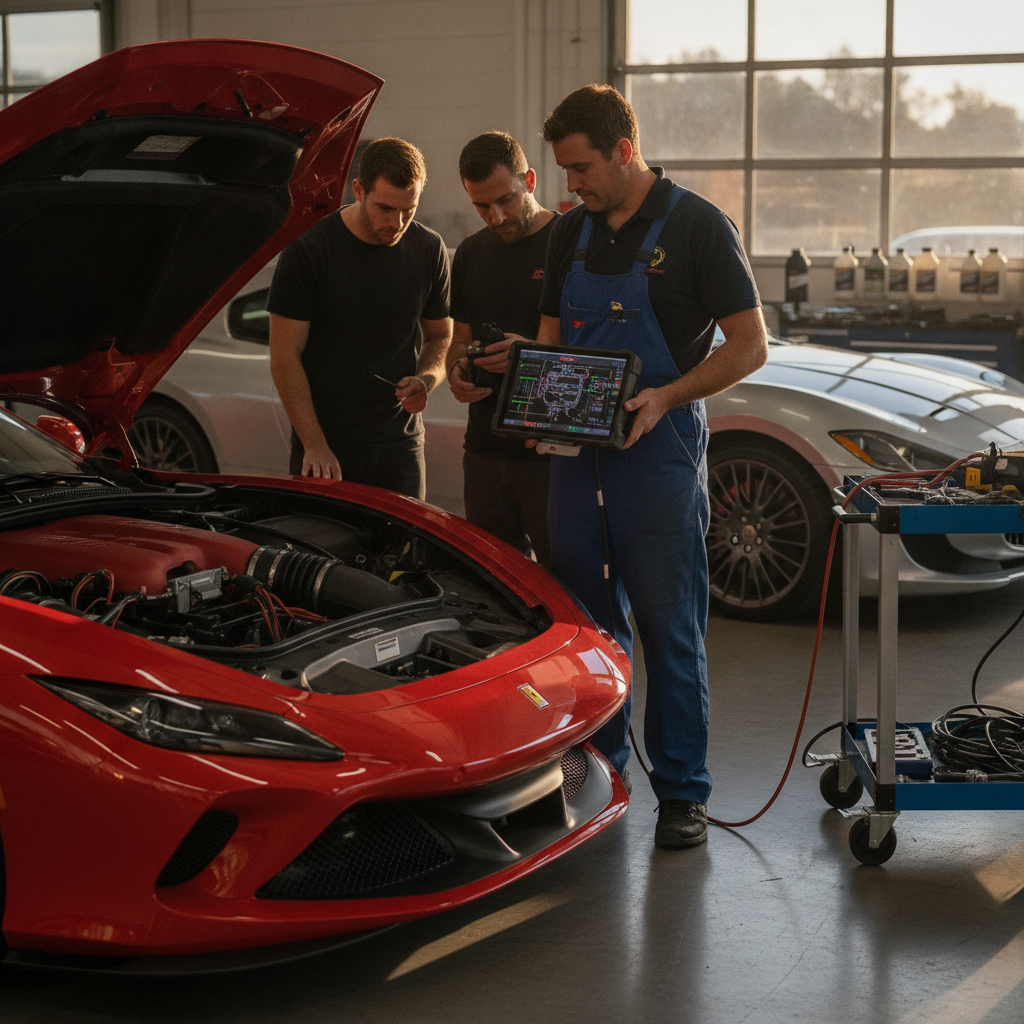
Why Is My Ferrari’s or Maserati’s Electrical System Throwing Random Faults in Healdsburg — and What Does a Factory-Level Italian Exotic Diagnostic Actually Involve?
If your Ferrari or Maserati is lighting up the instrument cluster with warning messages that seem to appear and disappear without pattern — especially after a weekend drive through Wine Country — the problem almost certainly isn’t random. Italian exotic electrical systems are among the most tightly integrated in the automotive world, and what looks like a ghost fault to a generic scan tool is often a very specific, traceable failure that only factory-grade diagnostic software can correctly identify. At Bavarian Performance in Santa Rosa, we work with Italian exotic owners throughout Healdsburg, Geyserville, and the broader Sonoma County wine country corridor who’ve already wasted time at shops that couldn’t get past a generic OBD-II read.
The Real Reason Italian Exotics Throw Electrical Faults More Often Than You’d Expect
Ferrari and Maserati electrical architectures aren’t designed to simplify diagnosis — they’re designed to perform. That means multiple control modules communicating across proprietary CAN bus networks, with fault thresholds calibrated to factory spec tolerances that standard aftermarket diagnostic platforms simply don’t know exist. A Maserati GranTurismo, for example, manages its transmission, traction control, adaptive suspension dampers, and F1 automated clutch system through an interlocked network where a marginal voltage drop in one module can cascade into fault flags across several others. A Ferrari California T’s complex hybrid climate and powertrain electronics are similarly layered.
The critical point is this: reading the fault code is only the first step. Understanding which module generated it, what the operating conditions were at the time, what the freeze frame data shows, and whether it represents an actual component failure or a communication anomaly between modules — that’s where diagnosis actually happens. And that level of interpretation requires factory-grade scan tools, not the Bluetooth OBD-II dongle approach that too many shops in Northern California still rely on for exotic vehicles.
What Local Conditions in Healdsburg and Wine Country Actually Do to Exotic Electrical Systems
The environment along the Highway 101 corridor between Windsor and Geyserville isn’t kind to sensitive electronics. Temperature swings between cool coastal mornings and dry summer afternoons stress wiring harness insulation and ground connections. The fine vineyard dust that drifts across the Alexander Valley and through passes above Healdsburg infiltrates cabin electronics, sensor arrays, and connector housings. If your Ferrari or Maserati spends any time on unpaved wine country access roads — or even the rougher stretches of Dry Creek Road — vibration works at connector pins and grounds in ways that create intermittent faults that are notoriously difficult to replicate on demand.
Post-wildfire ash and airborne particulates, still a recurring reality in Sonoma County since the 2017 Tubbs Fire season, have a particular talent for accelerating corrosion inside electrical connectors. Combined with occasional coastal moisture from the Bodega Bay fog belt pushing inland through the Russian River Valley, you get an environment that tests Italian electrical systems harder than their native Emilia-Romagna climate ever did. These aren’t reasons to park the car — they’re reasons to work with a specialist who understands both the vehicles and the region.
Why Generic Scan Tools Fail Ferrari and Maserati Electrical Diagnosis
A standard OBD-II reader gives you generic fault codes — the ones mandated by federal emissions standards. It cannot access the proprietary Magneti Marelli or Bosch module data embedded in Ferrari’s powertrain and chassis management systems. It cannot read Maserati’s EOBD extended diagnostics, perform actuation tests on individual solenoids, or monitor live data streams across the full module network simultaneously.
This is why owners in Healdsburg and across Sonoma County sometimes come to us after being told by a quick-lube shop or general repair facility that they found “no codes” — when the Ferrari’s own instrument cluster is clearly indicating a fault. The codes are there. They’re just in a proprietary diagnostic layer that requires the right software, the right interface hardware, and the experience to interpret what the data means in context. Our Ferrari repair capabilities include factory-equivalent diagnostic platforms that access exactly those systems.
What a Proper Italian Exotic Electrical Diagnosis Actually Involves
When a Ferrari or Maserati comes in for electrical fault diagnosis, the process looks nothing like plugging in a code reader and calling it done. Here’s what a thorough diagnostic workup actually covers:
- Full module scan across all networks: Engine, transmission, ABS/stability control, suspension, climate, instrument cluster, and body control modules — not just powertrain.
- Freeze frame and event data review: When did the fault occur? What were the RPM, vehicle speed, coolant temp, and throttle position at the moment the flag was set? This context separates real failures from intermittent communication errors.
- Ground and power supply verification: Many Italian exotic electrical faults trace back to degraded chassis grounds, corroded battery terminals, or a battery that can no longer hold adequate voltage under load. A parasitic draw or low resting voltage will generate phantom module faults across the entire network.
- Connector and harness inspection: Particularly relevant in Sonoma County’s variable climate — pin corrosion, backed-out terminals, and chafed harnesses near exhaust or suspension components are common physical causes of intermittent faults.
- Live data monitoring and actuation testing: Where the fault points to a specific actuator or sensor, factory software allows direct command of that component to verify response — something generic tools fundamentally cannot do.
- Module programming and adaptation resets: After repairs, some systems require re-adaptation procedures that can only be executed with factory or factory-equivalent software.
Maserati-Specific Electrical Concerns Worth Knowing
Maserati’s F1 automated single-clutch transmission system — used in older GranTurismo and Quattroporte models — is a frequent source of electrical complaints. The hydraulic actuator unit, which handles clutch engagement and gear selection, communicates through a network of position sensors and solenoid drivers. When fluid contamination or actuator wear sets in, the faults that appear look electrical when the root cause is mechanical-hydraulic. Diagnosing this correctly the first time saves significant time and money. Similarly, the Skyhook adaptive suspension on Quattroporte models generates module faults when damper sensors drift out of calibration — a condition that responds well to sensor replacement and adaptation reset, but only if the diagnostic correctly identifies which sensor is at fault rather than condemning the entire suspension ECU.
For Maserati owners throughout Sonoma County, understanding these system-specific patterns is the difference between a precise repair and a cycle of parts replacement that never resolves the underlying issue.
When to Address Electrical Faults — and When They’re Urgent
Not all warning lights on an Italian exotic demand immediate roadside intervention, but none of them should be ignored for weeks. A fault in the traction control or ABS module that seems cosmetic can mask an actual sensor failure that reduces active safety system effectiveness — particularly relevant on the winding roads around Healdsburg and into the Sonoma Mountain passes. Engine management faults that trigger a restricted performance mode protect the powertrain but also indicate that you’re running with reduced monitoring capability until the root cause is resolved. Electrical faults that cycle on and off intermittently are often the most insidious — they’re telling you something is marginal before it fails completely, and diagnosing them while still intermittent is far more cost-effective than waiting for a hard failure.
Frequently Asked Questions
Can any European auto shop in Sonoma County diagnose a Ferrari or Maserati electrical fault?
Not effectively. Italian exotic electrical diagnosis requires proprietary software access and experience with these specific platforms. A shop that primarily works on German brands may have excellent diagnostic tools for BMW or Audi but lack the Maserati or Ferrari-specific software needed to access full module data and perform factory-level procedures.
How long does an electrical diagnostic take on an Italian exotic?
A thorough full-system diagnostic typically takes two to four hours for initial evaluation. If the fault is intermittent and requires monitored road testing or extended module observation, the process may extend further. Shortcuts here almost always result in misdiagnosis.
Will disconnecting the battery clear the faults on my Ferrari or Maserati?
It will temporarily clear stored codes, but it also resets module adaptations and can introduce new complications — particularly with the Maserati F1 transmission system, which requires specific adaptation after any power interruption. More importantly, clearing codes without diagnosing root cause guarantees the fault returns.
Is it safe to drive my Ferrari from Healdsburg to Santa Rosa with a warning light active?
It depends on which system is flagging and whether the vehicle has entered a reduced performance or limp mode. A general caution light with normal driving behavior is usually not an emergency, but a fault accompanied by power reduction, unusual transmission behavior, or any oil pressure/temperature warning warrants stopping and calling for advice before continuing.
Do Maserati and Ferrari electrical faults get worse if ignored in Wine Country climates?
Often yes. The temperature cycling, dust exposure, and occasional moisture infiltration common in Healdsburg and the broader Sonoma Valley can accelerate connector corrosion and harness degradation once a fault has been identified. A marginal ground connection that throws occasional faults in summer can become a persistent failure by late fall.
Work With a Specialist Who Knows These Cars
If your Ferrari or Maserati is throwing electrical faults in Healdsburg, Windsor, Sonoma, or anywhere across the Wine Country, the worst thing you can do is hand it to a shop that’s going to throw generic parts at a system that requires precise diagnosis. Bavarian Performance brings factory-level diagnostic depth to Italian exotic ownership in Sonoma County — without the wait times, inconvenience, or dealership-level overhead that comes with the nearest authorized service center.
Contact us to schedule a diagnostic appointment or ask a question about what your warning lights are actually telling you. We’re here to give you the straight answer, not a parts estimate based on guesswork. Reach out to Bavarian Performance today and let’s get your exotic running the way it was built to.