
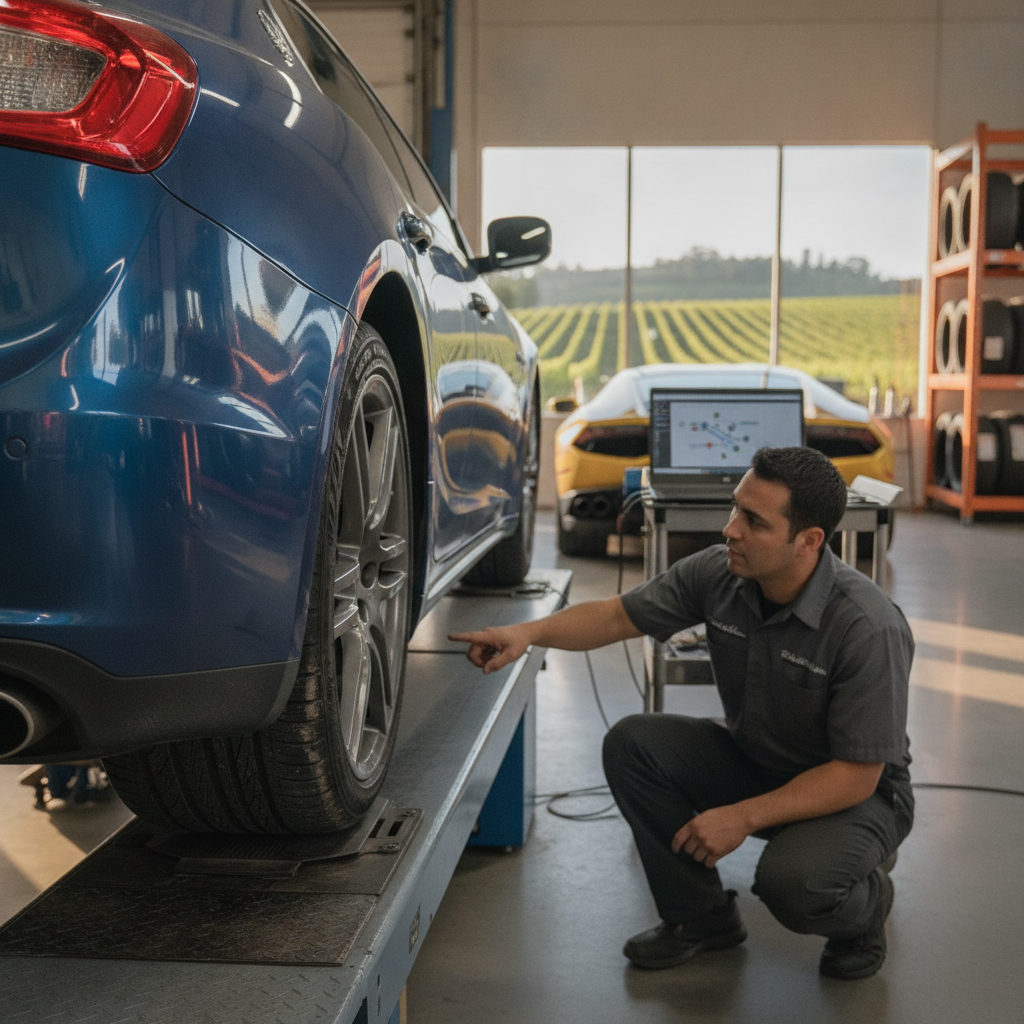
Why Are My Maserati’s or Lamborghini’s Tires Wearing Unevenly in Santa Rosa — and What Does Road-Force Balancing Actually Fix?
If you’re driving a Maserati Ghibli, Quattroporte, or GranTurismo — or a Lamborghini Huracán or Urus — and you’re noticing uneven tire wear, a persistent steering vibration at highway speeds, or scalloping on the inner or outer edges of your tires, you’re dealing with something that a standard spin balance at a general tire shop is unlikely to fully resolve. In Santa Rosa and across Sonoma County’s Wine Country roads, these symptoms are both common and commonly misdiagnosed. The answer usually involves road-force balancing, but the real fix often starts deeper — at the wheel, the alignment geometry, or the suspension itself.
What Standard Balancing Misses on Exotic Vehicles
A conventional static or spin balance measures weight distribution across a wheel and tire assembly. It works reasonably well for everyday passenger cars. But high-performance Italian exotics run ultra-low-profile tires — often 245/35ZR20 fronts and 305/30ZR20 rears on a Huracán, or staggered 19- and 20-inch fitments on a Maserati Ghibli S — where even minor road-force variation causes vibration that a weight correction simply can’t address.
Road-force balancing goes further. The machine simulates the load of the vehicle pressing down on the tire as it rolls, measuring the actual radial and lateral force variation in the tire-and-wheel assembly as it rotates. It identifies stiff spots in the tire carcass — what technicians call high-force zones — that create a rhythmic pulse at speed even when the static weight balance is perfect. On a performance exotic where ride quality and steering precision are engineered to tenths of an inch, those force variations are the difference between a car that feels planted and one that shimmies at 70 mph on Highway 101.
This is a gap that most local general tire shops simply aren’t equipped to address on exotic vehicles. The machine matters, but so does the technician’s experience interpreting the data and knowing when to match-mount (rotating the tire on the wheel rim to minimize force variation) versus when the tire itself is the problem.
When Tire Wear Is a Symptom, Not the Root Cause
Here’s what most owners miss: uneven tire wear on a Maserati or Lamborghini is frequently a downstream symptom of alignment or suspension issues, not a tire quality problem. Eating through the inner edge of a rear tire on a Ghibli? That’s almost certainly negative camber out of spec — a natural consequence of aggressive suspension geometry that drifts over time, especially if the car has seen Santa Rosa’s hillier neighborhoods like Fountaingrove or Oakmont where repeated cornering loads stress suspension components more than flat freeway driving.
Feathering across the tread face — where each tread block is worn at an angle like a saw blade — typically points to toe alignment being off. On a Lamborghini Urus with active torque vectoring, toe errors can create subtle but expensive wear patterns that shorten tire life dramatically on a set of tires that already costs $3,000–$5,000 to replace.
Cupping or scalloping — random high-and-low wear around the circumference of the tire — usually indicates a shock absorber or strut that’s no longer controlling wheel rebound properly. On older Maserati Quattroportes, worn Skyhook dampers are a known culprit. On a Huracán, even minor damper degradation shows up in tire wear before you feel it in handling.
The diagnostic sequence matters: road-force balance first to identify force variation, then a full four-wheel alignment with manufacturer-spec geometry targets, then a suspension inspection if alignment corrects but wear patterns persist. Skipping straight to new tires without this sequence is expensive — and the new tires will wear just as unevenly within a few thousand miles.
Why Local Roads Accelerate Tire Wear on Italian Exotics
Sonoma County’s road network is beautiful and genuinely hard on exotic car tires. The Highway 12 corridor between Santa Rosa and Sonoma runs through rolling terrain with road surfaces that shift between smooth pavement and rural patching. The same is true of the vineyard roads near Kenwood and Glen Ellen — scenic, but rough enough to introduce impact loading that gradually knocks alignment out of spec. For an owner in Healdsburg or Oakmont who drives their Maserati year-round rather than trailering it to track days, tire wear accumulates faster than the factory maintenance schedule anticipates.
The low-profile, wide-footprint tires on most Italian exotics have very little sidewall to absorb impact. A pothole that a sedan barely notices can introduce a flat spot or internal carcass damage to a 245/35 tire that then shows up as road-force variation no amount of balancing can fully correct. At that point, the tire needs replacement — but knowing that with certainty requires a road-force measurement, not guesswork.
What to Expect from a Proper Exotic Tire Service
When you bring a Maserati or Lamborghini in for a tire concern, the service should include more than pulling the wheels and spinning them. A qualified specialist will:
- Perform road-force measurement on all four corners, not just the wheel reporting vibration
- Inspect tire carcasses for impact damage, sidewall bulges, and wear pattern irregularities before deciding whether to balance or replace
- Check torque specs on wheel fasteners — Lamborghini and Maserati use specific torque sequences that matter on aluminum wheel hubs
- Pull a four-wheel alignment printout and compare it to the OEM geometry spec, not a generic passenger car tolerance
- Inspect front and rear suspension components for play, worn bushings, or damaged control arm hardware that would invalidate any alignment correction
On a vehicle like a Maserati GranTurismo or Lamborghini Huracán, this is also a good time for a multi-point inspection — exotic car owners often defer inspection items because dealership visits feel cumbersome, but catching a worn control arm bushing before it throws your new alignment off is far cheaper than repeating the tire service in 8,000 miles.
Tires on high-performance exotics are a meaningful investment. Tire replacement and road-force balancing at a specialist shop means that investment is protected by the correct diagnostic process — not just a weight balance and a rotation.
Independent Specialist vs. Dealership for Exotic Tire Work
One question owners in the Fountaingrove and Oakmont areas frequently ask is whether exotic tire and alignment work genuinely requires a dealership. For most tire and alignment services, it does not — but it does require a shop with the right equipment, OEM alignment targets loaded for your specific model year and trim, and technicians who understand how active suspension systems (like the Maserati Skyhook or Lamborghini MagneRide) interact with alignment geometry.
A specialist with genuine alignment equipment and exotic experience can match or exceed dealership quality on tire and wheel services, usually with faster turnaround and without the service advisor markup that Bay Area and Wine Country dealerships routinely apply to exotic vehicle customers. What matters is whether the shop is working from factory geometry specs — not a generic database approximation — and whether they have road-force capability with a machine rated for the load ranges these vehicles require.
For Ferrari and Lamborghini owners considering independent service, the same logic applies across broader repair categories. See our Lamborghini repair services and Maserati repair services pages for a full picture of what Bavarian Performance handles for Italian exotics in Sonoma County.
Frequently Asked Questions
How often should a Maserati or Lamborghini have its tires balanced and alignment checked?
Every 10,000–12,000 miles, or any time you notice vibration, uneven wear, or the steering pulling to one side. After hitting a significant pothole or road debris, check immediately — you don’t need to wait for visible wear to appear.
Can road-force balancing fix a shimmy that standard balancing didn’t fix?
Often, yes — especially on low-profile performance tires. If a standard balance correction didn’t eliminate the vibration, road-force measurement usually identifies force variation in the tire carcass that weight alone can’t correct. Match-mounting — repositioning the tire on the rim to the lowest-force orientation — resolves it in most cases without needing a new tire.
Is alignment for a Lamborghini or Maserati different from a regular alignment?
Yes. These vehicles have aggressive camber and toe specifications designed for performance handling, not comfort. A shop needs OEM geometry targets for your exact model and year. Running generic “passenger car” tolerances on an exotic will give you a printout that looks fine but won’t match how the car was engineered to handle — or how its tires were designed to wear.
What tire brands does Bavarian Performance recommend for Italian exotics?
We work with Pirelli P Zero, Michelin Pilot Sport, and Bridgestone Potenza — the OEM-approved lines for most Maserati and Lamborghini applications. We stock and can source staggered fitments and run-flat variants where specified. We don’t recommend substituting budget-tier tires on exotic vehicles; the carcass construction of premium performance tires is part of how the suspension was calibrated to behave.
My Maserati Ghibli is eating its rear inner tires. Is that a warranty issue?
Inner rear tire wear on a Ghibli is almost always a negative camber alignment issue — it’s very common on this platform, especially after 30,000–40,000 miles. It’s not typically a defect but rather the natural drift of suspension geometry under normal load cycles. An alignment correction and, if necessary, an inspection of rear suspension control arm bushings should resolve it.
Protect Your Investment — Get It Right the First Time
Exotic car tires are expensive. Misdiagnosing the cause of wear — and skipping road-force measurement, alignment verification, and suspension inspection — means you’ll be repeating the tire purchase far sooner than necessary. At Bavarian Performance in Santa Rosa, we service Maserati, Lamborghini, Ferrari, and Alfa Romeo alongside the full range of European vehicles, with the equipment and OEM knowledge to do it correctly from the first visit.
If you’re seeing uneven wear, feeling a vibration above 50 mph, or simply approaching a tire rotation interval on your Italian exotic, contact us to schedule an appointment. We’ll start with the diagnostics, give you an honest assessment of what’s actually causing the issue, and tell you exactly what it will take to fix it — without the dealership wait or the dealership markup.
Contact Bavarian Performance to schedule your tire, alignment, or suspension inspection today.