
Why Is My Mini Cooper or BMW’s Brake Pedal Feeling Spongy in Petaluma — and What Does a Full Brake Fluid Flush Actually Fix?
If you’re pressing your brake pedal and it feels softer than it used to — or it travels noticeably farther before the car responds — your hydraulic brake system is telling you something important. For Mini Cooper and BMW owners driving the rolling terrain between Petaluma, Penngrove, and Santa Rosa, a spongy pedal isn’t something to normalize. It’s a measurable symptom with a specific cause, and a proper brake fluid flush is often the first corrective step. Here’s what’s actually happening inside your brake system and why this service matters more on European vehicles than most owners realize.
Why Brake Fluid Degrades — and Why It Matters More on a BMW or Mini
Brake fluid is hygroscopic, meaning it actively absorbs moisture from the atmosphere over time. That moisture absorption is unavoidable — it enters through brake lines, rubber hoses, reservoir caps, and caliper seals. As water content rises, the fluid’s boiling point drops significantly. Fresh DOT 4 fluid (the factory specification for BMW and Mini Cooper) has a dry boiling point of around 509°F. Once moisture content reaches just 3–4%, that boiling point can fall below 320°F — well within the range that aggressive braking on a descent from the Petaluma hills or a hard stop on Highway 101 can reach.
When brake fluid boils, it vaporizes inside the calipers and brake lines. Vapor compresses — liquid does not. The result is that characteristic soft, spongy pedal that feels like you’re pressing into a sponge rather than engaging a firm hydraulic circuit. This is called brake fade, and on a performance-oriented platform like a BMW 3 Series or a Mini Cooper S with sport brakes, it degrades the precise pedal feel these cars are engineered to deliver.
Beyond the boiling point issue, degraded fluid is also more corrosive. Over time, it attacks the internal seals inside your ABS modulator, master cylinder, and brake calipers. On BMW platforms, the ABS/DSC modulator is an expensive component — and premature seal failure from neglected fluid is one of the more avoidable ways it fails early.
What a Brake Fluid Flush Actually Involves — and What It Doesn’t
This is where a lot of general repair shops fall short, and it’s worth being specific. A proper brake fluid flush is not a top-off. It is not opening the reservoir and pouring in fresh fluid. Those approaches dilute the old fluid but don’t remove the degraded, moisture-laden fluid from your calipers, brake lines, and ABS modulator — which is exactly where it does the most damage.
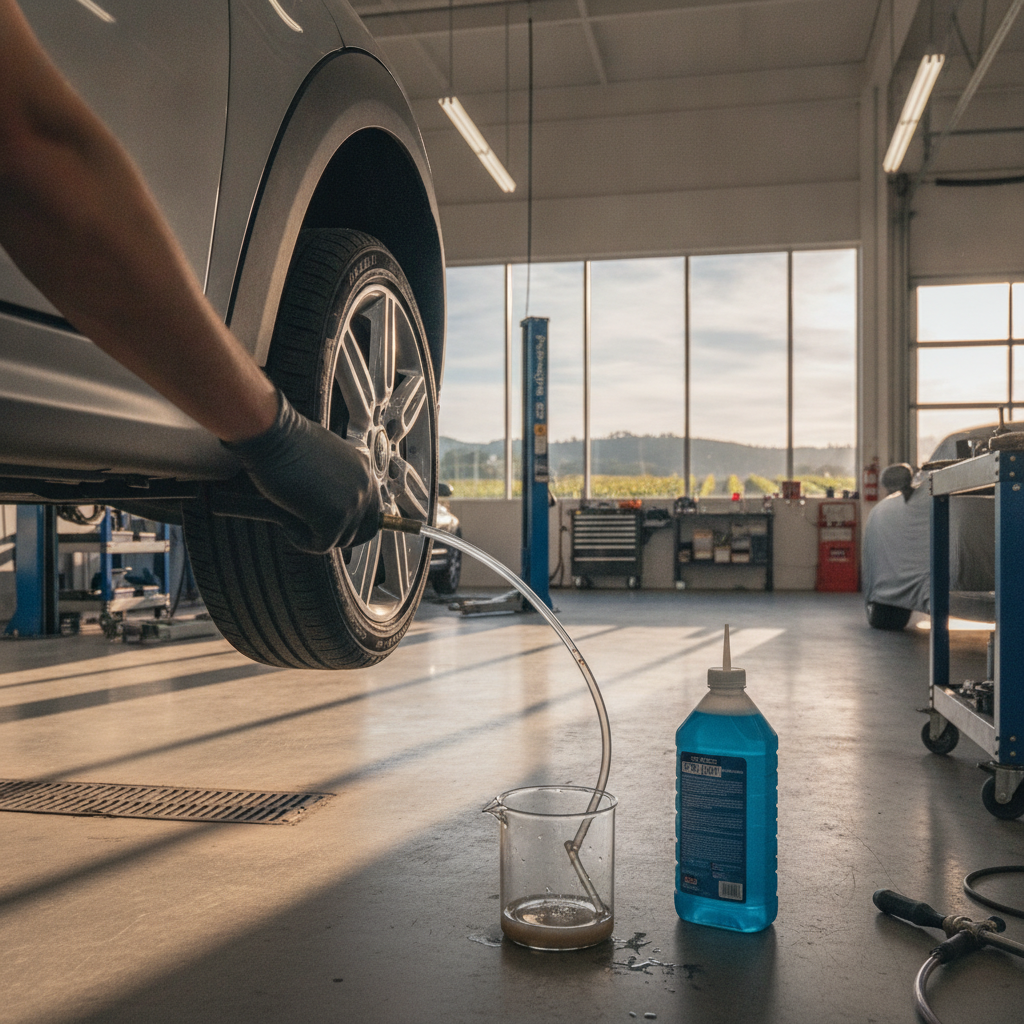
A correct flush on a BMW or Mini Cooper involves bleeding fluid through each caliper in the proper sequence until fresh, clear fluid runs through. On vehicles equipped with electronic parking brake actuators — which includes most current BMW 3, 4, and 5 Series, as well as later Mini Cooper models — this requires factory-grade diagnostic software to retract the rear caliper pistons during the bleeding process. You cannot do this with a hand bleeder kit and a generic OBD-II scanner. The rear caliper pistons on these platforms are motor-driven, not hydraulic-only, and attempting to compress them mechanically without first retracting them through software can destroy the actuator.
At Bavarian Performance in Santa Rosa, this is a standard part of the process. Factory-level tooling and software are not optional add-ons — they’re the baseline for doing the job correctly on any BMW or Mini in our bays.
How Sonoma County Driving Conditions Accelerate Brake Fluid Degradation
The local geography works against your brake system in a few specific ways that are worth understanding as an owner in this area.
The hilly terrain throughout Petaluma, Penngrove, and the approaches to Santa Rosa means your brakes are doing real work on every commute — not just highway driving. Repeated braking on descents generates sustained heat, which accelerates moisture vaporization in already-degraded fluid. If you’re also driving through Sebastopol or along the coastal routes toward Bodega Bay, the marine air and fog that define the west Sonoma County climate accelerate moisture infiltration through brake hose permeation. That combination — heat from hills, humidity from the coast — is particularly hard on brake fluid service life.
BMW’s factory recommendation is a brake fluid flush every two years regardless of mileage. Mini Cooper follows the same interval. If you’re in this area and doing meaningful driving rather than flat freeway miles, two years is the right interval. Many owners on extended service schedules push past that window without realizing it, and the pedal feel degradation happens gradually enough that it goes unnoticed until something more concerning develops.
Spongy Pedal vs. Other Causes: How to Tell the Difference
Brake fluid is the most common cause of a spongy pedal, but it’s not the only one. Before you assume a flush will fully resolve the symptom, it’s worth knowing what else can contribute.
- Air in the brake lines: If a caliper bleeder screw was loosened at any point, or a brake line fitting wasn’t fully torqued after a prior service, air can enter the hydraulic circuit and produce a spongy pedal. A proper bleeding procedure addresses this as part of the flush.
- Worn or cracked brake hoses: Rubber brake hoses that have hardened, ballooned internally, or cracked at the fittings can mimic the feel of degraded fluid. On older BMW E46, E90, or early Mini R56 platforms, hose inspection is a standard part of any brake service we perform.
- Master cylinder wear: An internal bypass in the master cylinder — where fluid crosses the piston seal without building pressure — produces a pedal that slowly sinks toward the floor under steady pressure. This is distinct from the general sponginess of degraded fluid and indicates the master cylinder needs replacement.
- Caliper piston seal failure: A weeping caliper allows fluid to escape slowly and introduces air into the system. This is often accompanied by uneven braking, a car that pulls to one side, or visible fluid residue on the inside of a wheel.
A thorough inspection of the entire brake hydraulic circuit — not just a fluid test — is the right starting point. That’s exactly what our multi-point inspection includes, and it’s the reason we don’t quote brake work sight-unseen.
What to Expect: Service Timeline and What Gets Checked
A standalone brake fluid flush on a BMW or Mini Cooper typically takes one to one and a half hours when the system is in good condition. If we identify worn hoses, weeping calipers, or master cylinder issues during the process, we’ll walk you through exactly what’s needed and why before any additional work is approved.
We use OEM-specification DOT 4 fluid — not a generic DOT 3/4 blend — because BMW and Mini engineers spec DOT 4 for its higher dry boiling point and its compatibility with the ABS modulator seals. Using the wrong fluid specification is a surprisingly common shortcut at general shops, and it matters on platforms where the hydraulic circuit interfaces directly with the ABS/DSC electronics.
For a complete overview of brake repair and service, visit our brake repair page for what we cover on European platforms.
Frequently Asked Questions
How do I know if my brake fluid needs flushing vs. just a top-off?
If your reservoir is low, that’s usually a sign of worn brake pads (as pads wear down, the caliper pistons extend and the reservoir level drops) or a leak — not a reason to simply top off. Fluid condition is tested with a moisture content strip or refractometer, not by visual appearance alone. Clear-looking fluid can still have elevated moisture content. If you’ve gone more than two years without a flush, schedule one regardless of what the fluid looks like.
Can I do a brake fluid flush myself on a newer BMW or Mini?
On older platforms without electronic parking brake actuators, a DIY flush with the right bleeder kit is technically possible. On any BMW or Mini from roughly 2012 onward with electric rear calipers, you need factory-grade software to retract the pistons before bleeding. Attempting this without the correct tool risks damaging the rear caliper actuator, which is a costly repair that’s entirely avoidable.
How often should I flush brake fluid on my Mini Cooper or BMW in Sonoma County?
Every two years is the factory-recommended interval for both brands. Given the combination of hilly local terrain around Petaluma and Santa Rosa and the coastal moisture levels in west Sonoma County, that two-year interval is worth sticking to rather than stretching.
Will a brake fluid flush fix brake fade I’m experiencing on downhill drives?
If the fade is accompanied by a spongy pedal and the fluid hasn’t been changed recently, a flush is the right first step and often fully resolves the issue. If pedal feel remains soft after fresh fluid is installed, the investigation moves to hoses, calipers, and the master cylinder. Brake fade that occurs after sustained heavy braking on long descents — even with fresh fluid — may indicate that brake pads and rotors are beyond their service life and need replacement.
Does Bavarian Performance service Mini Coopers as well as BMWs?
Yes. Mini Cooper shares significant engineering DNA with BMW, and we work on the full range — from the classic R53 supercharged Cooper S through current F and U-series platforms. Mini-specific issues like the N14 timing chain tensioner and water pump housing leaks are well within our diagnostic scope. Learn more on our Mini Cooper repair page.
Schedule Your Brake Inspection at Bavarian Performance
If your BMW or Mini Cooper’s brake pedal doesn’t feel the way it should — whether you’re driving Petaluma’s back roads, navigating Rohnert Park’s Highway 101 on-ramps, or winding through the hills above Santa Rosa — don’t wait for the symptom to get worse. A spongy pedal is your hydraulic system asking for attention, and catching it early keeps the repair straightforward and affordable.
Bavarian Performance is Santa Rosa’s factory-trained European specialist, serving drivers throughout Sonoma County with the tooling, software, and OEM-specification parts that these vehicles actually require. Reach out to schedule an inspection or brake service — we’ll diagnose the root cause before recommending any work. Contact us here to book your appointment.