
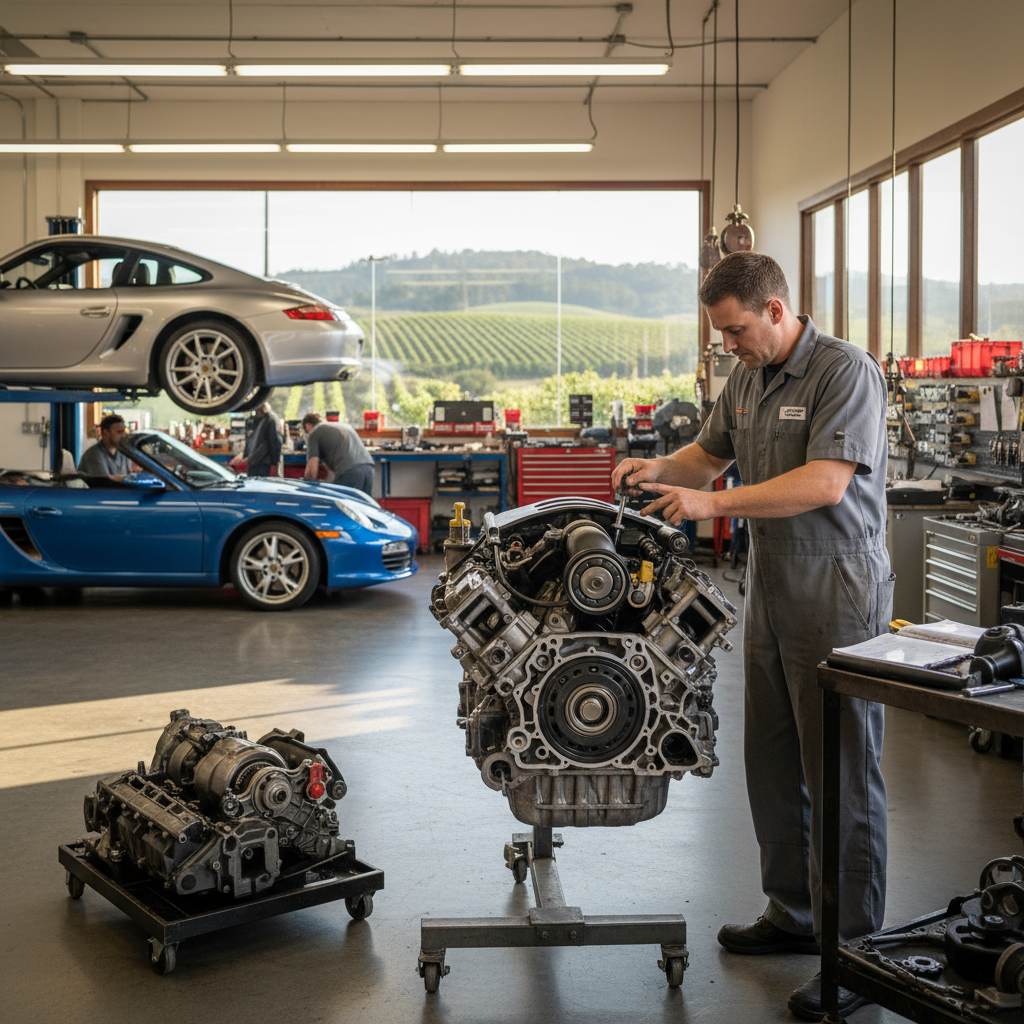
Why Is My Porsche 996 or Boxster’s IMS Bearing a Problem in Santa Rosa — and What Should You Actually Do About It?
If you own a Porsche 996 Carrera, Boxster, or early Cayman and you haven’t yet addressed the IMS bearing, this is the article you need to read. In Santa Rosa and across Sonoma County, we see more of these cars than you might expect — tucked into garages in Fountaingrove, driven through the Sonoma Valley on weekend runs, or parked outside tasting rooms along Highway 12. They’re wonderful machines. And the IMS bearing is, without question, the single most important preventative maintenance item on the platform. Left unaddressed, it can destroy an otherwise healthy engine with very little warning.
What Is the IMS Bearing and Why Does It Fail?
The Intermediate Shaft (IMS) bearing sits at the rear of the M96 and M97 engine — the flat-six that Porsche used across the 996, Boxster, and base Cayman from 1997 through 2008. Its job is to support the intermediate shaft, which drives the camshafts via a chain. The problem is Porsche’s decision to use a sealed, non-serviceable ball bearing in this location. Over time, that bearing loses lubrication, develops play, and can fail catastrophically. When it does, the timing chain relationship collapses, and metal debris spreads through the engine. The result is typically a complete engine failure requiring a full rebuild or replacement.
The failure rate varies by engine variant. The single-row bearing used in earlier cars (1997–2000 and certain later models) is statistically more prone to failure than the dual-row bearing introduced mid-production. But neither version is immune, and neither version is designed to be serviced in place. The only reliable solution is proactive replacement — ideally with an upgraded bearing from LN Engineering, which uses a higher-quality unit that can actually be lubricated via the engine’s oil supply.
What Does IMS Bearing Replacement Actually Involve?
This is where many Porsche owners get unclear information. IMS bearing replacement is not a simple job, but it’s also not as daunting as an engine-out rebuild — if you do it proactively before failure occurs. The transmission must come out to access the bearing, which makes it an ideal job to combine with a clutch replacement, rear main seal (RMS) service, or flywheel inspection. If your Boxster or 996 is approaching a clutch service interval anyway, doing both jobs together is the most cost-effective approach available to you.
At Bavarian Performance, we use the LN Engineering IMS retrofit solution — the same upgrade that Porsche specialists across the country recommend. This converts the sealed bearing to a lubricated design that draws oil from the engine, addressing the root cause of the failure rather than just replacing like with like. If you’ve already had an IMS failure and are looking at engine repair options, our engine repair team in Santa Rosa can assess the extent of damage and walk you through your realistic options.
When Should You Address This — and What Does It Cost?
The honest answer: as soon as possible, if you haven’t already. There is no mileage threshold that definitively predicts failure. Cars have failed at 40,000 miles and others have run past 150,000 miles without incident. But that unpredictability is precisely the point — you cannot manage your risk by waiting for a symptom. By the time a failed IMS bearing produces a symptom, the damage is almost always already done.
As a rough guide, combining an IMS retrofit with a clutch and RMS service typically falls in a range that makes far more financial sense than the cost of an engine rebuild after failure. We don’t quote prices online because labor and parts vary with the specific model year, transmission type (G86 manual vs. Tiptronic), and condition of adjacent components. What we can tell you is that proactive service costs a fraction of a post-failure rebuild — and that’s not a vague claim, it’s a straightforward arithmetic reality that every Porsche specialist will confirm.
Why Most Local Competitors Don’t Discuss This in Depth
If you’ve spent time on the websites of other shops serving Sonoma County, you’ve likely noticed that IMS bearing service is either mentioned in passing or not covered at all. That’s a significant gap in useful information for local Porsche owners who are actively researching this issue. The IMS bearing is not a niche concern — it affects hundreds of thousands of M96 and M97 engine vehicles still in daily and weekend use across the country, and Sonoma County has a healthy population of exactly these cars.
Understanding this failure point is part of what it means to own a 996 or Boxster responsibly. A shop that services these vehicles regularly should be able to discuss it clearly, source the correct LN Engineering components, and perform the work with the proper transmission removal procedure. Generic European repair experience isn’t enough here — you want a specialist who has done this job, understands the variant differences between model years, and can inspect the flywheel and rear crankshaft seal while the transmission is already out.
Local Factors That Make Proactive Service Even More Important
Sonoma County’s driving environment adds a few dimensions worth considering. If your Porsche lives in Healdsburg or makes regular runs through the Sonoma Valley on Highway 12, it’s likely spending meaningful time at higher operating temperatures — especially during our dry summer months. Heat cycles accelerate bearing degradation. Similarly, if the car sees spirited driving on the canyon roads near Sebastopol or the twisting stretches between Windsor and Geyserville, those are conditions that place sustained load on the drivetrain in ways that flat highway commuting simply doesn’t.
Cars that sit for extended periods between drives — which is common in the Wine Country area where weekend use is the norm — can also be harder on bearing lubrication than vehicles driven regularly. Consistent use and fresh oil at the correct intervals matter more on these platforms than many owners realize. If your 996 or Boxster is a seasonal driver, that’s actually a reason to be more attentive to the IMS issue, not less.
For Porsche owners throughout the region, our Porsche repair services in Santa Rosa cover everything from routine maintenance to complex drivetrain work — with factory-grade diagnostic tools including PIWIS and the component knowledge to do this job correctly the first time.
Frequently Asked Questions
Does my Porsche 997 or newer Boxster have the same IMS bearing issue?
No. The IMS bearing concern is specific to the M96 and M97 engine family used in the 996 Carrera, 986 Boxster, 987 Boxster (through early production), and base 987 Cayman. The 997.2 (2009 and later) moved to a different engine architecture that eliminated this design. If you’re unsure which engine generation your car has, we can confirm it quickly.
Can I check for IMS bearing wear with a diagnostic scanner?
Not directly. There is no fault code associated with early IMS bearing degradation. An oil analysis can sometimes detect bearing metal particles before catastrophic failure, and it’s a reasonable supplement to proactive replacement — but it is not a substitute. Factory-grade tools like PIWIS give us access to comprehensive engine data, but bearing condition is a mechanical inspection issue, not a software-readable parameter.
Should I combine IMS service with anything else?
Yes, whenever practical. Since the transmission must be removed to access the IMS bearing, it makes strong economic sense to simultaneously address the rear main seal, clutch disc and pressure plate, and flywheel resurfacing or replacement if any of those are approaching service life. Doing these jobs separately means paying for transmission removal twice. We review all of this with you during the initial inspection.
I bought a used 996 or Boxster and I don’t know if the IMS bearing has been addressed. What should I do?
This is one of the first things to verify when buying a used M96/M97 Porsche. Check for documented LN Engineering IMS retrofit service in the maintenance records. If records are incomplete or absent, treat the IMS bearing as unaddressed and factor replacement into your ownership plan. A pre-purchase inspection at a qualified Porsche specialist — not a general shop — is strongly recommended before buying any of these vehicles.
Is Bavarian Performance able to handle a full engine rebuild if the IMS bearing has already failed?
Yes. If you’ve already experienced an IMS-related engine failure, our team can evaluate the damage and discuss rebuilt, remanufactured, or used engine options with correct IMS retrofit installation included. It’s a more costly path than proactive service, but it’s a recoverable situation — and these engines, once properly rebuilt with the updated bearing, can go on to provide many more years of reliable service.
Ready to Protect Your Porsche?
Whether you’re in Santa Rosa, Petaluma, Sonoma, or anywhere across Sonoma County, the IMS bearing is a conversation worth having before the engine gives you no choice. Bavarian Performance specializes in exactly this kind of factory-informed preventative work — the kind that dealerships often defer and generic shops often miss entirely. We use the right parts, the right procedures, and the honest communication that informed Porsche ownership deserves.
Schedule a consultation or inspection through our contact page and let’s talk through where your car stands and what the right plan looks like for your specific model year and mileage.