
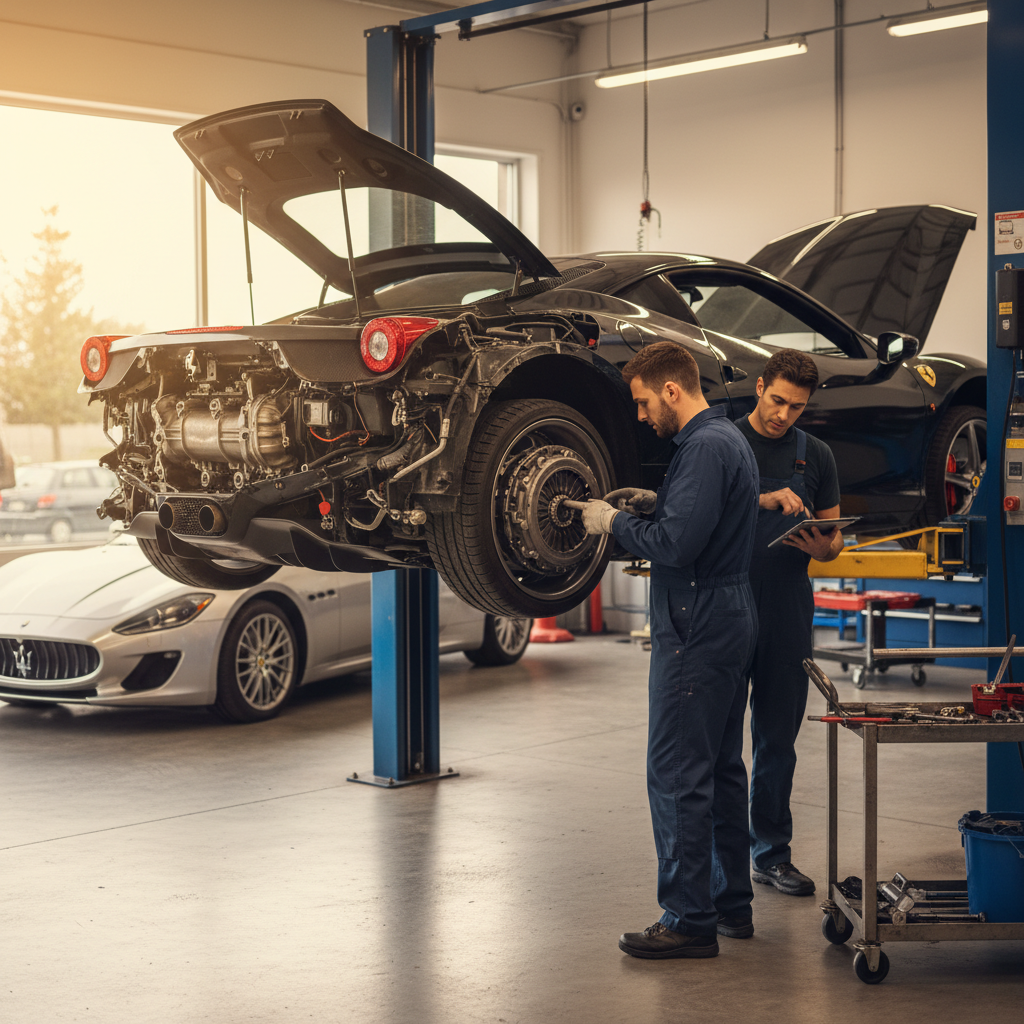
Why Is My Ferrari or Maserati’s Clutch Slipping in Santa Rosa — and What Does It Actually Cost to Fix?
If your Ferrari or Maserati is slipping out of gear, hesitating between shifts, shuddering at low speeds, or displaying a clutch warning on the dash, the answer is almost always the same: the semi-automatic clutch system is worn and needs professional attention — soon. For Santa Rosa and Sonoma County owners of Italian exotics, this is not a situation where waiting a few more weeks is advisable. These vehicles use electrohydraulic F1-style clutch actuators or dual-clutch (DCT) systems that operate with extremely tight tolerances, and the longer a worn clutch is driven, the more collateral damage accumulates. Here is what you actually need to know.
How Ferrari’s F1 Clutch and Maserati’s DCT Actually Work
Ferrari’s famous F1 transmission system — used across the 360, 430, 458, and California platforms, among others — is not a conventional manual or automatic. It is a single-dry-clutch, semi-automatic system operated by electrohydraulic actuators controlled by the vehicle’s TCU (transmission control unit). There is no clutch pedal. Instead, the system reads throttle position, rpm, and driving mode, then engages and disengages the clutch mechanically at the actuator’s command. When it works, it is spectacular. When it begins to fail, the symptoms are unmistakable: lurching at low speeds, difficulty engaging first gear, abrupt shifts, and eventually a warning light that reads something to the effect of GEAR NOT ENGAGED or CLUTCH WEAR.
Maserati’s approach evolved differently. Earlier GranTurismo and Quattroporte models used a similar single-dry-clutch automated manual. Newer models — including the Ghibli and later Quattroporte — use a ZF-sourced 8-speed automatic or, in higher-performance variants, a DCT system. The clutch wear concern is particularly acute in the older F1-type systems found in many Maseratis that are now 10 to 15 years old and squarely in the independent specialist sweet spot.
What Actually Causes These Clutches to Wear Out
The engineering reality of a single-dry-clutch F1 system is that it was designed for smooth engagement at speed — not for urban creep traffic or the kind of slow parking-lot maneuvering many owners subject their cars to. Every time the actuator slips the clutch to manage a low-speed crawl, friction material burns off. A few specific driving patterns accelerate wear dramatically:
- Slow traffic on Highway 101 during the Bay Area commute — the stop-and-go demands the clutch slip constantly, and it was never designed for that duty cycle
- Steep hill starts — Fountaingrove, Oakmont, and the grades along Sonoma Mountain Road are genuinely punishing on F1 actuator systems
- Parking lot maneuvering at wineries and resort properties in Healdsburg or the Sonoma Valley, where the car creeps at walking pace for extended periods
- Adaptive calibration drift — the TCU learns clutch engagement points over time, and if the clutch is worn, the calibration drifts until it no longer compensates correctly
The result is a clutch that is functionally worn at anywhere from 15,000 to 40,000 miles depending on driving habits — nowhere near the 100,000-mile life you might expect from a European sedan’s traditional manual clutch.
What a Clutch Replacement Actually Involves — and What It Costs
This is where many Ferrari and Maserati owners get a rude awakening. Replacing the clutch on an F1-equipped Ferrari or an older Maserati automated manual is not a simple swap. The job typically requires:
- Removal of the rear subframe or significant underbody disassembly to access the transaxle
- Replacement of the clutch disc, pressure plate, and often the flywheel if scoring or heat damage is present
- Actuator inspection and often replacement — the hydraulic clutch actuator has its own wear life and is frequently damaged by a slipping clutch
- TCU recalibration after installation using factory-grade diagnostic software
- Road-test validation through multiple drive cycles to confirm proper adaptive learning
On a Ferrari 430, expect a complete clutch job to run into five figures in parts and labor — this is not a surprise if you own the car, but it is a number that demands you choose your specialist carefully. Maserati GranTurismo and older Quattroporte clutch work is somewhat less involved but still a significant investment. Cutting corners on parts or skipping the TCU recalibration step is how you turn a clutch job into a transmission job.
One area where an independent specialist at the level of Bavarian Performance’s Ferrari service genuinely outperforms the dealer is in the combination of factory-equivalent diagnostic capability and significantly lower labor rate overhead. The diagnostic and calibration work on these systems requires proper software — not a generic OBD-II reader — but that is table stakes for any shop that works on Italian exotics regularly.
Why Most Local Shops in Sonoma County Cannot Actually Do This Work
This is the content gap that competitor shops in this area largely ignore: most European auto repair shops in the North Bay are BMW, Audi, and Mercedes-centric. Their tooling, their software subscriptions, and their hands-on experience reflect that reality. An F1 actuator calibration on a Ferrari 430 is a fundamentally different task from resetting a BMW service interval. Without the correct software environment and genuine familiarity with how the TCU’s adaptive learning interacts with clutch wear parameters, a shop can install a perfect clutch and still leave you with a car that shifts badly.
If you are in Sebastopol, Healdsburg, or the Sonoma Valley area and you own an Italian exotic, the question to ask any prospective shop is direct: What software platform do you use for Ferrari and Maserati diagnostics, and how many of these clutch jobs have your technicians completed? The answer will tell you everything you need to know.
When to Bring It In — Before You Lose the Option to Drive It
The F1 system will eventually reach a point where it simply refuses to engage. The TCU detects that it cannot complete a proper clutch engagement cycle and puts the car into a limp or lockout mode. At that point, you are calling a flatbed, not a service appointment. The smarter move is to address the early symptoms — the slight shudder at 5 mph, the occasional hesitation in Sport mode, the clutch warning that clears after a restart — before the system decides the issue for you.
A proper multi-point inspection that includes a clutch wear read-out from the TCU can give you an accurate picture of remaining clutch life and help you plan the repair on your schedule rather than the car’s.
Frequently Asked Questions
How many miles does a Ferrari F1 clutch typically last?
It varies significantly based on driving habits. Owners who use their Ferrari primarily on open roads and highways often see 25,000 to 40,000 miles. Those who drive regularly in urban traffic or do a lot of low-speed maneuvering may see clutch wear as early as 12,000 to 15,000 miles. The TCU stores a clutch wear percentage that a qualified technician can read directly.
Can I drive my Maserati with a clutch warning light on?
Briefly and carefully — but not for long. A clutch warning in an F1-type Maserati typically means the system has detected engagement issues. Continuing to drive risks actuator damage, which turns a clutch replacement into a clutch-and-actuator replacement and adds significant cost to the repair.
Is there an independent specialist in Santa Rosa who can actually service a Ferrari or Maserati properly?
Yes. Bavarian Performance in Santa Rosa services Ferrari, Maserati, Lamborghini, and Alfa Romeo alongside our German marque work. Proper Italian exotic service requires factory-compatible diagnostics and genuine parts — and that is exactly what we bring to every job.
Does Sonoma County driving specifically accelerate clutch wear on Italian exotics?
Yes, in several ways. The hilly terrain around Fountaingrove and Oakmont creates frequent hill-start demands that stress F1 actuator systems. Wine Country tourism driving — slow convoy traffic on Highway 12 and Sonoma Valley roads — mimics the urban stop-and-go that these clutches handle least well. And seasonal use patterns (many Italian exotics in the North Bay are driven primarily in spring and summer) can mean owners push harder mileage in concentrated bursts.
Should I use the Ferrari or Maserati dealer, or is an independent specialist acceptable for clutch work?
An independent specialist with the correct diagnostic software, genuine OEM parts sourcing, and documented experience with these specific systems is entirely appropriate — and for out-of-warranty cars, almost always the better value. The key is verifying those credentials before authorizing any work. Bavarian Performance meets that standard.
Ready to Get a Proper Assessment?
If your Ferrari, Maserati, Lamborghini, or Alfa Romeo is showing any of the symptoms described above — or if you simply want a clutch wear reading before the situation becomes urgent — the team at Bavarian Performance is ready to help. We serve owners throughout Santa Rosa, Sonoma County, and the surrounding North Bay region with the diagnostic tools and hands-on Italian exotic experience these cars demand. Contact us to schedule your appointment and let’s get an accurate picture of where your clutch stands before it becomes a roadside problem.