
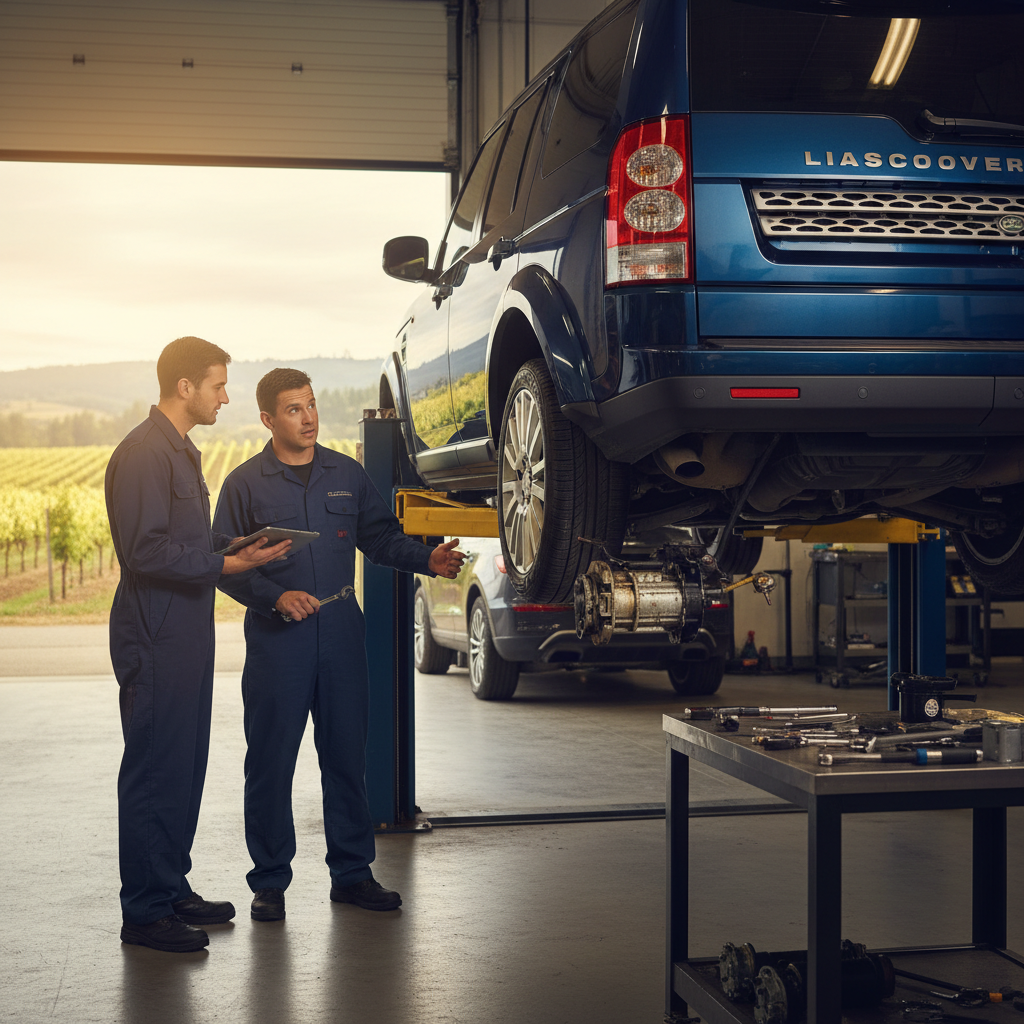
Why Is My Land Rover’s Air Suspension Compressor Failing in Healdsburg — and What Does It Actually Cost to Fix?
If your Land Rover Range Rover, Discovery, or LR4 is sitting noticeably lower on one corner — or you’re staring at a amber Suspension Fault message on your instrument cluster — there’s a very good chance the air suspension compressor is either already failing or working itself to death. This is one of the most common and misunderstood failures on Land Rover’s air-suspended platforms, and it affects owners across Sonoma County from Healdsburg down to Santa Rosa with a frustrating frequency. The good news: caught early, this repair is manageable. Ignored, it cascades into a significantly more expensive problem.
How Land Rover’s Air Suspension System Actually Works
Land Rover’s Terrain Response air suspension — used across the Range Rover Sport, Range Rover L322 and L405, Discovery 3/4/LR3/LR4, and Range Rover Sport — is genuinely impressive engineering. Four individual air struts replace conventional coil springs, each filled and pressurized by a single onboard compressor. The system continuously reads vehicle height sensors, road conditions, and driver inputs to adjust ride height in real time. It allows the vehicle to raise itself for off-road clearance, lower for highway stability and fuel economy, and kneel for easier entry and exit.
The compressor sits at the center of all of this. It runs every time the system needs to inflate a strut — which in normal driving happens dozens of times a day. When one air strut develops a slow leak (as they inevitably do with age), the compressor starts running more frequently to compensate. Over time, this overwork causes the compressor motor to burn out, its internal filter to clog, or its thermal protection to trigger and shut it down permanently.
Why Sonoma County Conditions Accelerate This Failure
Land Rover air suspension compressors fail everywhere, but the driving environment around Healdsburg, Windsor, and Geyserville creates conditions that accelerate the timeline considerably. Dusty vineyard backroads — common if you’re heading out toward Dry Creek Valley or Alexander Valley — introduce fine particulate matter that clogs the compressor’s intake filter faster than typical urban driving would. Once that filter is restricted, the compressor works harder for less output and overheats more readily.
Add to that the hilly terrain between Healdsburg and Cloverdale on the Highway 101 corridor, where constant height adjustments on winding grades stress the system, and you have a recipe for premature wear. Owners driving down from Fountaingrove or through the hillside neighborhoods north of Santa Rosa toward Wine Country will recognize this — the system is almost never at rest on this terrain.
Coastal moisture from the Bodega Bay corridor and the Russian River Valley also plays a role. The air suspension system draws ambient air to inflate struts, and humid air introduces moisture into the dryer bag and internal components. Over time, internal corrosion and valve degradation follow.
The Real Diagnostic Picture: It’s Rarely Just the Compressor
Here’s where many Land Rover owners get burned: they replace the compressor, drive for a few weeks, and find themselves back in the same situation. That’s because the compressor almost never fails in isolation. The air struts themselves — particularly the front struts on high-mileage Range Rovers and LR4s — develop slow leaks at the rubber air sleeve, the top mount, or the valve block fittings. A weakened strut is what caused the compressor to overwork in the first place.
Proper diagnosis requires more than a visual inspection and a generic OBD-II scan. Land Rover’s air suspension faults are best read with factory-level diagnostic software that can communicate with the suspension control module directly, read live height sensor data, and perform automated compressor and valve block tests. Generic scan tools simply cannot access this depth of information — they’ll show you a fault code, but not which strut is leaking, how far out of spec your height sensors are, or whether the valve block is passing pressure correctly.
At Bavarian Performance, we use professional-grade diagnostic tooling that speaks Land Rover’s native language — the same level of access a dealership employs, without the dealership wait time or overhead pricing. If you’ve already had a compressor replaced somewhere and the fault returned, a proper factory-level diagnostic is the correct next step before throwing more parts at the problem. You can learn more about our full diagnostic and Land Rover repair services here.
What It Actually Costs to Fix — Honest Numbers
Land Rover air suspension repair is not inexpensive, and anyone who tells you otherwise is either selling you an inferior part or underselling the labor involved. Here’s a realistic breakdown of what to expect in the Sonoma County market:
- Compressor replacement only (OEM or OEM-equivalent): Typically falls in the $800–$1,400 range for parts and labor, depending on the model year and platform.
- Single air strut replacement: Generally $900–$1,600 per strut including parts and labor for a quality OEM-spec component. Aftermarket struts exist at lower price points, but the quality variance is significant — cheap air sleeves fail faster, especially in our variable-humidity climate.
- Full four-corner air strut replacement: A complete set, if all four struts are degraded (common on 10-year-old+ vehicles), can run $3,500–$6,000+ depending on whether you use OEM or premium aftermarket components. This is a significant repair, but it’s also a one-time reset that restores the system to as-new performance.
- Valve block service: Often overlooked, valve block solenoids are frequently the source of height faults. Expect $400–$800 for the part and labor, depending on whether individual solenoids or the full block needs replacement.
The honest framing here: a Land Rover with a neglected air suspension that has been driven on a failed compressor can damage the struts, the valve block, and even the control module. Addressing the first warning sign — the Suspension Fault message or a corner sitting low overnight — is almost always less expensive than waiting.
OEM vs. Aftermarket Parts: What Actually Matters Here
This is a topic competitors in the area rarely address with any depth. The aftermarket for Land Rover air suspension parts is extensive and ranges from excellent to genuinely problematic. For the air struts themselves, the air sleeve quality is everything — cheap rubber compounds fail rapidly in Sonoma County’s climate swings, from summer heat to winter damp. We use OEM Dunlop/Continental-sourced struts or premium equivalent components with verified sleeve compounds and proper crimping — the same spec Land Rover specifies for the platform.
The compressor is another area where quality matters enormously. Cheap compressor units sourced from overseas marketplaces frequently use undersized motors with inadequate thermal protection. They work fine for a few months, then burn out under the same conditions that killed the original. Genuine Land Rover or Arnott-sourced compressors with upgraded components are worth the price difference when you’re factoring in labor costs to do the job twice.
Filters, seals, and desiccant bags, on the other hand, are acceptable in OEM-equivalent form — these are consumables where the specification matters more than the badge on the box. A proper preventative maintenance approach that includes compressor filter replacement at regular intervals can significantly extend the life of the entire system.
When to Consider a Suspension Conversion
For high-mileage Land Rovers where air suspension repairs are recurring, a coil spring conversion kit exists as a permanent solution. This eliminates the air suspension entirely and replaces it with conventional coil springs and dampers. It’s a legitimate option for a vehicle that’s primarily used as a daily driver on paved roads and where the cost of ongoing air suspension repair doesn’t justify itself. That said, it sacrifices the Terrain Response height adjustment and ride quality advantages that make a Range Rover a Range Rover. For most owners in the Healdsburg area who bought a Land Rover specifically for its capability and luxury ride, this trade-off isn’t worth it. But it’s a conversation worth having with a specialist who can give you an honest assessment of your specific vehicle’s condition.
Frequently Asked Questions: Land Rover Air Suspension Repair in Sonoma County
How long can I drive with a Land Rover suspension fault warning?
Not long, and not at all if the vehicle is sitting low on one corner. Driving on a deflated or underinflated air strut places uneven stress on the strut internals, the valve block, and the control arm bushings. A fault warning that appears and clears on its own is an early warning — take it seriously before it becomes a vehicle-sitting-on-the-bumpstops situation.
Will the dealer in Santa Rosa charge more than an independent specialist?
Typically yes, sometimes significantly. Dealership labor rates in the North Bay area for Land Rover can run $200–$250 per hour, and parts are sourced at retail MSRP. An independent specialist using the same OEM parts and factory-level diagnostics will typically deliver the same repair quality at a meaningfully lower total cost — the difference on a full strut replacement can be $800–$1,500 or more.
Can I get a Land Rover air suspension diagnostic in Healdsburg without driving to Santa Rosa?
The Bavarian Performance shop is located in Santa Rosa, which is roughly a 20–25 minute drive south from Healdsburg on Highway 101. If your vehicle is drivable — meaning it’s not actively sitting on the bump stops or showing a hard suspension fault — bringing it in for a proper diagnostic is straightforward. If you’re concerned about the drive, call ahead and our team can advise whether the vehicle is safe to drive in its current state.
Does wildfire smoke or ash damage Land Rover air suspension components?
Indirectly, yes. Since the 2017 Tubbs Fire and subsequent fire seasons, fine ash particulate has become a recurring issue in the Healdsburg and Windsor areas. The air suspension compressor draws in ambient air — ash-laden air accelerates filter clogging significantly. After any major smoke event, it’s worth having the compressor filter inspected. It’s an inexpensive service that can add years to your compressor’s lifespan.
What Land Rover models does Bavarian Performance service?
We service the full Land Rover lineup including Range Rover (all generations), Range Rover Sport, Discovery/LR3/LR4, Freelander, and Defender. Air suspension work, electrical diagnostics, cooling system service on supercharged V6 and V8 platforms, and comprehensive preventative maintenance are all within our scope.
Get Your Land Rover Diagnosed by Specialists Who Know the Platform
A Land Rover air suspension fault doesn’t get better on its own. If you’re driving through Healdsburg, Windsor, Geyserville, or anywhere in Sonoma County and you’re seeing that warning message — or your vehicle is sitting unevenly overnight — the right move is a proper factory-level diagnostic before the problem compounds. Bavarian Performance has the tooling, the parts sourcing relationships, and the platform-specific experience to get your Land Rover back to the ride height and capability it was engineered to deliver. Contact us today to schedule a diagnostic appointment — we’ll tell you exactly what’s happening and what it will take to fix it correctly the first time.