
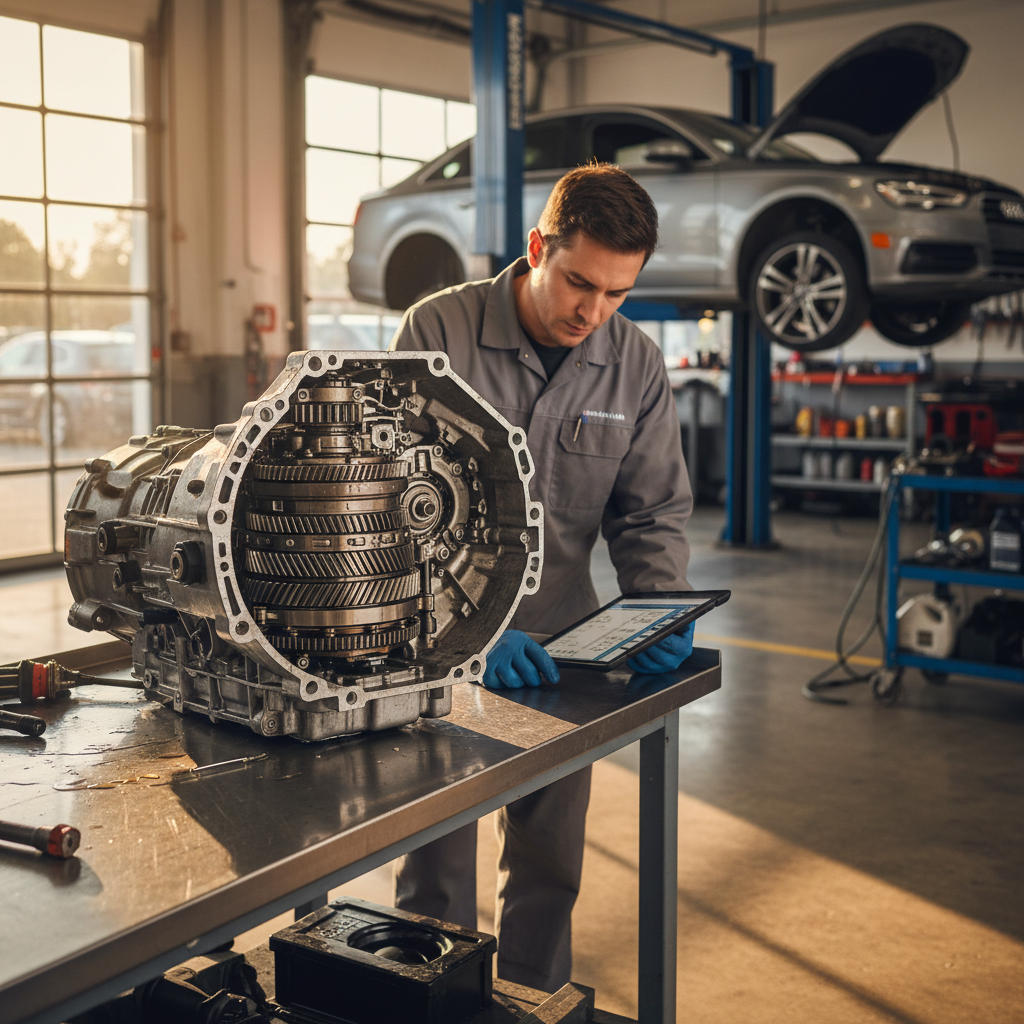
Why Is My Audi or VW’s DSG Transmission Shuddering in Rohnert Park — and What Should You Do About It?
If your Audi A3, A4, A5, TT, or Volkswagen Golf, GTI, Passat, or Tiguan is jerking at low speeds, shuddering on light throttle, or hesitating when pulling away from a stop, you’re experiencing one of the most widely misread symptoms in European car ownership. The DSG — Volkswagen Group’s Direct Shift Gearbox — is an engineering marvel when properly maintained. When it’s not, it becomes one of the most expensive lessons in deferred service. For drivers in Rohnert Park, Cotati, and across the Highway 101 corridor, this is a problem worth understanding before your service advisor recommends a mechatronic unit replacement that might have been entirely preventable.
What Is the DSG, and Why Does It Shudder?
The DSG is a dual-clutch automated transmission — not a conventional automatic, and not a true manual. It uses two separate clutch packs (one for odd gears, one for even gears) to pre-select the next gear before you even finish the current shift. The result is lightning-fast gear changes with minimal power interruption. Audi markets essentially the same unit under the S tronic name. Both are built around the same core architecture — and both share the same service sensitivities.
The shudder you’re feeling almost always traces back to one of three sources:
- Degraded or contaminated DSG fluid: Volkswagen Group uses a proprietary dual-clutch fluid (DSG fluid / mechatronic fluid) that does two jobs simultaneously — it lubricates the gearbox internals and provides hydraulic pressure to control the clutch packs. When this fluid breaks down or picks up metallic contamination from normal wear, the clutch engagement becomes inconsistent. The result is exactly that low-speed shudder you’re feeling at 5–15 mph.
- Mechatronic unit wear or failure: The mechatronic unit is the combined electro-hydraulic control module embedded inside the DSG. It regulates clutch pressure, manages shift logic, and communicates with the TCM (Transmission Control Module). When the mechatronic unit’s internal valve body or solenoids wear or its seals degrade, fluid pressure becomes erratic — causing shudder, harsh shifts, or outright gear selection failure.
- Clutch pack wear: On high-mileage or hard-driven examples — especially those that have never had a fluid service — the wet clutch packs themselves can glaze or wear unevenly. This is more common on the DQ250 (the 6-speed wet-clutch DSG used in most turbocharged four-cylinder applications) than on the DQ200 (the 7-speed dry-clutch unit used in lower-torque applications).
The DSG Service Interval Nobody Warned You About
Here’s where Volkswagen Group’s marketing created a long-running problem: the DSG was frequently marketed as a “lifetime” transmission requiring no fluid service. That language aged poorly. In real-world use — especially in stop-and-go commuting on Highway 101 between Rohnert Park and the Bay Area, or spirited driving on Highway 12 through Sonoma Valley — the fluid degrades well within a 40,000–50,000 mile window.
Our recommendation, consistent with what factory-trained specialists see in practice: DSG fluid and filter service every 40,000 miles under normal driving conditions. If you’re doing a lot of low-speed maneuvering, towing, or sustained stop-and-go commuting, shorten that to 30,000–35,000 miles. The cost of a proper DSG fluid and filter service — including the correct OEM-spec fluid and a filter element replacement — is a fraction of what a mechatronic unit replacement costs. We’ve seen drivers come in from Windsor and Petaluma who skipped two or three fluid intervals and are now facing a repair bill that reframes the entire ownership calculus.
For a deeper look at what’s involved in professional transmission repair and service for European vehicles, including DSG and other dual-clutch systems, Bavarian Performance covers the full scope of factory-spec gearbox work.
Why Generic Shops Get DSG Wrong
The DSG is not forgiving of shortcuts. Two areas where non-specialist shops consistently underdeliver:
Wrong fluid specification. Volkswagen’s DSG requires G 052 182 A2 fluid (or current equivalent) for the DQ250 wet-clutch unit. Using a generic ATF — even a high-quality one — will destroy clutch friction characteristics and accelerate the exact shudder you’re trying to fix. We have seen vehicles come in after well-meaning fluid services at general repair shops where the wrong fluid caused shudder symptoms to worsen within days.
No TCM adaptation reset. After any DSG fluid service or mechatronic work, the transmission control module needs to relearn clutch engagement parameters. This requires factory-level diagnostic software — specifically ODIS (Offboard Diagnostic Information System) for VW/Audi applications. A generic OBD-II scanner cannot perform this function. Without it, the clutch engagement points are miscalibrated to the old fluid characteristics, and the shudder persists even after a correct fluid service. This is one of the most common reasons owners report that a previous shop “fixed it but it still shudders.”
Mechatronic Replacement: When Is It Actually Necessary?
Not every shuddering DSG needs a mechatronic unit. Before any shop recommends that repair, they should have performed — and documented — a proper fluid service followed by a TCM adaptation reset and road test. If shudder persists after correct fluid service and adaptation, then mechatronic inspection and likely replacement becomes the appropriate next step.
On Audi applications, the S tronic unit in quattro-equipped vehicles adds another variable: the Haldex rear differential control unit interacts with the TCM during all-wheel-drive torque distribution. A shudder that’s actually a Haldex engagement issue can be misread as a DSG problem. Factory-grade diagnostics make this distinction clearly. If you’re an Audi quattro owner in Sonoma County, this nuance matters — your Audi deserves a diagnosis, not a guess.
Highway 101 Commuters: Your DSG Is Working Harder Than You Think
The stop-and-go nature of the 101 corridor — particularly during morning and evening commutes from Rohnert Park through Novato and into Marin County — is genuinely hard on dual-clutch transmissions. Unlike a traditional torque-converter automatic, which uses fluid coupling to absorb low-speed slip, the DSG’s wet clutch packs handle creep and crawl mechanically. Repeated engagement and disengagement at low speeds in traffic accelerates fluid breakdown and clutch wear in ways that highway driving simply does not.
If your daily drive involves regular commuting into the Bay Area, factor that into your service interval — and be honest with your technician about it. A preventative maintenance approach to your DSG is dramatically cheaper than a reactive one. Factory-scheduled preventative maintenance is exactly where the difference between informed ownership and expensive surprises is made.
Frequently Asked Questions: DSG Transmission Service in Rohnert Park and Santa Rosa
How do I know if my Audi or VW has a DSG or a conventional automatic?
If your vehicle is a Volkswagen or Audi with a turbocharged four-cylinder (2.0T, 1.8T) or turbocharged six-cylinder and an automatic-style shifter, it almost certainly has a DSG or S tronic dual-clutch unit. Your owner’s manual will confirm the designation. A conventional automatic would be identified as a Tiptronic. If you’re uncertain, any scan with ODIS will identify the exact transmission code immediately.
Can I keep driving if my DSG is shuddering?
A mild shudder at low speeds that goes away above 20 mph is typically a fluid or adaptation issue and is not immediately dangerous. However, continuing to drive on degraded DSG fluid accelerates wear on the mechatronic unit and clutch packs — turning a fluid service into a significantly larger repair. Get it inspected promptly rather than waiting for the next service milestone.
How much does a DSG fluid service cost compared to a mechatronic replacement?
We don’t publish flat rates because costs vary by model year, fluid capacity, and whether a filter element is accessible on your specific unit. What we can tell you honestly: a proper DSG fluid and filter service is measured in hundreds of dollars. A mechatronic unit replacement is measured in thousands. The math on preventative service is not complicated.
Does the 7-speed DQ200 dry-clutch DSG shudder the same way?
The DQ200 uses dry clutch packs and a different fluid architecture — it shudders for somewhat different reasons, most commonly related to clutch actuator wear or software adaptation issues. It’s more common in lower-torque Volkswagen applications. The diagnostic approach differs, which is another reason factory-level ODIS access matters.
Do you service Volkswagen DSG transmissions in addition to Audi?
Yes. Bavarian Performance services the full range of Volkswagen Group vehicles, including Volkswagen DSG applications across Golf, GTI, Jetta GLI, Passat, Tiguan, and Touareg platforms. The same factory-spec fluids, ODIS diagnostic capability, and TCM adaptation procedures apply across the VW/Audi family.
Don’t Wait for the Shudder to Get Worse
A DSG shudder that’s caught early — before clutch pack glazing or mechatronic contamination sets in — is one of the more straightforward repairs in European vehicle ownership. Left unaddressed, it becomes one of the more expensive ones. If you’re in Rohnert Park, Cotati, Santa Rosa, or anywhere across Sonoma County and you’re feeling that characteristic low-speed lurch from your Audi or Volkswagen’s gearbox, contact Bavarian Performance and let us diagnose it properly — with the factory tooling and OEM-spec fluids these transmissions require.
Reach out through our contact page to schedule a diagnostic appointment. We’ll tell you exactly what’s happening, what it will take to fix it, and whether a fluid service will resolve it before more expensive repairs become necessary.