
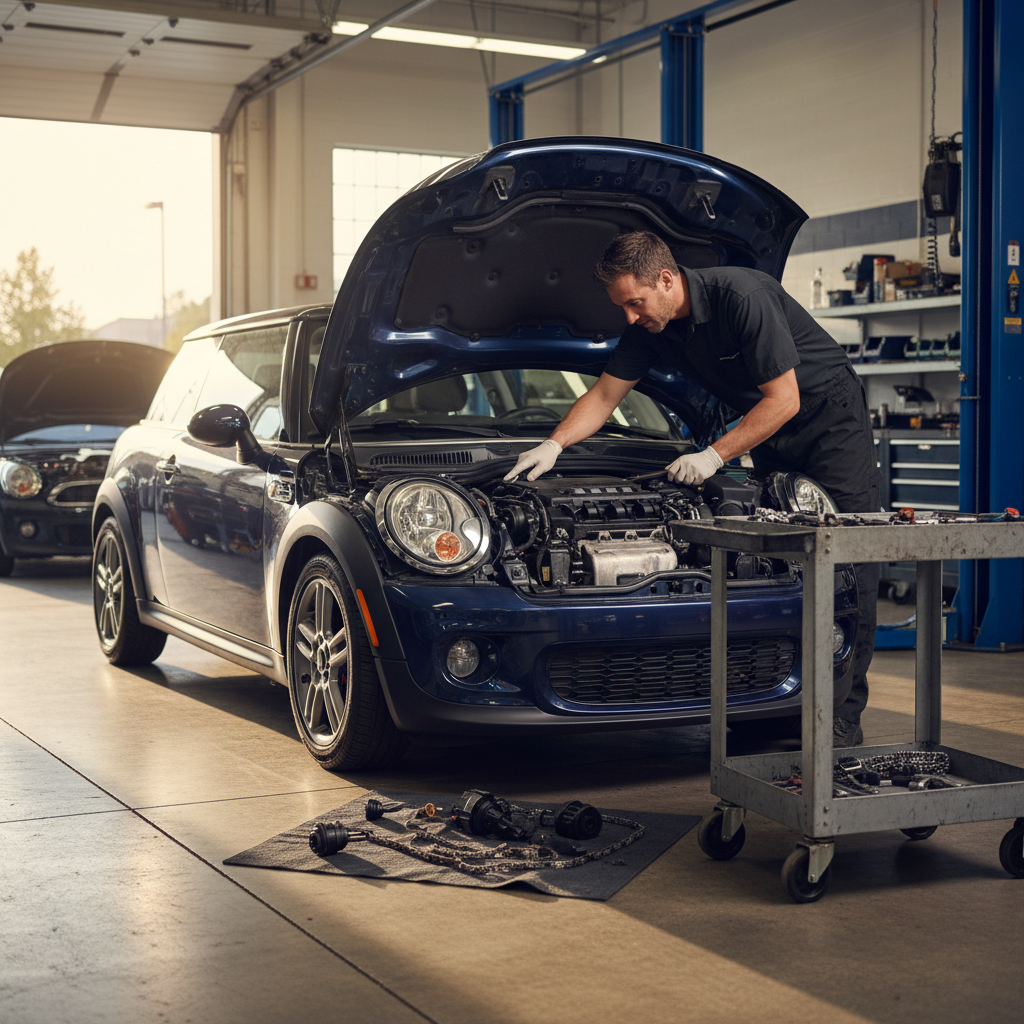
Why Is My Mini Cooper’s Timing Chain Rattling in Windsor — and Is It Too Late to Fix?
If you’re hearing a metallic rattle from your Mini Cooper’s engine in the first few seconds after a cold start — especially if you’re driving a 2007–2012 Cooper S or JCW with the N14 turbocharged engine — that sound is not something to dismiss. It’s almost certainly a failing timing chain tensioner, and it’s one of the most well-documented and expensive-if-ignored issues in the entire Mini Cooper lineup. The short answer: no, it’s probably not too late, but how quickly you act will determine whether you’re looking at a timing chain service or a full engine replacement.
What’s Actually Causing That Rattle in a Mini Cooper N14 Engine?
The N14 engine — the Prince-series turbocharged four-cylinder that powered the Cooper S from 2007 through 2012 — has a known weakness in its timing chain tensioner system. The tensioner is a hydraulically activated component that keeps your timing chain under proper tension as oil pressure builds after startup. On the N14, the tensioner loses its prime when the engine sits overnight, allowing the chain to slap against the timing cover guides during that brief window before oil pressure fully restores.
At first, this sounds like a quick two- or three-second rattle that disappears as the engine warms. Owners often dismiss it as normal cold-start behavior, especially in cooler mornings common to the Windsor and Larkfield-Wikiup corridor during fall and winter. It is not normal. What you’re hearing is the chain contacting plastic timing guides under low-tension conditions — and those guides wear down a little more with every single cold start.
Left unaddressed, the guide material fatigues, the chain develops excessive slack, and the result can be catastrophic: jumped timing, bent valves, and in severe cases, physical contact between the chain and other engine components. At that point, you’re no longer looking at a tensioner replacement — you’re looking at a partial or complete engine rebuild.
The N14 Tensioner Failure Timeline: What to Watch For
This failure doesn’t happen overnight, which is both reassuring and misleading. Because the early rattle is intermittent and brief, many Mini owners in the Santa Rosa area have driven tens of thousands of miles past the first warning signs before getting a proper diagnosis. Here’s a general progression:
- Stage 1 — Intermittent rattle on cold starts only: The tensioner is losing prime but still recovering quickly. This is the ideal window for a cost-effective repair.
- Stage 2 — Rattle lasts longer and occurs more frequently: Guide wear is accelerating. A timing chain service now is significantly more expensive than Stage 1 but still far less than what comes next.
- Stage 3 — Check engine light with camshaft position or timing codes: The chain has developed enough slack to affect cam timing. You may also notice rough idle, reduced power, or poor throttle response. Repair costs escalate sharply here.
- Stage 4 — Sudden loss of power, misfires, or engine won’t restart: The chain has jumped a tooth or more. Engine damage is likely. This is a worst-case scenario that a factory-trained specialist sees far too often — and always traces back to an early rattle that wasn’t addressed.
Why Generic OBD-II Scanners Miss This Problem Until It’s Too Late
One of the most frustrating patterns we see at Bavarian Performance is Mini Cooper owners who ran a basic code scan, got nothing, and assumed everything was fine. A Stage 1 or Stage 2 N14 tensioner issue frequently produces no stored fault codes at all. The ECU isn’t detecting a timing deviation yet — it’s just that your engine is slowly grinding through its timing guides every morning.
This is exactly why factory-grade diagnostic tools matter. A proper inspection of the N14 for timing chain wear involves more than a code scan — it requires a trained technician who knows what they’re listening for, when to check oil condition for plastic guide debris, and how to interpret live data from the crankshaft and camshaft position sensors under cold-start conditions. Generic national chains and quick-lube operations simply don’t have this in their toolbox. Mini Cooper specialists who work with these engines regularly can distinguish early-stage wear from a normal cold start in under five minutes of observation.
Oil Quality and Change Intervals: The Hidden Accelerant
Here’s a detail that competitor shops in the area rarely spell out clearly: the N14 tensioner failure rate is heavily correlated with extended oil change intervals and incorrect oil viscosity. Mini Cooper’s OBC (on-board computer) uses a condition-based service indicator that can suggest oil changes as far apart as 15,000 miles under light driving conditions. For a turbocharged engine with a hydraulic timing tensioner, that interval is too long.
Hot, dry Sonoma County summers — the kind that push temperatures into the 90s and 100s in Windsor, Healdsburg, and the Alexander Valley — accelerate oil degradation in the small N14 sump. Degraded oil loses viscosity faster, which means the tensioner takes longer to prime after a cold soak. If you’re running extended drain intervals on a Cooper S, you are accelerating the exact failure mode described above. Bavarian Performance recommends an annual oil service or 7,500-mile interval (whichever comes first) for N14 engines in this climate, using BMW/Mini-spec LL-01 certified full synthetic oil — not whatever’s on sale at a parts store.
What a Timing Chain Service on a Mini Cooper N14 Actually Involves
A proper N14 timing chain service is not a simple job. It involves removing the valve cover, front engine cover, and related components to access the chain, tensioner, guides, and sprockets. When done right — with OEM or OEM-equivalent parts — it also addresses the oil pump chain and tensioner, which is a secondary wear item on these engines that budget shops frequently overlook. Skipping the oil pump chain on an N14 timing job is a false economy that puts you back in the same position within another 30,000 miles.
The job typically takes the better part of a day for an experienced Mini specialist. Because labor rates and parts quality vary significantly, it’s worth asking any shop you approach two specific questions: Are you using OEM or OEM-spec timing components, not budget-tier aftermarket? And does this quote include the oil pump chain and guides?
For preventative maintenance on Mini Coopers with the N14 engine, addressing the timing system proactively — before any rattle develops — is an option worth discussing if your car is approaching 60,000 miles and has had any history of extended oil change intervals.
Does This Affect Later Mini Cooper Models Too?
The N18 engine that replaced the N14 starting in 2011 improved on the tensioner design, but it is not immune to timing chain wear under neglect. The newer B38 and B46 three- and four-cylinder engines in post-2014 Minis are generally more robust in this area, but they introduce their own service considerations. If you’re unsure which engine is in your Mini, your VIN will tell the story — and any factory-trained specialist can identify it in seconds.
Frequently Asked Questions
How do I know if my Mini Cooper has an N14 engine?
The N14 engine was used in the Cooper S and John Cooper Works (JCW) variants from 2007 through approximately 2012 (R56, R57, R58, R59 chassis). The base Cooper used the naturally aspirated N12. If your car is a Cooper S or JCW from that era, you almost certainly have an N14. A quick VIN lookup or a glance at the emissions sticker under the hood will confirm it.
I hear the rattle but my check engine light isn’t on. Do I still need to worry?
Yes — and this is the most important thing to understand about N14 timing chain failure. The rattle precedes fault codes by thousands of miles in most cases. Absence of a warning light does not mean the engine is healthy. Get it inspected by a Mini specialist, not a general repair shop that runs a basic scan and sends you on your way.
Can I drive my Mini Cooper from Windsor to Santa Rosa with a timing chain rattle?
Short distances for an immediate inspection — yes. Continuing to drive it daily without addressing it — no. Every cold start is additional wear on the guides. The 101 corridor between Windsor and Santa Rosa is a manageable trip to get the car diagnosed; it’s not a reason to delay the appointment.
What’s the difference between a timing chain and a timing belt, and does Mini use belts?
Mini Cooper N-series engines use a timing chain, not a belt. Chains are theoretically longer-lived but are oil-dependent and tensioner-dependent. Unlike belts, they don’t have a fixed replacement interval — they fail based on maintenance history and mechanical condition. This is why watching for early symptoms matters so much.
Are there Mini Cooper shops near Rohnert Park or Sonoma County that specialize in this repair?
Bavarian Performance in Santa Rosa services Mini Coopers throughout Sonoma County, including owners from Rohnert Park, Windsor, Healdsburg, and surrounding communities. Factory-trained familiarity with N14 and N18 engine quirks means you’re not paying for a technician to learn on your car.
Don’t Wait for the Rattle to Become a Code — or Worse
The N14 timing chain tensioner is one of those issues where the gap between “easily serviceable” and “catastrophic engine damage” is measured in oil change cycles and cold starts, not months or years. If you’re a Mini Cooper S owner in Windsor, Healdsburg, Larkfield-Wikiup, or anywhere else in Sonoma County and you’ve heard even a brief rattle on startup, the right move is a proper inspection by someone who knows these engines — not a generic scan at a national chain.
At Bavarian Performance in Santa Rosa, our technicians have the factory-level training and diagnostic equipment to assess your N14’s timing system accurately, give you an honest read on where it stands, and perform the repair with OEM-quality components if it’s needed. Reach out through our contact page to schedule an inspection. Catching this early is the single best investment you can make in your Mini’s long-term reliability.