
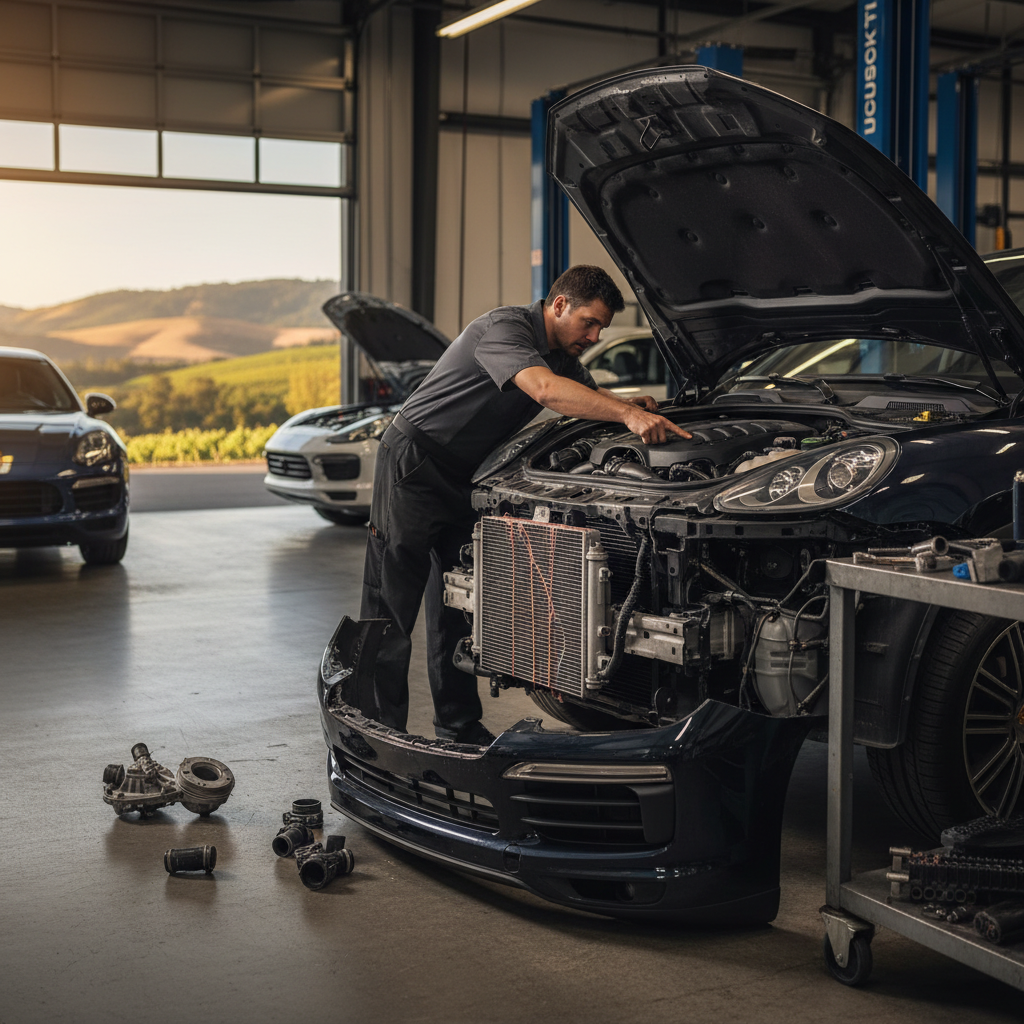
Why Is My Porsche Cayenne’s Coolant System Failing in Sonoma — and What Should You Do Before It Overheats?
If your Porsche Cayenne is leaving puddles in your driveway in Sonoma, or if the temperature gauge is creeping higher than it used to on a run along Highway 12 or the climb up to Kenwood, the cooling system is telling you something — and you should listen. The Cayenne’s coolant system, particularly on the V6 and V8 models produced from the early 2000s through the mid-2010s, has a well-documented set of failure points that are almost universal at a certain mileage. The good news is that when caught early, this is a manageable repair. When ignored in the middle of a hot Sonoma County summer, it becomes a much more expensive conversation about cylinder head damage or worse.
The Specific Failure Points Every Cayenne Owner Should Know
Porsche engineered the Cayenne as a serious performance SUV, but they made a choice on the early platforms that comes back to bite owners reliably: plastic coolant distribution pipes and fittings running beneath the intake manifold and through the valley of the engine. On the 4.5L V8 (and supercharged variants), these pipes are subject to constant heat cycling — they expand when the engine is hot and contract when it cools. After enough years and enough cycles, the plastic becomes brittle, micro-cracks form, and coolant begins to seep. At first it’s a small weep. Then it’s a puddle. Then it’s a cloud of steam and a car that can’t be driven.
The failure pattern looks like this in practice:
- Coolant loss without visible external leaks — the pipes are buried deep in the engine, so you may lose coolant without seeing where it’s going until the leak progresses
- A sweet smell from the engine bay after driving, particularly noticeable when you park in a garage in Oakmont or come home after a canyon run
- Gradual coolant reservoir drops between services that your last shop may have dismissed as “normal consumption”
- Overheating under sustained load — exactly the kind of driving you do climbing Sonoma Mountain or pulling onto Highway 101 at speed
The water pump is the second major failure point. On the Cayenne V8, the water pump impeller is plastic and prone to spinning off its shaft, meaning the pump is mechanically intact but moving no coolant whatsoever. Your temperature gauge will spike, and your engine will not forgive you if you keep driving. The thermostat is often replaced at the same time, since a stuck-closed thermostat in a Sonoma County July is its own form of engine damage waiting to happen.
Why Sonoma County’s Climate Accelerates This Problem
The Cayenne’s cooling system vulnerabilities are not unique to California, but the conditions here make them worse and make them happen sooner. Sonoma County’s summers are genuinely harsh on cooling systems — temperatures in Glen Ellen, Kenwood, and the Sonoma Valley regularly push into the mid-to-upper 90s, and a Cayenne working its way up a grade in that heat is asking a lot of aging plastic components.
If you live in the Oakmont area or navigate the grades around Fountaingrove regularly, your cooling system is under load more often than a flat-road commuter’s. Stop-and-go traffic on Highway 101 heading toward the Bay Area compounds the problem — at low speeds, the engine relies entirely on the water pump and thermostat function, with no airflow assist through the radiator. A partially failing system that seems manageable on the highway can overheat completely in a Petaluma traffic backup.
Post-wildfire conditions add another layer. The ash and particulate contamination that has been a reality in Sonoma County since the 2017 Tubbs Fire can reduce radiator efficiency when debris accumulates on cooling fins. If your Cayenne has not had its cooling system inspected since a fire season, that’s worth putting on the service agenda.
What a Proper Cooling System Service on a Cayenne Actually Involves
This is where independent specialists and dealerships diverge significantly — and where choosing the right shop matters. A proper cooling system repair on a Cayenne V8 is not simply swapping the water pump. The plastic coolant distribution pipes run deep in the engine valley and require substantial disassembly to access. On a supercharged model, the supercharger assembly itself must be removed to reach all of the pipe fittings.
The standard of care for a Cayenne cooling system job includes:
- Replacing all plastic coolant pipes and fittings in the engine valley — not just the one that leaked, because if one has failed, the others are at the same age and heat exposure
- Water pump replacement with a genuine OEM unit — aftermarket impellers have a poor track record on this application
- Thermostat replacement
- Full coolant system flush and refill with the correct Porsche-approved coolant (not universal green or standard orange coolant, which have different inhibitor packages)
- Pressure testing the system before returning the vehicle
Shops that replace only the failed component and send you on your way are setting you up for a repeat visit in twelve months. The pipes are all the same age. They will all fail.
A factory-grade diagnostic tool — in Porsche’s case, the PIWIS tester — is also valuable here because it can read coolant temperature sensor data, flag historical fault codes related to temperature excursions, and verify that the cooling system is functioning as Porsche intended after repairs. A generic OBD-II scanner will not give you this level of visibility into a Cayenne’s engine management data. Bavarian Performance services Porsche vehicles in Santa Rosa using factory-level diagnostic equipment for exactly this reason.
The Gap in What Local Shops Are Telling Cayenne Owners
Most of the repair shops serving Sonoma County touch on cooling system work in general terms, but very few address the Cayenne’s specific plastic pipe failure pattern with the detail that Cayenne owners actually need. This matters because owners who don’t know about this failure mode often respond to small coolant loss by topping off the reservoir and waiting — which is the worst possible approach on this platform. A Cayenne that is slowly losing coolant through a cracked valley pipe is an engine that is operating on borrowed time, especially in summer driving conditions between Healdsburg and the coast.
If your Cayenne is over seven or eight years old and has not had the coolant distribution pipes replaced, consider it deferred maintenance rather than a repair that can wait for something to break. The labor to do this job correctly is significant, but it is substantially less than the cost of head gasket repair or cylinder head resurfacing after an overheat event.
For a complete picture of your Cayenne’s health beyond the cooling system, a thorough multi-point inspection covers the other high-wear systems — air suspension, brakes, transmission fluid condition — that Cayenne owners in this area should be monitoring proactively.
Frequently Asked Questions: Porsche Cayenne Cooling System in Sonoma County
How do I know if my Cayenne has the plastic coolant pipe problem?
If your Cayenne is a 2003–2010 V8 model (or a supercharged variant) and has not had the coolant pipes replaced, assume they are original. A visual inspection alone won’t always catch early cracking — a pressure test and a thorough look at the engine valley by a technician familiar with this failure pattern is the reliable way to assess their condition.
Can I drive my Cayenne if the coolant level is dropping slowly?
Short answer: not without understanding why it’s dropping. Slow coolant loss on a Cayenne is not something to monitor and manage. It is an active leak somewhere in the system that will worsen, and it creates the risk of a sudden rapid loss scenario. Have it diagnosed before your next long drive, especially if you’re planning routes through the Sonoma Valley or up into the hills around Glen Ellen.
Is the Cayenne V6 cooling system the same problem?
The V6 Cayenne has a different engine architecture and does not share the exact same plastic pipe configuration as the V8, but it has its own cooling system wear items — particularly water pump and thermostat failure at higher mileages. Any Cayenne over 70,000 miles benefits from a cooling system inspection.
What coolant does a Porsche Cayenne require?
Porsche specifies a specific OAT (Organic Acid Technology) coolant — typically pink or red in color — that is different from standard green or universal orange coolants. Using the wrong coolant type can accelerate corrosion of internal cooling system components. Always confirm the correct spec before topping off or flushing.
How long does a Cayenne coolant pipe replacement take?
On a V8 Cayenne, a comprehensive coolant pipe replacement including water pump and thermostat is a multi-day job due to the disassembly required to access the engine valley. On supercharged models, plan for additional time. Rushing this job creates comebacks.
Schedule a Cooling System Inspection for Your Cayenne in Santa Rosa
If you own a Porsche Cayenne and you’re driving the roads between Sonoma, Healdsburg, and Santa Rosa without knowing the state of your cooling system, it’s worth a few minutes to get it checked before summer driving puts the system under real stress. At Bavarian Performance, we work on Cayennes with the same equipment and parts standards Porsche uses — genuine OEM components, factory-grade diagnostics, and technicians who understand the specific failure history of this platform.
Don’t wait for a temperature warning light on Highway 12 to find out what condition your cooling system is in. Contact Bavarian Performance to schedule a cooling system inspection or to discuss what your Cayenne needs. We serve Porsche owners throughout Sonoma County, from Sonoma and Kenwood to Petaluma and Healdsburg.