
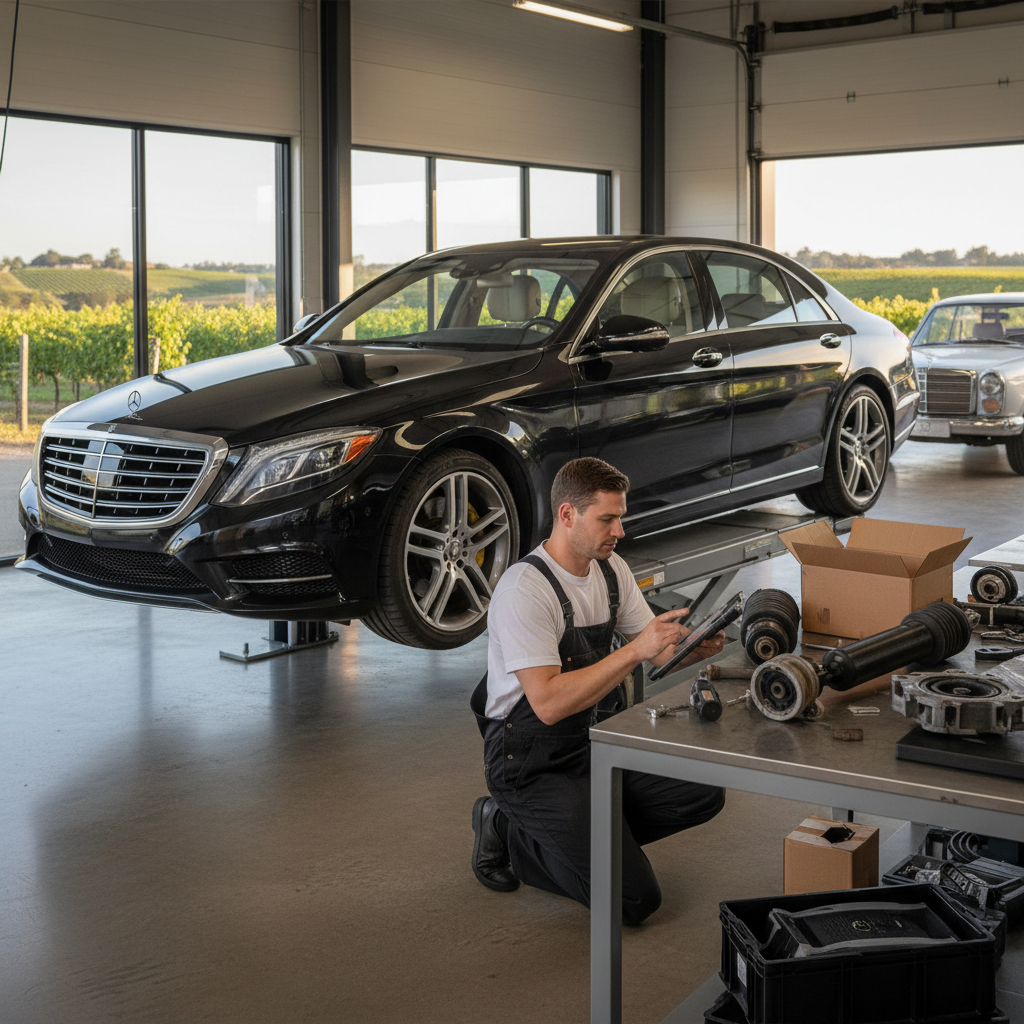
Why Is My Mercedes-Benz Air Suspension Sagging in Petaluma — and What Does It Cost to Fix?
If your Mercedes-Benz E-Class, S-Class, CLS, GL, or GLE is sitting noticeably low — especially on one corner — or if you’re greeted by a warning message on startup telling you the suspension is at its limit, the AIRMATIC system is almost certainly failing. This is one of the most common service issues we see on Mercedes-Benz vehicles throughout Sonoma County, and it’s one that deserves a clear, honest answer rather than dealership-level vagueness. The short version: yes, it’s fixable, the costs are real but manageable with the right shop, and catching it early prevents a much more expensive repair later.
What Is the AIRMATIC System and Why Does It Fail?
Mercedes-Benz AIRMATIC is an electronically controlled air suspension system that replaces conventional coil springs with pressurized air struts. It continuously adjusts ride height and damping based on load, speed, and road conditions — part of what makes a fully loaded GL cruising down Highway 101 feel composed despite its weight. It’s genuinely impressive engineering. It’s also a system with several failure-prone components, especially as vehicles pass the 80,000-mile mark or age beyond 8–10 years.
The four most common AIRMATIC failure points are:
- Air struts (air springs): The rubber bladder inside each strut degrades over time, developing micro-cracks or outright tears. This is the number one cause of that overnight sag — the corner loses pressure while the car sits. Heat cycles, UV exposure, and age all accelerate this. In Sonoma County’s hot, dry summers, rubber components on any European suspension take additional punishment.
- Air suspension compressor: The compressor constantly works to compensate for slow leaks. When a strut starts weeping air, the compressor runs more than it was designed to — often burning itself out in the process. A compressor replaced alone, without addressing a leaking strut, will fail again within months.
- Valve block (solenoid block): This distributes pressurized air to each corner. The internal rubber o-rings and membranes deteriorate, causing pressure loss across multiple corners simultaneously. If your car is sagging on more than one corner, suspect the valve block before assuming all four struts are gone.
- Ride height sensors: These send position data to the suspension control module. A faulty sensor can cause erratic ride height behavior — the system lowers a corner it thinks is too high, or raises one it thinks is too low — without any actual mechanical failure in the strut or compressor.
Why Sonoma County Roads Accelerate AIRMATIC Wear
The hilly terrain around Petaluma, through the Sonoma Valley, and up into the winding roads of Sonoma Mountain puts air suspension systems under load conditions that flat-terrain driving simply doesn’t. If you’re regularly driving Highway 12 toward Sonoma or navigating the grades in Fountaingrove or Oakmont in Santa Rosa, your AIRMATIC system is working continuously — adjusting, compensating, and cycling the compressor more frequently than Mercedes-Benz engineers may have modeled for typical urban use.
Add the temperature swings common in Wine Country — cool coastal mornings giving way to 95-degree afternoons inland — and you have conditions that accelerate rubber degradation in air struts faster than the calendar mileage alone would suggest. We’ve seen AIRMATIC struts fail on well-maintained S-Class vehicles with under 70,000 miles simply due to age and local climate.
What Does AIRMATIC Repair Actually Cost?
This is where owners deserve honesty. AIRMATIC repairs are not cheap, but they’re also not as catastrophic as dealership service advisors sometimes make them sound. Here’s a realistic breakdown:
- Single air strut replacement: Parts and labor for one corner typically runs in the $600–$1,100 range depending on the model and whether OEM or high-quality aftermarket (OES) parts are used. On S-Class and GLE platforms, expect the higher end.
- Air suspension compressor: Typically $400–$800 for parts and labor. Always diagnose the root cause of compressor failure first — replacing a compressor into a leaking system is money wasted.
- Valve block: Parts and labor typically in the $300–$600 range. Often the most cost-effective fix when multiple corners are affected.
- Full four-corner replacement: On older vehicles where all four struts are showing age, a complete refresh can run $2,500–$4,500 at a specialist shop — significantly less than dealership pricing, which frequently exceeds $6,000 for the same work.
The most important cost-control strategy is accurate diagnostics before any parts are ordered. A shop using factory-grade Mercedes-Benz diagnostic software — not a generic OBD-II scanner — can pinpoint exactly which component is failing and how the system is behaving under live conditions. This prevents the all-too-common scenario of replacing a compressor only to find the real culprit was a leaking rear strut.
The Diagnostic Gap: What Generic Scanners Miss
This is a topic almost entirely absent from most local competitor websites, and it matters enormously for AIRMATIC diagnosis. Consumer-grade and even professional-tier generic scan tools cannot fully interrogate Mercedes-Benz suspension control modules. They may read basic fault codes, but they miss live suspension height data, compressor run-time logs, and calibration offsets that tell the full story of what’s failing and why.
Factory-level Mercedes-Benz diagnostic software reads the suspension control module’s complete dataset — including whether a strut is leaking slowly over time, whether the compressor is overworking to compensate, and whether ride height sensors are reading accurately. This is the difference between replacing the right component on the first visit and spending money iteratively on the wrong parts. At Bavarian Performance, we use the same diagnostic tools and protocols that dealerships use — without the dealership overhead built into the labor rate.
OEM vs. Aftermarket Parts for AIRMATIC: What Actually Holds Up
Not all aftermarket AIRMATIC components are created equal. There’s a legitimate tier of OES (Original Equipment Supplier) parts — made by the same manufacturers who supply Mercedes-Benz directly, sold without the three-pointed star badge — that perform comparably to genuine OEM at a meaningful cost savings. These are appropriate for air struts and compressor assemblies on vehicles outside the warranty window.
Where we insist on genuine OEM parts: the electronic components. Ride height sensors, valve block solenoids, and any component that communicates with the suspension control module should be genuine Mercedes-Benz spec. Counterfeit or very low-cost alternatives in these categories introduce calibration errors that no amount of software alignment can correct — and they tend to fail again quickly.
Should You Convert to Coilover Springs Instead?
Conversion kits that replace AIRMATIC struts with conventional coil springs are widely available and significantly less expensive upfront. We’ll be straightforward with you: on a high-mileage vehicle worth less than the cost of a proper AIRMATIC rebuild, a conversion is a legitimate economic choice. However, on a well-maintained S-Class, GLE, or CLS that you intend to keep for years, the conversion compromises the ride quality, handling balance, and resale value that defined why you bought a Mercedes-Benz in the first place. It also eliminates the self-leveling capability under load — relevant if you routinely haul gear or passengers on runs between Petaluma and the Bay Area. We’re happy to walk through the numbers with you at our Petaluma-area service consultations so you can make an informed decision rather than a reactive one.
Frequently Asked Questions: Mercedes-Benz AIRMATIC Suspension in Sonoma County
How quickly does a sagging AIRMATIC strut become a serious problem?
A vehicle that sits low on one corner is already putting abnormal load on the compressor — which runs constantly trying to compensate. Within weeks, you risk burning out the compressor as a secondary failure. Don’t defer this repair for more than a few weeks once sagging is visible.
Can I drive my Mercedes with the AIRMATIC warning light on?
Short-distance driving at reduced speeds is generally fine if the vehicle isn’t bottomed out. However, driving at highway speeds on a compromised air strut risks contact between suspension components and the wheel well — which escalates quickly from a suspension repair to a bodywork repair. If the vehicle is very low on a corner, have it transported.
Is AIRMATIC covered under extended warranty or CPO?
Certified Pre-Owned Mercedes-Benz vehicles include limited suspension coverage. Independent extended warranty policies vary widely — many exclude air suspension components specifically. Review your policy documentation carefully before authorizing repairs, and ask your service advisor to document the failure mode so warranty reimbursement claims are accurate.
My Mercedes is 12 years old with 95,000 miles. Is a full AIRMATIC rebuild worth it?
That depends heavily on the overall condition of the vehicle and your intended ownership timeline. A well-maintained S550 or E550 at that mileage often has significant remaining life — these engines and transmissions, properly serviced, are capable of 200,000 miles. A full AIRMATIC rebuild on a solid example often makes more financial sense than selling the car and absorbing the depreciation hit on a replacement. We can give you an honest assessment of overall vehicle condition as part of our multi-point inspection before recommending a repair path.
Why does my Mercedes drop overnight but pump back up when I start it?
This is a classic slow-leak signature from a cracked air strut bladder or a seeping valve block. The compressor re-inflates the system on startup, masking the problem temporarily. The compressor is accumulating excessive runtime doing this — it will fail prematurely if the underlying leak isn’t addressed.
Get an Honest AIRMATIC Diagnosis in Santa Rosa
Whether you’re driving in from Petaluma, Sebastopol, Rohnert Park, or anywhere across Sonoma County, Bavarian Performance offers factory-trained diagnostics and AIRMATIC repair on Mercedes-Benz vehicles that dealership service departments simply can’t match on value. We use genuine and OES-grade parts, factory diagnostic software, and straightforward communication about what your vehicle actually needs — not what generates the highest repair order.
If your Mercedes is sagging, sitting uneven, or displaying a suspension warning, contact us today to schedule a diagnostic appointment. The earlier the diagnosis, the more repair options you have — and the less it costs. Reach our team at bavarian-performance.com/contact-us or call us at (707) 545-2002.